Daniel Priestley - Oversubscribed
Здесь есть возможность читать онлайн «Daniel Priestley - Oversubscribed» — ознакомительный отрывок электронной книги совершенно бесплатно, а после прочтения отрывка купить полную версию. В некоторых случаях можно слушать аудио, скачать через торрент в формате fb2 и присутствует краткое содержание. Жанр: unrecognised, на английском языке. Описание произведения, (предисловие) а так же отзывы посетителей доступны на портале библиотеки ЛибКат.
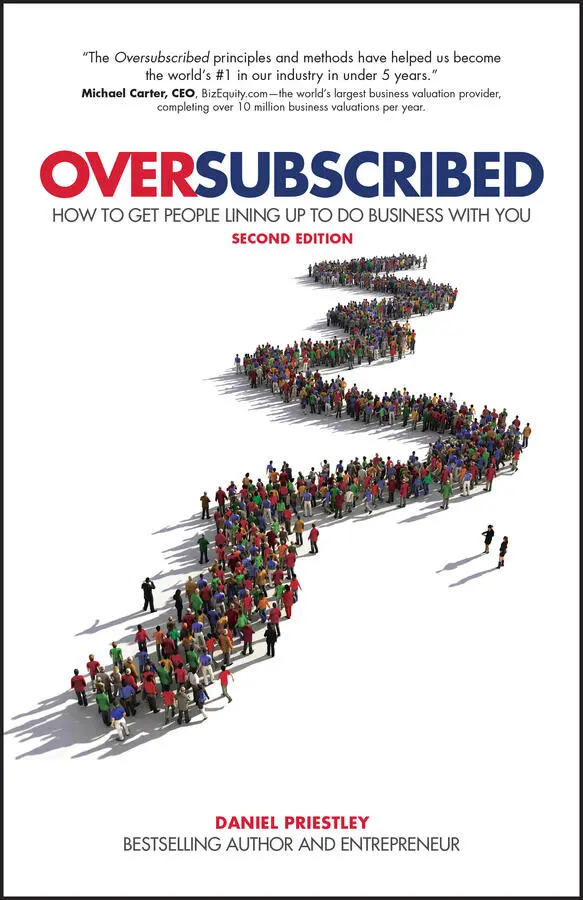
- Название:Oversubscribed
- Автор:
- Жанр:
- Год:неизвестен
- ISBN:нет данных
- Рейтинг книги:5 / 5. Голосов: 1
-
Избранное:Добавить в избранное
- Отзывы:
-
Ваша оценка:
Oversubscribed: краткое содержание, описание и аннотация
Предлагаем к чтению аннотацию, описание, краткое содержание или предисловие (зависит от того, что написал сам автор книги «Oversubscribed»). Если вы не нашли необходимую информацию о книге — напишите в комментариях, мы постараемся отыскать её.
. They have buyers who gladly queue up, pay more, and eagerly wait for the chance to hand over their money for the next thing. How do these businesses do it? More importantly, how can
become one of them?
Oversubscribed The principles and philosophies
businesses live by that are often the opposite of what most businesses do Specific steps for getting into the mind of your customer so they only want to buy from your business How to structure campaigns and product launches that systematically get your business Oversubscribed How to implement a process of signalling to market, and collect signals back from market to build up desire and demand for your products and services The new edition of
is a must-read for entrepreneurs, marketers, business leaders and owners, team managers, and business students.
Oversubscribed — читать онлайн ознакомительный отрывок
Ниже представлен текст книги, разбитый по страницам. Система сохранения места последней прочитанной страницы, позволяет с удобством читать онлайн бесплатно книгу «Oversubscribed», без необходимости каждый раз заново искать на чём Вы остановились. Поставьте закладку, и сможете в любой момент перейти на страницу, на которой закончили чтение.
Интервал:
Закладка:
Being oversubscribed requires nothing more than a situation whereby some people who really want something have to miss out on having it. Of course, it's a difficult situation because you and your company don't want people to miss out. Naturally, you want to sell to everyone who's willing to buy, yet that very mindset prevents you from becoming oversubscribed.
Lots of people who want a Ferrari can't get one – but the people at Ferrari aren't losing sleep over it. They know that the fact that some people have to miss out is what makes their automobile so coveted. Every product that is oversubscribed has people who didn't get it, even though they were willing to buy.
In 2014, Facebook purchased mobile messaging app WhatsApp for $19.3 billion; the figure seemed ridiculously high to almost everyone on Earth at the time – except one other bidder. Google was the other company who wanted to buy WhatsApp and the two rival companies bid the price of the relatively small startup into the stratosphere. At the time, WhatsApp was just five years old, had a team of less than 100 people and had recently raised funding at a valuation of $1.5 billion. Fortunately for the founders of WhatsApp it only takes two tenacious bidders for an astronomical valuation to materialise.
If you can get the balance right and keep yourself oversubscribed – disappointing those people who missed out without them losing interest in you entirely, while still delivering remarkable value to those who got through – you'll have no problem being profitable. If supply is too great and everyone who wants what you have can get what you have, the prices will fall and so will the margins. Eventually your business will make losses.
The principles for becoming oversubscribed can be useful across many aspects of your business. For example, if you want to hire top talent, you need to be oversubscribed for top talent. That means that some talented people who would love the job will miss out. If you want impactful publicity, you need to be oversubscribed for people who want the story you have to share, so some news outlets won't get the story. If you want investors, you need to be oversubscribed for funding – more people are ready to put in the money than you require and some of them ultimately miss out.
If you want to be oversubscribed, you'll need to get comfortable with some people missing out on what you have to offer. That's how markets work – and that's how the market determines your rewards.
PROFITS, LOSSES OR WAGES?
When it comes to the rewards you and your stakeholders will make from business, there are three ways the demand and supply relationship can be set up:
Oversubscribed – Demand outstrips supply, resulting in profit being tolerated on top of normal wages.
Balanced – Demand and supply are relatively even resulting in normal wages being tolerated but not profit.
Undersubscribed – Excess supply is available above demand, resulting in losses.
It doesn't matter what the product is, where the business is based or how dedicated the team members are. The only thing that matters is the relationship between demand and supply. Even when the product stays the same, if that relationship changes, the profitability changes.
In California in the 1980s, millions of people decided that they wanted plastic surgery. The surgeons who could deliver this service were in short supply and they made vast sums of money providing breast enhancements, nose jobs and Botox. Anyone who could perform these operations ended up with a mansion, a yacht, supercars and lucrative investments. They were making millions because the market had vastly more buyers than sellers when it came to plastic surgeons. The cosmetic surgery market at that time tolerated wages and profits.
This is no longer the case nowadays. LA is filled with plastic surgeons. Attracted by the vast available wealth, a whole lot of medical students switched their major in the late 1980s and headed for Beverly Hills to make big money. But they discovered upon arriving that they weren't the only ones who had taken this path. By the end of the 1990s the demand and supply relationship returned to a balance, and today most plastic surgeons in LA make a normal surgeon's wage.
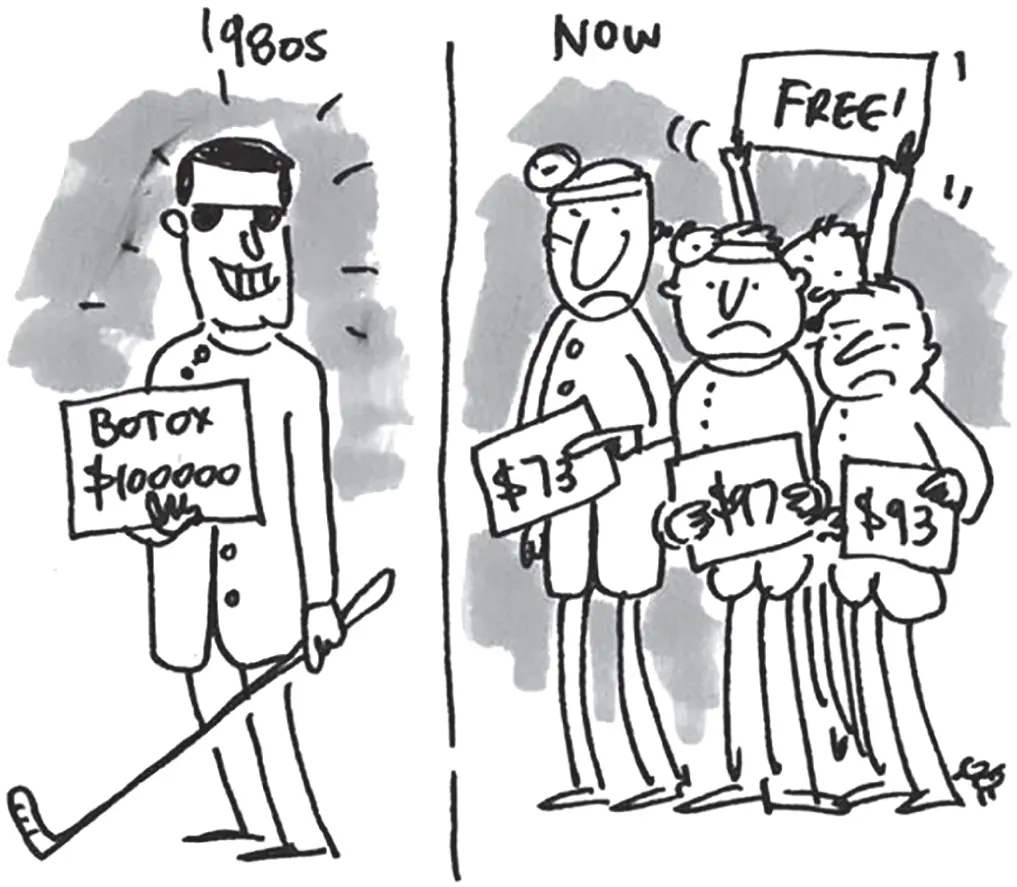
The 1980s plastic surgeons made more money than surgeons today because of a trend that happened for a niche within the medical industry. It wasn't the nature of what they were offering that made it profitable; it was the demand‐and‐supply tension that set the price.
There are cycles in whole industries whereby demand for anyone in a chosen field will be highly in demand. This is known as an industry boom, for example, the dot‐com boom in the late 1990s, whereby almost any Silicon Valley company could raise millions for little more than an idea.
There are cycles in the economy whereby demand from consumers as a whole outstrips supply from industry as a whole. In these times, everyone seems to be doing well and there's an economic boom for almost everyone, such as what happened in the era known as the Roaring Twenties.
You do not want to be at the whims of the economy or your industry trends. Your ability to earn and profit is far too important to leave to chance, and as you'll see from the principles and strategies we explore in this book, it's possible to be completely independent of your industry or the economy and build a market of your own.
It's possible to play an advanced game in which you are completely in control of the forces of demand and supply that impact on your business. This is when you can become oversubscribed on your own terms, regardless of what's happening for everyone else.
Even in saturated markets, even when competition is fierce or you are up against companies with vast resources, it is still within your power to become oversubscribed and enjoy profits on top of the normal wages of your industry by creating a market of your own.
The forces of demand and supply work the same when customers perceive you as separate from your industry. Even better, you don't need very many people in order to create your own market, become oversubscribed and to maintain a profitable price if you can get a few key things right and create your own fiercely loyal market.
PRINCIPLE 2 THE ONLY PEOPLE THAT MATTER ARE YOUR PEOPLE
Being part of an open market is a problem; you'll forever be battling the forces of demand and supply outside of your control. Having a market of your own is the key to becoming oversubscribed.
CREATE YOUR OWN MARKET
Let's take a look at actors in the US as an example of an industry in oversupply. There are more than 160,000 people who have a Screen Actors Guild (Screen Actors Guild – American Federation of Television and Radio Artists) membership and there are barely 3,000 actors who make better than minimum wage from their acting income. About 99% of actors can't afford to live on the money they earn from acting. Fewer than 1,000 actors in the US make over $150,000 a year.
From an economic standpoint there is a massive oversupply of screen actors. So, there's absolutely no reason why a producer would pay a large sum for an actor. Yet, as we know, they do it all the time. For some actors, a fee of millions per film isn't only a possibility; people line up to pay it. These actors are separate from the market. They have made their own market.
George Clooney, Brad Pitt, Sandra Bullock, Jennifer Lawrence and Julia Roberts have millions of people who will go and see a film if they are in it. They have created their own market and they are oversubscribed. Their income isn't linked to the market; it's linked to their market.
Читать дальшеИнтервал:
Закладка:
Похожие книги на «Oversubscribed»
Представляем Вашему вниманию похожие книги на «Oversubscribed» списком для выбора. Мы отобрали схожую по названию и смыслу литературу в надежде предоставить читателям больше вариантов отыскать новые, интересные, ещё непрочитанные произведения.








Обсуждение, отзывы о книге «Oversubscribed» и просто собственные мнения читателей. Оставьте ваши комментарии, напишите, что Вы думаете о произведении, его смысле или главных героях. Укажите что конкретно понравилось, а что нет, и почему Вы так считаете.