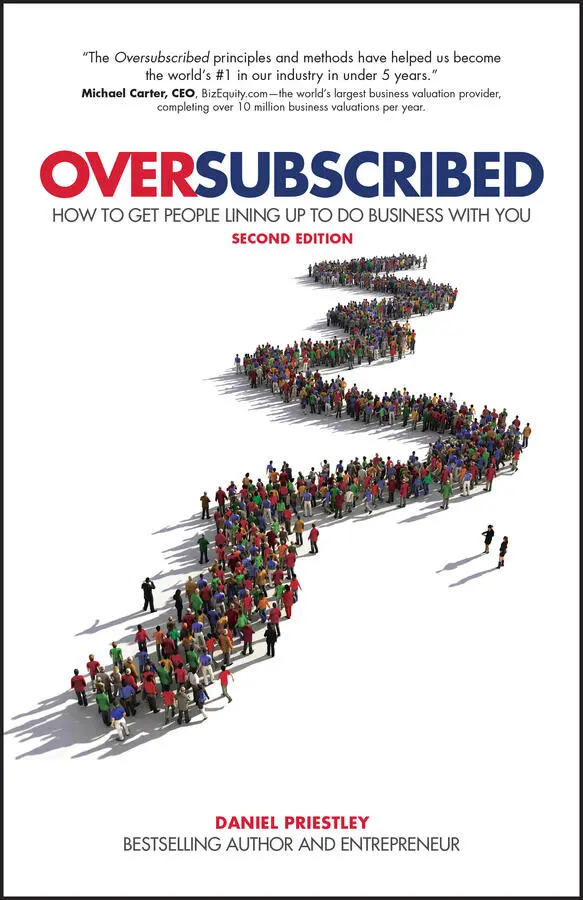
Daniel Priestley - Oversubscribed
Здесь есть возможность читать онлайн «Daniel Priestley - Oversubscribed» — ознакомительный отрывок электронной книги совершенно бесплатно, а после прочтения отрывка купить полную версию. В некоторых случаях можно слушать аудио, скачать через торрент в формате fb2 и присутствует краткое содержание. Жанр: unrecognised, на английском языке. Описание произведения, (предисловие) а так же отзывы посетителей доступны на портале библиотеки ЛибКат.
- Название:Oversubscribed
- Автор:
- Жанр:
- Год:неизвестен
- ISBN:нет данных
- Рейтинг книги:5 / 5. Голосов: 1
-
Избранное:Добавить в избранное
- Отзывы:
-
Ваша оценка:
Oversubscribed: краткое содержание, описание и аннотация
Предлагаем к чтению аннотацию, описание, краткое содержание или предисловие (зависит от того, что написал сам автор книги «Oversubscribed»). Если вы не нашли необходимую информацию о книге — напишите в комментариях, мы постараемся отыскать её.
. They have buyers who gladly queue up, pay more, and eagerly wait for the chance to hand over their money for the next thing. How do these businesses do it? More importantly, how can
become one of them?
Oversubscribed The principles and philosophies
businesses live by that are often the opposite of what most businesses do Specific steps for getting into the mind of your customer so they only want to buy from your business How to structure campaigns and product launches that systematically get your business Oversubscribed How to implement a process of signalling to market, and collect signals back from market to build up desire and demand for your products and services The new edition of
is a must-read for entrepreneurs, marketers, business leaders and owners, team managers, and business students.
Oversubscribed — читать онлайн ознакомительный отрывок
Ниже представлен текст книги, разбитый по страницам. Система сохранения места последней прочитанной страницы, позволяет с удобством читать онлайн бесплатно книгу «Oversubscribed», без необходимости каждый раз заново искать на чём Вы остановились. Поставьте закладку, и сможете в любой момент перейти на страницу, на которой закончили чтение.
Интервал:
Закладка:
As I mentioned, most business events in Sydney are free, don't get more than 100 attendees and are run by people who live in Sydney and have access to local contacts and networks. Our event was brand‐new, priced at the top end – and we didn't have a single staff member on the ground in Sydney at that time.
The email wasn't a joke, a gimmick or a ploy. It was genuine. We had sold too many tickets to our event. We had a similar problem in Melbourne two weeks later, then in London, then in Florida.
This wasn't happening by accident. It was orchestrated to be like this. And this book will show you how it's done.
My business often books clients three months in advance. We don't do it to be difficult; it's just the amount of time people need if they want to work with us. If someone says they aren't sure about working with us, we don't argue or try too hard to sell them. We smile politely and say that it's OK not to. We don't need to convince people – there are others lined up, waiting.
I launched my first company in 2002 at age 21 with a $7,000 credit card. It was a boutique marketing company specializing in event promotions in the financial services industry. Within 12 months I'd made over $1 million in revenue and had more than $300,000 cash in the bank. By age 25, I'd used the same insights to make over $10 million in sales and had made myself an enviable amount of money for a young man. Along the way, I discovered some very valuable ideas on how to make a product or service oversubscribed.
At age 25, I moved to London with my best friends and business partners. We launched a new business with a small amount of start‐up capital and once again made millions in sales within 12 months. At age 29 I wrote my first book and used the ideas set out in this book to send it to the number one spot for business books on Amazon. I've raised millions of investment capital for my businesses and helped charities to raise hundreds of thousands of dollars in a short space of time by using the ideas that I will share with you in the pages to come.
As you'll discover as you continue to read through this book, there's no scarcity in the world for people who share abundantly. One of the ways I keep myself oversubscribed today is by the very process of sharing big ideas. I've come to discover that the more I share, the more people demand.
I also believe that the principles in this book lead to better businesses for everyone involved – for the customers who get a higher level of service, for the business owners who stop chasing and for the employees who enjoy working for a company that's in demand.
My vision and hope is for millions of entrepreneurs and leaders to become more empowered to tackle bigger problems. This book is part of that vision. The ideas in this book are designed for quality businesses that care about what they do and want to be able to take their products to market more effectively. They are not for people who want to run a gimmick, make a fast sale or pull a swift win over their unsuspecting buyers.
Before you even begin, you must feel confident that your offering is something that genuinely serves people. You must be passionate about it and the value it presents to the world. You must love what you do, care about your customers and want to be in your business for the long haul. For the rest of this book, I will assume that's a given.
Being oversubscribed is the way for you to do your best work and spend more time with your current clients rather than chasing new ones. It gives you more down time to innovate your products rather than running around selling them – and it enables you to build your brand rather than blend in with the crowd.
I've also written this book because I understand the struggle most entrepreneurs and leaders undergo.
We live in remarkable, changing times. Many ideas that worked five years ago aren't working anymore. Everyone is under pressure to innovate and put results on the board. The decade ahead is going to be both challenging and inspiring. The pace of change is speeding up and the way the world of business and society works won't look the same in ten years from now.
Many people will see this as a great wave of change that sweeps them out to sea, and others view it as one they can surf and enjoy. If you're like me, you'll be paddling hard.
By the end of this book, you'll have a method for becoming oversubscribed. I'm going to unpack a process for getting yourself in the enviable position of being in demand. Of course, it will be up to you to apply the process to your business – and it'll take trial and error before you get it right. Ideas are easy; it's the implementation that's hard. Stick with it though, because the payoff is extraordinary. Once you are oversubscribed you'll earn more money, have more fun and attract more opportunities.
You won't have to chase opportunities; you'll curate those that show up. Your inbox will become a garden of prospects rather than an endless stream of tasks to follow up on.
This book isn't just about marketing principles and business methods. I will begin by addressing some problems that most businesses suffer from and sharing some of the stories and principles that drive the deeper philosophy behind the book. My goal is for you to understand these concepts on a deep enough level that you'll make better decisions intuitively and you'll be approaching your business with a different outlook.
You might need to read this book several times and let the ideas sink in for that to happen. Some of the ideas are subtly woven into the stories. There's a rich tapestry out there and you're part of it. But as with any tapestry, you can't see it if you don't have the right perspective. When you take a few steps back you can see the bigger picture.
I'm hoping this book gives you a look at the bigger picture for you and your business. Let's begin a journey together that starts where you are right now and leads you to where you want to be.
PRINCIPLE 1 ONLY OVERSUBSCRIBED BUSINESSES MAKE A PROFIT
You likely learned long ago that the market forces of demand and supply determine the price and the profit you'll make. But what you didn't learn is that you can make your own market forces.
It's vital that you take control of this sacred balance because unless your business becomes oversubscribed, you're unlikely to realise your full value.
YOU ONLY NEED TWO BIDDERSG
I was in a room with 400 people who had come to see renowned entrepreneur and author Gary Vaynerchuk share his ideas on social media marketing. He announced at the end of his presentation that he'd be auctioning off a one‐hour, one‐on‐one business consultation with him, and the proceeds would go to charity.
He explained that the last time he did a consultation like this he had made several introductions to his network and the person had made an additional $50,000 in less than 30 days. “It's not just a consultation,” he explained. “It's potentially access to my network – and I know some of the world's most powerful people.”
This had put the audience into a frenzy. I opened the auction with a bid of £500 and immediately another person took it to £600. Within a flash the price hit £1,000 and the hands kept popping up.
Bids were coming in thick and fast. £2,000, £2,200, £2,400, £2,600, £2,800.
As the bidding passed the £3,000 mark, it came down to two men who clearly both wanted this prize. Everyone else was out of the race, but these two guys kept matching each other and taking the price up another £100 each time.
They were the only two people still bidding in a room with 400 individuals. The rest were sitting patiently or enjoying the spectacle.
Читать дальшеИнтервал:
Закладка:
Похожие книги на «Oversubscribed»
Представляем Вашему вниманию похожие книги на «Oversubscribed» списком для выбора. Мы отобрали схожую по названию и смыслу литературу в надежде предоставить читателям больше вариантов отыскать новые, интересные, ещё непрочитанные произведения.








Обсуждение, отзывы о книге «Oversubscribed» и просто собственные мнения читателей. Оставьте ваши комментарии, напишите, что Вы думаете о произведении, его смысле или главных героях. Укажите что конкретно понравилось, а что нет, и почему Вы так считаете.