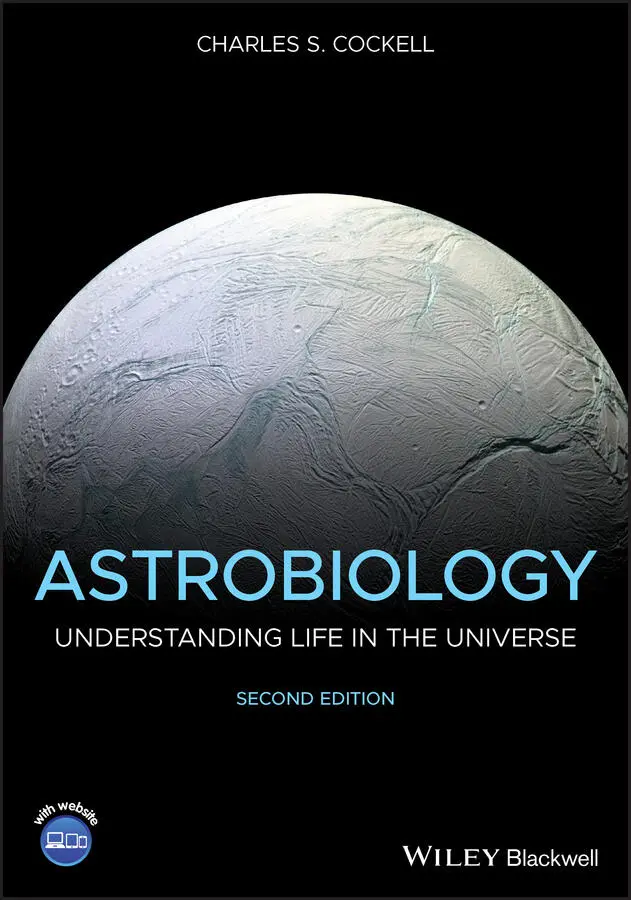
Charles S. Cockell - Astrobiology
Здесь есть возможность читать онлайн «Charles S. Cockell - Astrobiology» — ознакомительный отрывок электронной книги совершенно бесплатно, а после прочтения отрывка купить полную версию. В некоторых случаях можно слушать аудио, скачать через торрент в формате fb2 и присутствует краткое содержание. Жанр: unrecognised, на английском языке. Описание произведения, (предисловие) а так же отзывы посетителей доступны на портале библиотеки ЛибКат.
- Название:Astrobiology
- Автор:
- Жанр:
- Год:неизвестен
- ISBN:нет данных
- Рейтинг книги:3 / 5. Голосов: 1
-
Избранное:Добавить в избранное
- Отзывы:
-
Ваша оценка:
Astrobiology: краткое содержание, описание и аннотация
Предлагаем к чтению аннотацию, описание, краткое содержание или предисловие (зависит от того, что написал сам автор книги «Astrobiology»). Если вы не нашли необходимую информацию о книге — напишите в комментариях, мы постараемся отыскать её.
offers an introductory text that explores the structure of living things, the formation of the elements required for life in the Universe, the biological and geological history of the Earth, and the habitability of other planets. Written by a noted expert on the topic, the book examines many of the major conceptual foundations in astrobiology, which cover a diversity of traditional fields including chemistry, biology, geosciences, physics, and astronomy.
The book explores many profound questions such as: How did life originate on Earth? How has life persisted on Earth for over three billion years? Is there life elsewhere in the Universe? What is the future of life on Earth?
is centered on investigating the past and future of life on Earth by looking beyond Earth to get the answers. Astrobiology links the diverse scientific fields needed to understand life on our own planet and, potentially, life beyond. This new second edition:
Expands on information about the nature of astrobiology and why it is useful Contains a new chapter “What is Life?” that explores the history of attempts to understand life Contains 20% more material on the astrobiology of Mars, icy moons, the structure of life, and the habitability of planets New ‘Discussion Boxes’ to stimulate debate and thought about key questions in astrobiology New review and reflection questions for each chapter to aid learning New boxes describing the careers of astrobiologists and how they got into the subject Offers revised and updated information throughout to reflect the latest advances in the field Written for students of life sciences, physics, astronomy and related disciplines, the updated edition of
is an essential introductory text that includes recent advances to this dynamic field.
Astrobiology — читать онлайн ознакомительный отрывок
Ниже представлен текст книги, разбитый по страницам. Система сохранения места последней прочитанной страницы, позволяет с удобством читать онлайн бесплатно книгу «Astrobiology», без необходимости каждый раз заново искать на чём Вы остановились. Поставьте закладку, и сможете в любой момент перейти на страницу, на которой закончили чтение.
Интервал:
Закладка:
With this overarching view of the history of our planet, we might be tempted to think that all this geological and biological evolution has been smooth and orderly. Unicellular organisms evolved into animals, and then intelligence emerged. However, the next two chapters elaborate on why this isn't the case. By investigating rises in atmospheric oxygen that have occurred in our planet's past and the role of mass extinctions in changing biological diversity, we can see that the emergence of life on a planet, and its success over billion-year timescales, is fraught with difficulties, including astronomical perturbations such as asteroid and comet impacts.
We will see that life itself is responsible for some of these changes, such as the rise of oxygen, but in other cases, such as the effects of an asteroid impact, it has been a hapless passenger. Are these challenges universal and were the opportunities that presented themselves during the co-evolution of the planet and life ones that we would expect to occur on any planet that has life? This question is discussed as we progress, but you might like to keep it in mind at any time you are thinking about the history of life on Earth. If there is life on other planets, is our own planet a universal template for how it too would evolve? What features of this planet's biological evolution are an idiosyncratic result of particular conditions here?
At this stage, we have a more complete understanding of planet Earth, its history, its life, its geology. We have got to grips with a detailed understanding of the one planet we know that supports life, its characteristics and how life shaped, and was shaped by, its environment. So now we take this knowledge and expand further to the cosmic context: We leave Earth and head outwards.
In the following chapters, we take what we know about Earth and consider what might make a planet habitable for life and where else in the Universe such environments might exist. Taking a look close to home – our own Solar System – we investigate how Mars compares to Earth. We examine the icy moons of Jupiter and Saturn that host oceans beneath their surfaces. Are other planetary bodies in our Solar System habitable? We move on from this position to consider the billions of other planets in our Universe, looking at the methods used to search for planets around other stars, so-called exoplanets, how we determine their different physical characteristics (Figure 1.6), and how we might search for life on them.
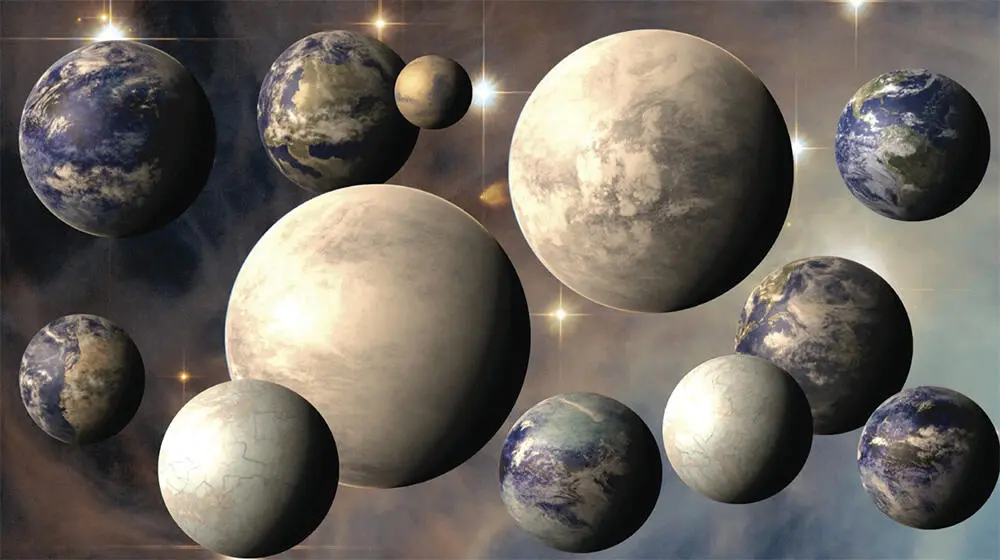
Figure 1.6 Habitable worlds orbiting other stars. As this artist's impression makes clear, the detection of rocky worlds around other stars offers us the possibility of a statistical assessment of how common Earth-like worlds are in the cosmos, an analysis of their diversity, and the possibility of determining whether they host detectable life.
Source: Reproduced with permission of NASA/JPL-Caltech/R. Hurt (SSC-Caltech).
In the final chapters of the book, we consider extraterrestrial intelligence and whether there are any other intelligences in the Universe with which we can communicate. Is intelligence inevitable and has it arisen elsewhere? If it has evolved elsewhere, can we communicate with it? What happens if we do?
Astrobiology is not just about non-human life on our planet. As a tool-building civilization that has the capacity to travel beyond Earth and even change the life support system of our own spaceship Earth, our own past and future are part of a complete investigation of the relationship between life and its cosmic environment. In the final chapter, we contemplate the future and fate of our own civilization. We can ask questions about ourselves such as: Will humans leave Earth permanently? How do we settle on other planets? How do we preserve Earth while settling in space? How will we adapt to space? Can society be successfully expanded to these environments? (Figure 1.7). These are not so much scientific questions, more technical questions, but they very much have a bearing on the applications of astrobiology to human society. These questions generate direct links between astrobiology and humanities and social sciences as they force us to confront our own place in the cosmos and the story of life.
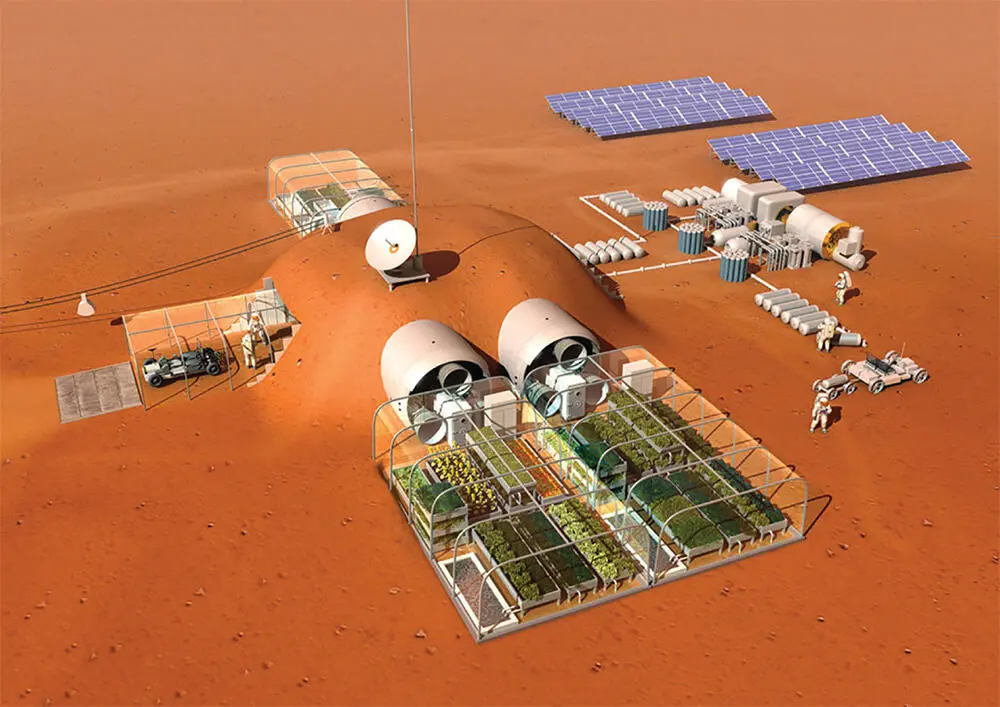
Figure 1.7 Astrobiology is concerned with the human future beyond the Earth. Can we establish stations on other planetary surfaces and will they eventually become self-sustaining?
Source: Reproduced with permission of NASA.
In summary, each chapter in this textbook is designed to present a text on a particular aspect of the link between life and the cosmos. I have attempted to explain some of the principles of astrobiology with respect to each subject area, so that you can read the book in a structured, directional way. Alternatively, you can pick and choose aspects of astrobiology that are of special interest for a whole astrobiology course or parts of a course by reading selected chapters.
1.3 Some Other Features of the Textbook
There are a few other general points I'd like to make about the chapter contents of the textbook. You will notice that the units I use in the textbook are not consistent throughout. For example, growth temperatures of microorganisms are usually shown in Celsius. Temperatures of planetary surfaces are often expressed in Kelvin. Different scientific fields tend to use different units, and, rather than creating complete consistency (which would result in seemingly odd units being used for phenomena where they are not normally used), I have stuck with the normal conventions. These differences highlight the multidisciplinary nature of astrobiology.
In all the chapters, I have included some other information shown in boxes. Some of the boxes present points of debate in astrobiology that are worth discussing with others or contemplating yourself. These “Discussion Points” are an opportunity to get you to think about ideas in different fields that link to astrobiological questions. I have also written them in places where the material might seem very conventional. I hope they will stimulate you to think about the material being described in new ways. For example, is the biochemical structure of life on Earth something universal or a very particular outcome of Earth's experiment in biological evolution? Such a question should encourage you to think about what the basics of biology might, or might not, tell us about life elsewhere, if it exists. I have attempted to provide some similar thoughts and questions in all the chapters. The content and questions in these boxes are by no means exhaustive, and you should use them to encourage other discussions or come up with new questions. In particular, try to think about questions that bridge different chapters and the different fields in the book.
Here and there I have included some textboxes about some of the major facilities that astrobiologists use. There are a vast number of techniques that astrobiologists employ in the laboratory, but some large facilities, coordinated internationally, such as space telescopes, expand the reach of the science significantly. They also give you a flavor of the modern nature of international science.
I have included some further reading. This was, perhaps, the most difficult task. It is impossible to do justice to all the literature that exists in every field that comprises astrobiology, let alone list all the main contributions. Instead, I've suggested two or three popular and/or technical books that relate to each chapter that might provide some enjoyable additional reading. I have also listed a set of papers. They are papers I think will give a representative sprinkling of just some of the possible avenues an interested reader might pursue and that relate to the main themes and subjects covered in each chapter. Again, no significance should be placed on the omission of many important papers or the inclusion of the ones listed.
Читать дальшеИнтервал:
Закладка:
Похожие книги на «Astrobiology»
Представляем Вашему вниманию похожие книги на «Astrobiology» списком для выбора. Мы отобрали схожую по названию и смыслу литературу в надежде предоставить читателям больше вариантов отыскать новые, интересные, ещё непрочитанные произведения.








Обсуждение, отзывы о книге «Astrobiology» и просто собственные мнения читателей. Оставьте ваши комментарии, напишите, что Вы думаете о произведении, его смысле или главных героях. Укажите что конкретно понравилось, а что нет, и почему Вы так считаете.