Charles S. Cockell - Astrobiology
Здесь есть возможность читать онлайн «Charles S. Cockell - Astrobiology» — ознакомительный отрывок электронной книги совершенно бесплатно, а после прочтения отрывка купить полную версию. В некоторых случаях можно слушать аудио, скачать через торрент в формате fb2 и присутствует краткое содержание. Жанр: unrecognised, на английском языке. Описание произведения, (предисловие) а так же отзывы посетителей доступны на портале библиотеки ЛибКат.
- Название:Astrobiology
- Автор:
- Жанр:
- Год:неизвестен
- ISBN:нет данных
- Рейтинг книги:3 / 5. Голосов: 1
-
Избранное:Добавить в избранное
- Отзывы:
-
Ваша оценка:
Astrobiology: краткое содержание, описание и аннотация
Предлагаем к чтению аннотацию, описание, краткое содержание или предисловие (зависит от того, что написал сам автор книги «Astrobiology»). Если вы не нашли необходимую информацию о книге — напишите в комментариях, мы постараемся отыскать её.
offers an introductory text that explores the structure of living things, the formation of the elements required for life in the Universe, the biological and geological history of the Earth, and the habitability of other planets. Written by a noted expert on the topic, the book examines many of the major conceptual foundations in astrobiology, which cover a diversity of traditional fields including chemistry, biology, geosciences, physics, and astronomy.
The book explores many profound questions such as: How did life originate on Earth? How has life persisted on Earth for over three billion years? Is there life elsewhere in the Universe? What is the future of life on Earth?
is centered on investigating the past and future of life on Earth by looking beyond Earth to get the answers. Astrobiology links the diverse scientific fields needed to understand life on our own planet and, potentially, life beyond. This new second edition:
Expands on information about the nature of astrobiology and why it is useful Contains a new chapter “What is Life?” that explores the history of attempts to understand life Contains 20% more material on the astrobiology of Mars, icy moons, the structure of life, and the habitability of planets New ‘Discussion Boxes’ to stimulate debate and thought about key questions in astrobiology New review and reflection questions for each chapter to aid learning New boxes describing the careers of astrobiologists and how they got into the subject Offers revised and updated information throughout to reflect the latest advances in the field Written for students of life sciences, physics, astronomy and related disciplines, the updated edition of
is an essential introductory text that includes recent advances to this dynamic field.
Astrobiology — читать онлайн ознакомительный отрывок
Ниже представлен текст книги, разбитый по страницам. Система сохранения места последней прочитанной страницы, позволяет с удобством читать онлайн бесплатно книгу «Astrobiology», без необходимости каждый раз заново искать на чём Вы остановились. Поставьте закладку, и сможете в любой момент перейти на страницу, на которой закончили чтение.
Интервал:
Закладка:
A great deal of this book is unapologetically focused on a basic understanding of biology. Indeed, even if alien life is your focus, you still need to know about the one type of life we currently know – life on Earth – before you can embark on any discussion about the conditions and possibilities for life elsewhere.
The textbook therefore begins with a study of life on Earth (Figure 1.4). There is another reason for starting with biology. If we want to investigate how the elements required for life were produced during and after the Big Bang or why a habitable environment needs certain characteristics, or why certain molecules and environments might have been needed for life to emerge, we need to know about biology first. We need to understand its structure, its requirements, and what conditions it can subsist under in order to question how those characteristics were made possible. In that sense, the first part of this book looks very much like standard biology textbook material and, at its core, it is. However, I have written it specifically to provide you with the necessary understanding of biology to enable you to think about the major questions of astrobiology. Throughout these chapters, I address some of the topics in biology that relate to questions about the conditions and possibilities for life elsewhere. These chapters are biology with an astrobiology flavor.
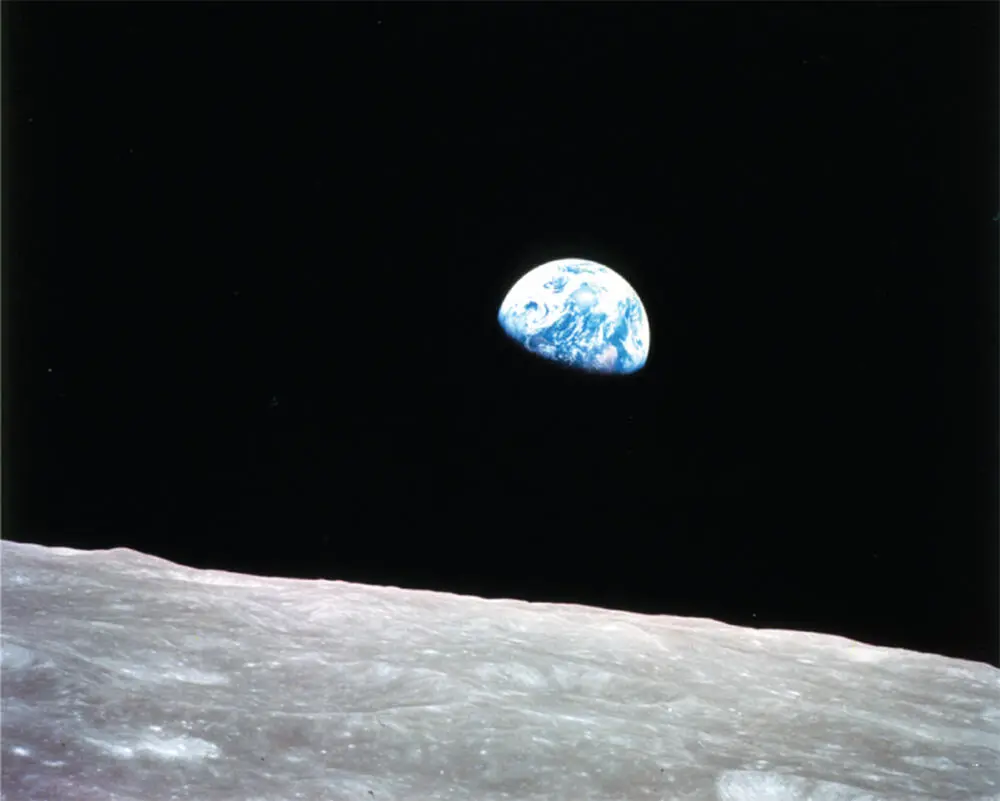
Figure 1.4 The one example we have of a planet that harbors life: Earth. Astrobiology seeks to understand how the phenomenon of life came about and whether it is unique in the Universe. Here, Earth rises over the lunar landscape in this iconic image taken by Apollo 8 in 1968. The image is sometimes called “Earthrise”.
Source: Reproduced with permission of NASA.
We start this tour of life by looking at the fundamental properties of matter and how those properties underpin the structure of the molecules of life. We then consider how these molecules are assembled into the major components of living cells. With a knowledge of the structure of life, we can then move on to think about how these cells can get the energy they need to grow and reproduce, all the time being mindful of those factors that might be specific to terrestrial life or from which we could learn something about life anywhere.
Once life did become established on Earth, what were its limits? We will investigate the physical and chemical boundaries of life that might define how diverse or extensive this life can become in extreme environments at the limits of planetary habitability. If we can find out what the physical and chemical extremes of life are, i.e. the most extreme conditions it can tolerate, we can begin to assess the habitability of other planetary bodies as locations for life. This knowledge even helps us to assess what the impact of human activity and industry might be on the biosphere. Questions that fascinate astrobiologists in this area of research include: What are the limits of life? How does life survive at physical and chemical extremes? Are these limits universal? What do these limits tell us about habitable conditions or the possible presence of life elsewhere? These probing lines of thought drive us to study life in unusual environments, from the deep oceans to the freezing wastes of Antarctica.
Supported by our knowledge of living things, we then explore how all life on Earth is related or linked into a “tree of life.” Buried within this tree of life are profound questions. The diversity of life on Earth is extraordinary. But what unites organisms and what is the relationship between them? How has this diversity changed over time? (Figure 1.5). Astrobiologists want to gain a better understanding of the evolutionary links between diverse organisms. We take an introductory look at the tree of life and see how biologists can construct phylogenetic trees to make sense of all the diversity of life on the planet, and to address certain scientific hypotheses.
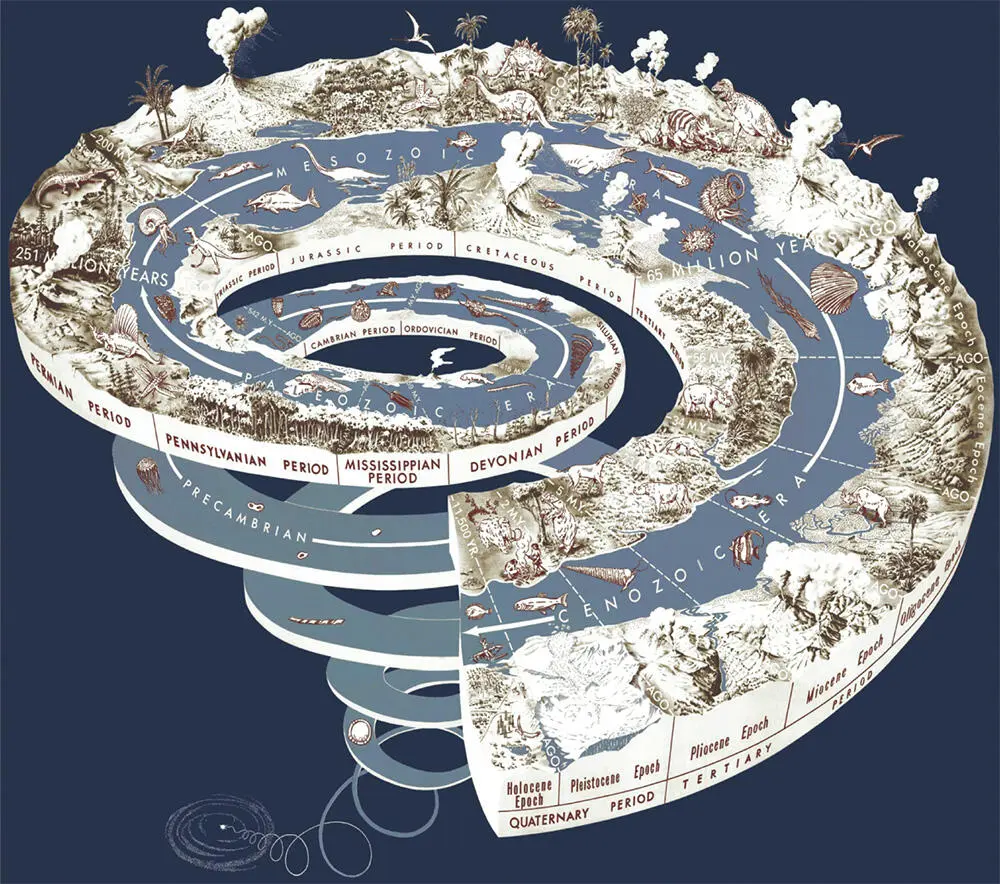
Figure 1.5 A schematic of the history of Earth. Understanding this history and the co-evolution of life and the planet constitutes a key objective in astrobiology.
Source: Reproduced with permission of William Crochot.
At this point, we will be equipped with a solid understanding of the structure, interrelationships, and capabilities of the life that we know on Earth. It is time to put this into a more cosmic context.
In the next part of the textbook, we rewind and return to the beginning of the Universe and investigate how stars and planets formed. This distinctly astronomical turn of events in the book is a good way to address the question: How did the elements required for life (which we identified in the first part of the textbook) form, and where did they form? In particular, we examine the conditions for the formation of carbon compounds in the Universe, since carbon-containing compounds are the most important class of compounds for life.
I should stress that one could tackle astrobiology in the opposite direction. We could start at the beginning of the Universe and work our way through to the emergence of life. Chronologically, this does make sense. However, to know which elements that were formed in the early Universe are relevant for life, it's important to know something about biology in the first place, which is why I have started the textbook with biology. However, I have attempted to write each chapter as a stand-alone text. If you want to select chapters and work through them in a different order, such as from the beginning of the Universe in a more astronomically focused class, you can do that.
Once we have investigated the history of the Universe, the formation of the elements of life and the important role of carbon, the textbook then returns to Earth to examine the emergence of life on this habitable planet. We investigate the environmental characteristics of our planet during its first billion years to understand what sort of environments and habitats could have existed on Earth at that time.
The question of how life might have originated in this early environment is our next task. We consider the chemical reactions and environments in which life could have originated and discuss some of the ideas for the reactions that allowed simple precursor molecules to come together to make the macromolecules of biology – how chemical reactions led to the formation of the first self-replicating cell. This leads to questions such as: How did life originate? Where did life originate? Was it inevitable? When did it happen? All of these questions encompass the question of the origin of life on Earth and might tell us something about whether an origin of life could happen somewhere else.
We follow this up by considering the evidence of early life on Earth. We consider some of the complexities and controversies associated with the evidence of preserved life in the rock record. These problems make full use of our acquired knowledge about the structure of life, the energy sources it can use, and the environments in which it can persist.
It's then time to take yet another step back and to think about how this early period fits into the whole history of our planet. We begin a chapter where we consider how geologists date rocks and order their understanding of the history of Earth, and we discuss some of the major transitions in life during the history of the planet, including the rise of multicellular animals. In a similar way to the first chapters, which may seem quite basic to a biologist, the geologists among you may feel that these chapters are very much in the tone of a standard geology textbook, and you'd be right. But remember, we are bringing scientists from many disciplines on this astrobiology journey, so for a biologist or chemist, for instance, this material may be new. However, as with the chapters on biology, I have written these chapters with an astrobiological flavor, so even if the core material is familiar to you, I hope you will consider it from a new angle.
Читать дальшеИнтервал:
Закладка:
Похожие книги на «Astrobiology»
Представляем Вашему вниманию похожие книги на «Astrobiology» списком для выбора. Мы отобрали схожую по названию и смыслу литературу в надежде предоставить читателям больше вариантов отыскать новые, интересные, ещё непрочитанные произведения.






Обсуждение, отзывы о книге «Astrobiology» и просто собственные мнения читателей. Оставьте ваши комментарии, напишите, что Вы думаете о произведении, его смысле или главных героях. Укажите что конкретно понравилось, а что нет, и почему Вы так считаете.