Hafiz M. H. Babu - Reversible and DNA Computing
Здесь есть возможность читать онлайн «Hafiz M. H. Babu - Reversible and DNA Computing» — ознакомительный отрывок электронной книги совершенно бесплатно, а после прочтения отрывка купить полную версию. В некоторых случаях можно слушать аудио, скачать через торрент в формате fb2 и присутствует краткое содержание. Жанр: unrecognised, на английском языке. Описание произведения, (предисловие) а так же отзывы посетителей доступны на портале библиотеки ЛибКат.
- Название:Reversible and DNA Computing
- Автор:
- Жанр:
- Год:неизвестен
- ISBN:нет данных
- Рейтинг книги:3 / 5. Голосов: 1
-
Избранное:Добавить в избранное
- Отзывы:
-
Ваша оценка:
Reversible and DNA Computing: краткое содержание, описание и аннотация
Предлагаем к чтению аннотацию, описание, краткое содержание или предисловие (зависит от того, что написал сам автор книги «Reversible and DNA Computing»). Если вы не нашли необходимую информацию о книге — напишите в комментариях, мы постараемся отыскать её.
Reversible and DNA Computing — читать онлайн ознакомительный отрывок
Ниже представлен текст книги, разбитый по страницам. Система сохранения места последней прочитанной страницы, позволяет с удобством читать онлайн бесплатно книгу «Reversible and DNA Computing», без необходимости каждый раз заново искать на чём Вы остановились. Поставьте закладку, и сможете в любой момент перейти на страницу, на которой закончили чтение.
Интервал:
Закладка:
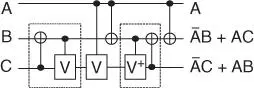
Figure 1.4Quantum realization of reversible Fredkin (FRG) gate.
Example 1.5
The cost of all 2  2 gates is the same, and it is 1. For 1
  1 gate, the cost is 0. Every circuit can be constructed from those 1
  1 and 2
  2 quantum primitives, and the cost of circuit is the total sum of required 2
  2 gates.
1.7 Delay
The delay of a logic circuit is the maximum number of gates in a path from any input line to any output line. The definition is based on two assumptions: (i) Each gate performs computation in one unit time and (ii) all inputs to the circuit are available before the computation begins.
Example 1.6
The delay of each 1  1 and 2
  2 reversible gate is taken as unit delay 1. Any 3
  3 reversible gate can be designed from 1
  1 reversible gates and 2
  2 reversible gates, such as CNOT gate, controlled‐V, and controlled‐
  gates (V is a square root of NOT gate and
  is its hermitian). Thus, the delay of a 3
  3 reversible gate can be computed by calculating its logical depth when it is designed from smaller 1
  1 and 2
  2 reversible gates.
1.8 Power
Power of a gate is defined by the energy. Energy of a basic quantum gate is 142.3 meV. Quantum circuits can be implemented with the basic quantum gates and the number of quantum gates depends on the number of basic quantum gates needed to realize it. That means the total number of required quantum gates in the quantum representation of a reversible quantum circuit or gate. So, the power of a reversible gate can be defined as follows: Power = Number of quantum gates  Energy of a basic quantum gate
Example 1.7
Figure 1.5shows the quantum realization of the reversible HNG gate. From this figures, it is seen that the quantum realization of reversible HNG gate requires total six quantum gates. So, the power of the reversible HNG gate is (6  142.3) meV = 853.8 meV, where the number of quantum gates of HNG circuit is 6.
1.9 Area
The area of a reversible gate is defined by the feature size. This size varies according to the number of quantum gates. The size of the basic quantum gates ranges from 50–300 Å. The Angstrom (Å) is a unit equal to  m (one ten‐billionth of a meter), or 0.1 nm. Its symbol is the Swedish letter Å. So, the area of a reversible gate can be defined as follows:
Area = Number of quantum gates  Size of a basic quantum gate
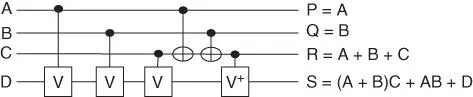
Figure 1.5The quantum representation of reversible HNG gate.
Example 1.8
Figure 1.5shows the quantum realization of the reversible HNG gate. From this figures, it is seen that the quantum realization of reversible HNG gate requires total six quantum gates. So, the area of the reversible HNG gate is ((50  6) Å – (300
  6)Å) = (300 Å – 1800 Å), where the number of quantum gates of HNG circuit is 6.
1.10 Hardware Complexity
The hardware complexity of a reversible logic circuit specifies the total number of Ex‐OR operations, NOT operations, and AND operations used in the circuit. Consequently, the hardware complexity can be determined using the following equation:
(1.10.1) 
where
= Hardware complexity (total logical operations)
= A two input EX‐OR gate logical operation
= A two input AND gate logical operation
= A NOT gate logical operation
Example 1.9
Figure 1.6shows the block diagram of a reversible Fredkin (FRG) gate. The figure describes that there is only one NOT operation, two EX‐OR operations, and four AND operations. So, the hardware complexity of the reversible FRG gate is  .
.
1.11 Quantum Gate Calculation Complexity
The quantum gate calculation complexity of the quantum representation of a reversible circuit specifies the total number of quantum gates (NOT gates, CNOT gates, and controlled‐V (controlled‐  ) gates) used in the quantum representation of a reversible circuit. Consequently, the quantum gate calculation complexity can be determined using the following equation:
Интервал:
Закладка:
Похожие книги на «Reversible and DNA Computing»
Представляем Вашему вниманию похожие книги на «Reversible and DNA Computing» списком для выбора. Мы отобрали схожую по названию и смыслу литературу в надежде предоставить читателям больше вариантов отыскать новые, интересные, ещё непрочитанные произведения.





Обсуждение, отзывы о книге «Reversible and DNA Computing» и просто собственные мнения читателей. Оставьте ваши комментарии, напишите, что Вы думаете о произведении, его смысле или главных героях. Укажите что конкретно понравилось, а что нет, и почему Вы так считаете.