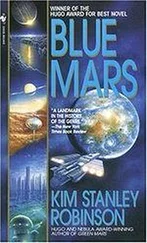
Kim Stanley Robinson - Blue Mars
Здесь есть возможность читать онлайн «Kim Stanley Robinson - Blue Mars» — ознакомительный отрывок электронной книги совершенно бесплатно, а после прочтения отрывка купить полную версию. В некоторых случаях можно слушать аудио, скачать через торрент в формате fb2 и присутствует краткое содержание. Жанр: unrecognised, на английском языке. Описание произведения, (предисловие) а так же отзывы посетителей доступны на портале библиотеки ЛибКат.

- Название:Blue Mars
- Автор:
- Жанр:
- Год:неизвестен
- ISBN:нет данных
- Рейтинг книги:5 / 5. Голосов: 1
-
Избранное:Добавить в избранное
- Отзывы:
-
Ваша оценка:
Blue Mars: краткое содержание, описание и аннотация
Предлагаем к чтению аннотацию, описание, краткое содержание или предисловие (зависит от того, что написал сам автор книги «Blue Mars»). Если вы не нашли необходимую информацию о книге — напишите в комментариях, мы постараемся отыскать её.
Blue Mars — читать онлайн ознакомительный отрывок
Ниже представлен текст книги, разбитый по страницам. Система сохранения места последней прочитанной страницы, позволяет с удобством читать онлайн бесплатно книгу «Blue Mars», без необходимости каждый раз заново искать на чём Вы остановились. Поставьте закладку, и сможете в любой момент перейти на страницу, на которой закончили чтение.
Интервал:
Закладка:
On the other hand, Tempe was low in altitude, and humid, with the ice ocean just a few kilometres to the north and west. And various Johnny Appleseed flights had passed over the entire southern shoreline of the new sea-part of Biotique’s efforts, begun some decades ago, when Sax had been in Burroughs. So there was some lichen to be seen, if you looked hard. And small patches of fellfield. And a few krummholz trees, half-buried in snow. All these plants were in trouble in this northern summer-turned-winter, except for the lichen of course. There was a fair bit of miniaturized fall colour already, there in the tiny leaves of the ground-hugging koenigia, and pygmy buttercup, and icegrass, and, yes, arctic saxifrage. The reddening leaves served as a kind of camouflage in the ambient redrock; often Sax didn’t see plants until he was about to step on them. And of course he wasn’t drawing attention to them anyway, so when he did stumble on one, he gave it a quick evaluative glance and walked on.
They climbed a prominent knoll overlooking the canyon west of the refuge, and there it was: the great ice sea, all orange and brass in the late light. It filled the lowland in a great sweep and formed its own smooth horizon, from southwest to northeast. Mesas of the fretted terrain now stuck out of the ice like sea stacks or cliff-sided islands. In truth this part of Tempe was going to be one of the most dramatic coastlines on Mars, with the lower ends of some fossae filling to become long fjords or lochs. And one coastal crater was right at sea level, and had a break in its sea side, making it a perfect round bay some fifteen kilometres wide, with an entry channel about two kilometres across. Farther south, the fretted terrain at the foot of the Great Escarpment would create a veritable Hebrides of an archipelago, many of the islands visible from the cliffs of the mainland. Yes, a dramatic coastline. As one could see already, looking at the broken sheets of sunset ice.
But of course this was not to be noted. No mention at all of the ice, the jagged bergs jumbled on the new shoreline. The bergs had been formed by some process Sax wasn’t aware of, though he was curious – but it could not be discussed. One could only stand in silence, as if having stumbled into a cemetery.
Embarrassed, Sax kneeled to look at a specimen of Tibetan rhubarb he had almost stepped on. Little red leaves, in a floret from a central red bulb.
Ann was looking over his shoulder. ‘Is it dead?’
‘No.’ He pulled off a few dead leaves from the exterior of the floret, showed her the brighter ones beneath. ‘It’s hardening for the winter already. Fooled by the drop in light.’ Then Sax went on, as if to himself: ‘A lot of the plants will die, though. The thermal overturn,’ which was when air temperatures turned colder than the ground temperatures, ‘came more or less overnight. There won’t be much chance for hardening. Thus lots of winterkill. Plants are better at handling it than animals would have been. And insects are surprisingly good, considering they’re little containers of liquid. They have supercooling cryoprotectants. They can stand whatever happens, I think.’
Ann was still inspecting the plant, and so Sax shut up. It’s alive, he wanted to say. Insofar as the members of a biosphere depend on each other for existence, it is part of your body. How can you hate it?
But then again, she wasn’t taking the treatment.
The ice sea was a shattered blaze of bronze and coral. The sun was setting, they would have to get back. Ann straightened and walked away, a black silhouette, silent. He could speak in her ear, even now when she was a hundred metres away, then two hundred, a small black figure in the great sweep of the world. He did not; it would have been an invasion of her privacy, almost of her thoughts. But how he wondered what those thoughts were. How he longed to say Ann, Ann, what are you thinking? Talk to me, Ann. Share your thoughts.
The intense desire to talk with someone, sharp as any pain; this was what people meant when they talked about love. Or rather; this was what Sax would acknowledge to be love. Just the super-heightened desire to share thoughts. That alone. Oh Ann, please talk to me.
* * *
But she did not talk to him. On her the plants seemed not to have had the effect they had had on him. She seemed truly to abominate them, these little emblems of her body, as if viriditas were no more than a cancer that the rock must suffer. Even though in the growing piles of wind-drifted snow, plants were scarcely visible any more. It was getting dark, another storm was sweeping in, low over the black-and-copper sea. A pad of moss, a lichened rockface; mostly it was rock alone, just as it had ever been. Nevertheless.
Then as they were getting back into the refuge lock, Ann fell in a faint. On the way down she hit her head on the door-jamb. Sax caught her body as she was landing on a bench against the inner wall. She was unconscious, and Sax half-carried her, half-dragged her all the way into the lock. Then he pulled the outer door shut, and when the lock was pumped, pulled her through the inner door into the changing room. He must have been shouting over the common band, because by the time he got her helmet off, five or six Reds were there in the room, more than he had seen in the refuge so far. One of the young women who had so impeded him, the short one, turned out to be the medical person of the station, and when they got Ann up onto a rolling table that could be used as a gurney, this woman led the way to the refuge’s medical clinic, and there took over. Sax helped where he could, getting Ann’s walker boots off her long feet with shaking hands. His pulse rate – he checked his wristpad – was a hundred and forty-five beats a minute – and he felt hot, even light-headed.
‘Has she had a stroke?’ he said. ‘Has she had a stroke?’
The short woman looked surprised. ‘I don’t think so. She fainted. Then struck her head.’
‘But why did she faint?’
‘I don’t know.’
She looked at the tall young woman, who sat next to the door. Sax understood that they were the senior authorities in the refuge. ‘Ann left instructions for us not to put her on any kind of life support mechanism, if she were ever incapacitated like this.’
‘No,’ Sax said.
‘Very explicit instructions. She forbade it. She wrote it down.’
‘You put her on whatever it takes to keep her alive,’ Sax said, his voice harsh with strain. Everything he had said since Ann’s collapse had been a surprise to him; he was a witness to his actions just as much as they were. He heard himself say, ‘It doesn’t mean you have to keep her on it, if she doesn’t come around. It’s just a reasonable minimum, to make sure she doesn’t go for nothing.’
The doctor rolled her eyes at this distinction, but the tall woman sitting in the doorway looked thoughtful.
Sax heard himself go on: ‘I was on life support for some four days, as I understand it, and I’m glad no one decided to turn it off. It’s her decision, not yours. Anyone who wants to die can do it without having to make a doctor compromise her Hippocratic oath.’
The doctor rolled her eyes even more disgustedly than before. But with a glance at her colleague, she began to pull Ann onto the life support bed; Sax helped her; and then she was turning on the medical AI, and getting Ann out of her walker. A rangy old woman, now breathing with an oxygen mask over her face. The tall woman stood and began to help the doctor, and Sax went and sat down. His own physiological symptoms were amazingly severe, marked chiefly by heat all through him, and a kind of incompetent hyperventilation; and an ache that made him want to cry.
After a time the doctor came over. Ann had fallen into a coma, she said. It looked like a small heart rhythm abnormality had caused her to faint in the first place. She was stable at the moment.
Читать дальшеИнтервал:
Закладка:
Похожие книги на «Blue Mars»
Представляем Вашему вниманию похожие книги на «Blue Mars» списком для выбора. Мы отобрали схожую по названию и смыслу литературу в надежде предоставить читателям больше вариантов отыскать новые, интересные, ещё непрочитанные произведения.








Обсуждение, отзывы о книге «Blue Mars» и просто собственные мнения читателей. Оставьте ваши комментарии, напишите, что Вы думаете о произведении, его смысле или главных героях. Укажите что конкретно понравилось, а что нет, и почему Вы так считаете.