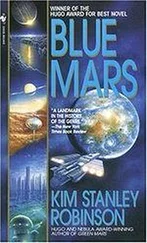
Kim Stanley Robinson - Blue Mars
Здесь есть возможность читать онлайн «Kim Stanley Robinson - Blue Mars» — ознакомительный отрывок электронной книги совершенно бесплатно, а после прочтения отрывка купить полную версию. В некоторых случаях можно слушать аудио, скачать через торрент в формате fb2 и присутствует краткое содержание. Жанр: unrecognised, на английском языке. Описание произведения, (предисловие) а так же отзывы посетителей доступны на портале библиотеки ЛибКат.

- Название:Blue Mars
- Автор:
- Жанр:
- Год:неизвестен
- ISBN:нет данных
- Рейтинг книги:5 / 5. Голосов: 1
-
Избранное:Добавить в избранное
- Отзывы:
-
Ваша оценка:
Blue Mars: краткое содержание, описание и аннотация
Предлагаем к чтению аннотацию, описание, краткое содержание или предисловие (зависит от того, что написал сам автор книги «Blue Mars»). Если вы не нашли необходимую информацию о книге — напишите в комментариях, мы постараемся отыскать её.
Blue Mars — читать онлайн ознакомительный отрывок
Ниже представлен текст книги, разбитый по страницам. Система сохранения места последней прочитанной страницы, позволяет с удобством читать онлайн бесплатно книгу «Blue Mars», без необходимости каждый раз заново искать на чём Вы остановились. Поставьте закладку, и сможете в любой момент перейти на страницу, на которой закончили чтение.
Интервал:
Закладка:
‘The Holocene.’
And then lastly, everything had been scoured by two billion years of ceaseless wind, scoured so hard that the older craters were completely rimless, everything stripped by the relentless winds stratum by stratum, leaving behind a wilderness of rock. Not chaos, technically speaking, but wild, speaking its unimaginable age in polyglot profusion, in rimless craters and etched mesas, dips, hummocks, escarpments, and oh so many blocky pitted rocks.
Often they stopped the rover to walk around. Even small mesas seemed to tower over them. Sax found himself staying near their rover, but nevertheless he came upon all kinds of interesting features. Once he discovered a rover-shaped rock, cracked vertically all the way through. To the left of the block, off to the west, he had a view to a distant horizon, the rocky land out there a smooth yellow glaze. To the right, the waist-high wall of some old fault, pocked as if by cuneiform. Then a sand drift bordered by ankle-high rocks, some of them pyramidal dark basaltic ventifacts, others lighter, pitted, granulated rocks. There a balanced shattercone, big as any dolmen. There a sand tail. There a crude circle of ejecta, like an almost completely weathered Stonehenge. There a deep snake-shaped hollow – the fragment of a watercourse, perhaps – behind it another gentle rise – then a distant prominence like a lion’s head. The prominence next to it was like the lion’s body.
In the midst of all this stone and sand, plant life was unobtrusive. At least at first. One had to look for it, to pay close attention to colour, above all else to green, green in all its shades, but especially its desert shades – sage, olive, khaki and so on. Nanao and Tariki kept pointing out specimens he hadn’t seen. Closer he looked, and closer again. Once attuned to the pale, living colours, which blended so well with the ferric land, they began to jump out from the rust and brown and umber and ochre and black of the rockscape. Hollows and cracks were likely places to see them, and near the shaded patches of snow. The closer he looked, the more he saw; and then, in one high basin, it seemed there were plants tucked everywhere. In that moment he understood; it was all fellfield, the whole Tyrrhena Massif.
Then, coating entire rockfaces, or covering the inside areas of drip catchments, were the dayglow greens of certain lichens, and the emerald or dark velvet greens of the mosses. Wet fur.
The diversicoloured palette of the lichen array; the dark green of pine needles. Bunched sprays of Hokkaido pines, foxtail pines, Sierra junipers. Life’s colours. It was somewhat like walking from one great roofless room to another, over ruined walls of stone. A small plaza; a kind of winding gallery; a vast ballroom; a number of tiny interlocked chambers; a sitting room. Some rooms held krummholz bansei against their low walls, the trees no higher than their nooks, gnarled by wind, cut along the top at the snow level. Each branch, each plant, each open room, as shaped as any bonsai – and yet effortless.
Actually, Nanao told him, most of the basins were intensively cultivated. ‘This basin was planted by Abraham.’ Each little region was the responsibility of a certain gardener or gardening group.
‘Ah!’ Sax said. ‘And fertilized, then?’
Tariki laughed. ‘In a manner of speaking. The soil itself has been imported, for the most part.’
‘I see.’
This explained the diversity of plants. A little bit of cultivation, he knew, had been done around Arena Glacier, where he had first encountered the fellfields. But here they had gone far beyond those early steps. Labs in Sabishii, Tariki told him, were trying their best to manufacture topsoil. A good idea; soil in fellfields appeared naturally at a rate of only a few centimetres a century. But there were reasons for this, and manufacturing soil was proving to be extremely difficult.
Still, ‘We pick up a few million years at the start,’ Nanao said. ‘Evolve from there.’ They hand-planted many of their specimens, it seemed, then for the most part left them to their fate, and watched what developed.
‘I see,’ Sax said.
He looked more closely yet. The clear dim light: it was true that each great open room displayed a slightly different array of species. ‘These are gardens, then.’
‘Yes … or things like that. Depends.’
Some of the gardeners, Nanao said, worked according to the precepts of Muso Soseki, others according to other Japanese Zen masters; others still to Fu Hsi, the legendary inventor of the Chinese system of geomancy called feng shui; others to Persian gardening gurus, including Omar Khayyam; or to Leopold or Jackson, or other early American ecologists, like the nearly forgotten biologist Oskar Schnelling; and so on.
These were influences only, Tariki added. As they did the work, they developed visions of their own. They followed the inclination of the land, as they saw that some plants prospered, and others died. Co-evolution, a kind of epigenetic development.
‘Nice,’ Sax said, looking around. For the adepts, the walk from Sabishii up onto the massif must have been an aesthetic journey, filled with allusions and subtle variants of tradition that were invisible to him. Hiroko would have called it areo-formation, or the areophany. ‘I’d like to visit your soil labs.’
‘Of course.’
They returned to the rover, drove on. Late in the day, under dark threatening clouds, they came to the very top of the massif, which turned out to be a kind of broad, undulating moor. Small ravines were filled with pine needles, sheered off by winds so that they looked like the blades of grass on a well-mowed yard. Sax and Tariki and Nanao again got out of the car, walked around. The wind cut through their suits, and the late afternoon sun broke out from under the dark cloud cover, casting their shadows all the way out to the horizon. Up here on the moors there were many big masses of smooth, bare bedrock; looking around, the landscape had the red, primal look Sax remembered from the earliest years; but then they would walk to the edge of a small ravine, and suddenly be looking down into green.
Tariki and Nanao talked about ecopoesis, which for them was terraforming redefined, subtilized, localized. Transmuted into something like Hiroko’s areoformation. No longer powered by heavy industrial global methods, but by the slow, steady, and intensely local process of working on individual patches of land. ‘Mars is all a garden. Earth too for that matter. This is what humans have become. So we have to think about gardening, about that level of responsibility to the land. A human-Mars interface that does justice to both.’
Sax waggled a hand uncertainly. ‘I’m used to thinking of Mars as a kind of wilderness,’ he said, as he looked up the etymology of the word garden. French, Teutonic, Old Norse, gard , enclosure. Seemed to share origins with guard , or keeping. But who knew what the supposedly equivalent word in Japanese meant? Etymology was hard enough without translation thrown into the mix. ‘You know – get things started, let loose the seeds, then watch it all develop on its own. Self-organizing ecologies, you know.’
‘Yes,’ Tariki said, ‘but wilderness too is a garden now. A kind of garden. That’s what it means to be what we are.’ He shrugged, his forehead wrinkled; he believed the idea was true, but did not seem to like it. ‘Anyway, ecopoesis is closer to your vision of wilderness than industrial terraforming ever was.’
‘Maybe,’ Sax said. ‘Maybe they’re just two stages of a process. Both necessary.’
Tariki nodded, willing to consider it. ‘And now?’
‘It depends on how we want to deal with the possibility of an ice age,’ Sax said. ‘If it’s bad enough, kills off enough plants, then ecopoesis won’t have a chance. The atmosphere could freeze back onto the surface, the whole process crash. Without the mirrors, I’m not confident that the biosphere is robust enough to continue growing. That’s why I want to see those soil labs you have. It may be that industrial work on the atmosphere remains to be done. We’ll have to try some modelling and see.’
Читать дальшеИнтервал:
Закладка:
Похожие книги на «Blue Mars»
Представляем Вашему вниманию похожие книги на «Blue Mars» списком для выбора. Мы отобрали схожую по названию и смыслу литературу в надежде предоставить читателям больше вариантов отыскать новые, интересные, ещё непрочитанные произведения.










Обсуждение, отзывы о книге «Blue Mars» и просто собственные мнения читателей. Оставьте ваши комментарии, напишите, что Вы думаете о произведении, его смысле или главных героях. Укажите что конкретно понравилось, а что нет, и почему Вы так считаете.