Museum Transformations
Здесь есть возможность читать онлайн «Museum Transformations» — ознакомительный отрывок электронной книги совершенно бесплатно, а после прочтения отрывка купить полную версию. В некоторых случаях можно слушать аудио, скачать через торрент в формате fb2 и присутствует краткое содержание. Жанр: unrecognised, на английском языке. Описание произведения, (предисловие) а так же отзывы посетителей доступны на портале библиотеки ЛибКат.
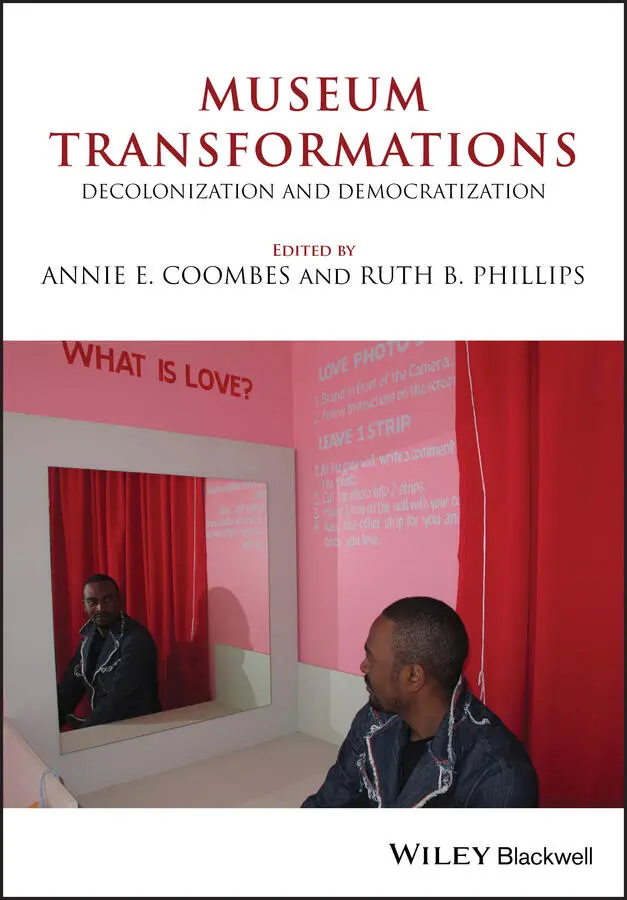
- Название:Museum Transformations
- Автор:
- Жанр:
- Год:неизвестен
- ISBN:нет данных
- Рейтинг книги:4 / 5. Голосов: 1
-
Избранное:Добавить в избранное
- Отзывы:
-
Ваша оценка:
Museum Transformations: краткое содержание, описание и аннотация
Предлагаем к чтению аннотацию, описание, краткое содержание или предисловие (зависит от того, что написал сам автор книги «Museum Transformations»). Если вы не нашли необходимую информацию о книге — напишите в комментариях, мы постараемся отыскать её.
Museum Transformations — читать онлайн ознакомительный отрывок
Ниже представлен текст книги, разбитый по страницам. Система сохранения места последней прочитанной страницы, позволяет с удобством читать онлайн бесплатно книгу «Museum Transformations», без необходимости каждый раз заново искать на чём Вы остановились. Поставьте закладку, и сможете в любой момент перейти на страницу, на которой закончили чтение.
Интервал:
Закладка:
At the beginning of the new millennium, in 2002, a consortium of directors representing some of the wealthiest major museums in Europe, Russia, and North America came together to defend the “importance and value of universal museums.” 9This defense was launched in the face of more than a decade of deconstructive postcolonial critique and an even longer history of demands for the return of treasures of world art that had entered European museums during and after the colonial era. Disingenuously claiming to speak for the “international museum community,” the directors marshaled globalization and internationalism as key arguments against restitution: “Although each case has to be judged individually, we should acknowledge that museums serve not just the citizens of one nation but the people of every nation.” 10Interestingly MacGregor’s speech two years later, in 2004, on the occasion of the British Museum’s two hundred and fiftieth anniversary celebrations, turns on a similar contradiction using the three (and as we have now seen, rather controversial) examples already discussed – Sokari Douglas Camp’s sculpture Otobo , the Benin bronzes, and the Throne of Weapons – as justification for the Museum’s status as guardian of the world’s culture. According to MacGregor, these three objects offer the viewer, “a range of different approaches – personal, political, sacred, military, historical, cultural and international.” “I don’t know,” he says, “where else a visitor can apprehend Africa in so many contexts. A collection that embraces the whole world allows you to consider the whole world. That is what an institution such as the British Museum is for.” 11Thus, MacGregor’s initiative in A History of the World in 100 Objects represents a somewhat different and more knowing response to an old argument, but its effect and the underlying political motivation are predictably similar.
What does it mean that governments in Western nations such as the United Kingdom, Sweden, Canada, and Australia are shoring up borders, excluding refugees and limiting benefits to immigrants while the museums they sponsor are celebrating “world art”? Are these contradictions evidence that in an era of “globalization” such museums continue to be used to create false consciousness and to finesse the neocolonial activities of sponsoring governments?
Yet we also find other museums, sometimes in the same cities, which are less invested in promoting their institutions as global guardians and which have been increasingly inventive in involving a mixed and representative local community. London’s Wallace Collection is not far from the British Museum and is best known for its exhibitions of medieval armor and eighteenth-century French paintings. Spurred on by the Heritage Lottery Fund’s criteria of cultural diversity and inclusivity, it became the unlikely site of the innovative Refugee Tour Guides program. 12The museum offered training sessions to refugees who took visitors on guided tours, inflecting their narratives about the collections with interpretations and perspectives drawn from their own cultural backgrounds (Martin 2012). The project began life in 2011 as a collaboration that included Newham Family Learning Services, West Hampstead Asian Women’s Group, Aaina Women’s Group, and West Ealing Deaf Women’s Minorities Group, with the aim of making artwork for an intergenerational community exhibition entitled Journeys East . Supported by the Heritage Lottery Fund, it celebrated the refurbishment of the Wallace Collection’s East Galleries which focus on the histories of the Dutch East India Company. The Southeast Asian communities were a target audience, as they were perceived to have been directly affected by the legacies of this period (Martin 2012). Such initiatives may simply demonstrate the degree to which liberal arguments presented in a museum are not yet seen as a threat by conservative governments. But they may also confirm the value of the museum’s semiautonomous status in relation to state patronage – something that has permitted even the boards of trustees of major national institutions to play a liberalizing role in mediating the decisions taken by museum administrators. Importantly, whatever the answer to these questions, the effects for the participants of such initiatives can be both enriching and enabling. It is telling, however, that these liberalizing and progressive programs have often been initiated by education departments or other interstitial environments within the museum rather than by curatorial and exhibitions staff.
Difficult histories
A number of key political transformations and their recent anniversaries (the end of apartheid in South Africa; the commemoration of the Civil War and the retirada in Spain; the abolition of the Atlantic slave trade; the Canadian and Australian governments’ apologies for their abusive residential school system and forced removal policy for Aboriginal children; together with a series of brutal civil wars (Rwanda, Libya, Sudan, Serbia, and Syria)) have provoked a spate of commemorative initiatives including museums which claim to forge a path through the turmoil of memories left in their wake. In important ways, public history and its institutions have sought to tackle violent pasts where perpetrators and victims (rarely as clearly distinguishable as those labels suggest) are daily confronted with each other’s presence on the streets of their hometowns. For survivors of these tragic histories in Phnom Penh or on the streets of Kigali, Londonderry, Johannesburg, or Madrid, simply walking down the road may provoke a sudden collapse or terror generated by the insecurity of never being certain about the past of one’s interlocutor. Jens Andermann’s chapter (8) compares the implications of the different juridical and political contexts of two recent memorial museums in Latin America in Argentina (the Museo de la Memoria) and Chile (Museo de la Memoria y los Derechos Humanos). Often the decision to create a museum has followed public inquiries such as the South African Truth and Reconciliation Commission. The task is inevitably daunting for any institution attempting to expose a history of political motives and their violent consequences that aims both to promote understanding for a broad public who may not have been directly involved and to foster reconciliation between the main protagonists. Another problem raised by the increase in museums dedicated to difficult histories is that they often focus only on large-scale atrocities that can be categorized as massacres or genocides. Accounts of the day-to-day forms of degradation and brutalization inflicted on individuals by oppressive regimes are left out. In the absence of acknowledgment of the effects of political repression in the domestic sphere of family life, women’s experience is often seen as secondary in these revisionist histories. In representing difficult histories, as in more standard historical narratives, questions arise over the valorization of certain kinds of experience over others and the kinds of narratives that can legitimately be included in the museum.
While it has clearly been crucial that difficult histories be acknowledged and exposed to public scrutiny, this museological trend has also spawned the institutionalization of new comparative areas of museum studies such as dark tourism and genocide. 13These are moral and ethical minefields. Inevitably, individuals speak on behalf of constituencies who are not there to speak for themselves. The reliance on ocularcentric narrative devices can tempt the museum to produce a visually stimulating account that may simply end up exposing victims to a form of epistemic violence. Similarly, attempts to recreate somatic experiences for visitors through immersive reconstructions of slave ships or gas chambers usually fail to produce an understanding of the relationship between the historical horrors that are being recalled and contemporary manifestations of slavery or genocide. Thus the constant refrain of “never again” reiterated at the exits of the Holocaust Memorial Museums in Washington and Los Angeles or in the Apartheid Museum in Johannesburg rarely elicits the kind of call to arms which might make such exhibitions unnecessary in the future. But where emphasis has been placed on making the museum serve more as a meeting place that facilitates dialogue and less as the site of a spectacle to be consumed, community groups and human rights organizations have cooperated in turning it into an arena for social action and change. In some instances sites associated with violent political histories have been transformed into the headquarters of organizations committed to the highest ideals of new dispensations, and have become symbolic of their aspirations. Thus the Gender Equality Commission’s offices and the offices of the Forum for the Empowerment of Women (FEW) are now literally part of the built fabric of the site of the Women’s Jail in Johannesburg in its reincarnation as a heritage site museum, the subject of Annie Coombes’s chapter (9) in this volume.
Читать дальшеИнтервал:
Закладка:
Похожие книги на «Museum Transformations»
Представляем Вашему вниманию похожие книги на «Museum Transformations» списком для выбора. Мы отобрали схожую по названию и смыслу литературу в надежде предоставить читателям больше вариантов отыскать новые, интересные, ещё непрочитанные произведения.





Обсуждение, отзывы о книге «Museum Transformations» и просто собственные мнения читателей. Оставьте ваши комментарии, напишите, что Вы думаете о произведении, его смысле или главных героях. Укажите что конкретно понравилось, а что нет, и почему Вы так считаете.