2D Monoelements
Здесь есть возможность читать онлайн «2D Monoelements» — ознакомительный отрывок электронной книги совершенно бесплатно, а после прочтения отрывка купить полную версию. В некоторых случаях можно слушать аудио, скачать через торрент в формате fb2 и присутствует краткое содержание. Жанр: unrecognised, на английском языке. Описание произведения, (предисловие) а так же отзывы посетителей доступны на портале библиотеки ЛибКат.
- Название:2D Monoelements
- Автор:
- Жанр:
- Год:неизвестен
- ISBN:нет данных
- Рейтинг книги:5 / 5. Голосов: 1
-
Избранное:Добавить в избранное
- Отзывы:
-
Ваша оценка:
2D Monoelements: краткое содержание, описание и аннотация
Предлагаем к чтению аннотацию, описание, краткое содержание или предисловие (зависит от того, что написал сам автор книги «2D Monoelements»). Если вы не нашли необходимую информацию о книге — напишите в комментариях, мы постараемся отыскать её.
Recent advances in phosphorene The diverse properties of two-dimensional antimonene, of graphene and its derivatives The molecular docking simulation study used to analyze the binding mechanisms of graphene oxide as a cancer drug carrier Metal-organic frameworks (MOFs)-derived carbon (graphene and carbon nanotubes) and MOF-carbon composite materials, with a special emphasis on the use of these nanostructures for energy storage devices (supercapacitors) Two-dimensional monoelements classification like graphene application in field-effect transistors for sensing and biosensing Graphene-based ternary materials as a supercapacitor electrode Rise of silicene and its applications in gas sensing
2D Monoelements — читать онлайн ознакомительный отрывок
Ниже представлен текст книги, разбитый по страницам. Система сохранения места последней прочитанной страницы, позволяет с удобством читать онлайн бесплатно книгу «2D Monoelements», без необходимости каждый раз заново искать на чём Вы остановились. Поставьте закладку, и сможете в любой момент перейти на страницу, на которой закончили чтение.
Интервал:
Закладка:
2.2.2 Electronic Band Structure
Based on first-principles calculations, bulk antimony is a typical semimetal material, while it is interesting that it will be transformed into a semiconductor when thinned to be a monolayer antimonene. Zhang et al. reported the electronic band structure of β-antimonene, which was calculated by the hybrid functional theory (HSE06) method [8]. As illustrated in Figure 2.2, trilayer and bilayer antimonene are still semi-metallic, where both valence-band tops and conduction-band bottoms cross the Fermi level at several points, causing a band gap of 0 eV in the Brillouin zone. However, for monolayer antimonene, the valence band and conduction band shift respectively down and up, resulting in the formation of a wide band gap of 2.28 eV. The valence band maximum (VBM) locates at K point, while the conduction maximum (CBM) is at Γ point, showing that monolayer antimonene is an indirect semiconductor. Due to the wide and indirect band gap, monolayer antimonene-based optoelectronic devices prefer to respond to the blue and ultraviolet light. After applying a small biaxial tensile strain, antimonene will experience an indirect-to-direct band-gap transition, making it more suitable for the applications of optoelectronic devices. The calculated electron effective masses of monolayer antimonene are 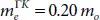 and
and  , indicating that it owns a high carrier mobility.
2.3 Experimental Preparation
2.3.1 Mechanical Exfoliation
Mechanical exfoliation is the most common method for preparing monolayer or few-layer 2D materials. In 2004, Novoselov and Geim obtained the first monolayer graphene via this method in human history [1]. Thereafter, this method is widely applied to the preparation of other layered materials. The van der Waals bond between the layers of the layered material is weak, and the binding energy is only 40–70 meV, so the layers and layers are more easily isolated by the external force [13]. The mechanical exfoliation is very suitable for scientific research because of its simple method, and the obtained sample is free from contamination and has a higher crystal quality.
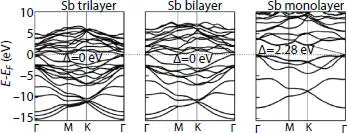
Figure 2.2 HSE06 calculated electronic band structures of trilayer, bilayer, and monolayer antimonene. Dots: Fermi levels. Reproduced with permission [8]. Copyright 2015, Wiley-VCH.
Since the calculated binding energy of β-antimony is smaller than 30 meV, this method can be used to peel off its monolayer form [11]. Ares et al. first obtained monolayer antimonene by a modified mechanical exfoliation with a double-step transfer procedure [14]. The specific preparation process is shown in Figure 2.3a, it started by repetitive peeling a freshly cleaved antimony crystal using adhesive tape, where sub-millimeter flakes were easily obtained. Instead of direct transfer of these flakes onto a SiO 2/Si substrate, an initial transfer from the adhesive tape to a viscoelastic stamp (Gel-park Gel-film) was needed. The stamp was then pressed against the surface of the SiO 2/Si substrate and slowly peeled off from it, consequently, large-area antimony thin flakes were prepared in a more controlled way [15]. The isolated antimony flakes can be identified by optical microscopy, where different colors represent different thicknesses. The thickness was determined by atomic force microscopy (AFM), and it was found that the height of a monolayer terrace was 0.9 nm due to the presence of water layers. By measuring the step height of single folds, the thickness of a monolayer antimonene was considered to be 0.4 nm ( Figure 2.3b, c). The isolated flakes showed good stability in ambient conditions, even if they were immersed in water.
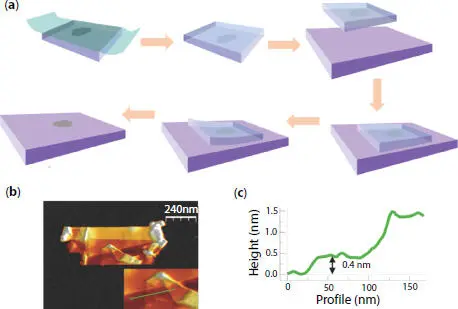
Figure 2.3 (a) Diagram of the steps involved in the sophisticated version of mechanical exfoliation. (b) AFM image of folded antimonene flake. (c) Profile along the green line in the inset of (b). (a) Reproduced with permission [15]. Copyright 2014, IOP Publishing Ltd. (b–c) Reproduced with permission [14]. Copyright 2016, Wiley-VCH.
Mechanical exfoliation process usually causes antimony flakes with different thicknesses, but Raman signals of these flakes are too weak to be detected which cannot provide their thickness information. Another work by Ares et al. developed a simple and quite accurate method to identify the thicknesses of isolated antimony flakes using optical microscopy [16]. Comparing the optical contrast versus thickness measurements with a Fresnel Law model, the refractive index and absorption coefficient of these flakes in the visible spectrum can be yielded, which are obviously different in thin and thick flakes, then being used to distinguish various thicknesses. After that, Abellán et al. prepared few-layer antimonene flakes on the SiO 2/Si and gold substrates by mechanical exfoliation and then functionalized their surface with a perylene bisimide (PDI) [17]. This noncovalent functionalization process increases the optical contrast of antimonene under white-light illumination and leads to an obvious quenching of the perylene fluorescence, allowing easy characterization of the flakes in seconds by scanning Raman microscopy.
2.3.2 Liquid Phase Exfoliation
Liquid phase exfoliation (LPE) is the process of placing a bulk material into a liquid and peeling off large quantities of dispersed layers by the action of liquid molecules. According to the need for surfactants, LPE can be divided into two categories, i.e., surfactant-free and surfactant-assisted LPE [18]. Common liquids in the LPE include aqueous and organic solutions. This method is expected to realize the inexpensive production of large-scale 2D materials. Currently, monolayer and few-layer 2D materials have been successfully prepared by the LPE.
Gibaja et al. first reported the production of few-layer antimonene by surfactant-free LPE under sonication assistance [19]. Through several attempts, they obtained the best solvent for peeling off antimonene that is the 2-propanol/water mixture with volume ratio of 4:1. In addition to solvent selection, other factors such as sonication time, initial quantity of antimony crystals, and centrifugation conditions were also considered to optimize the LPE process. Ground antimony crystals in selected solvent were sonicated (400 W, 24 kHz) for 40 min, yielding a colorless dispersion with a Faraday-Tyndall effect ( Figure 2.4a). After removing the unpeeled bulk materials by centrifugation (3,000 rpm) for 3 min, a stable-dispersion suspensions of micro-scale few-layer antimonene can be obtained with a concentration of ~1.74×10 −3gL −1. The surface topography of few-layer antimonene flakes was observed by AFM ( Figure 2.4b), confirming the successful exfoliation of antimony crystals using the LPE method. Analyzing the step heights of these flakes in Figure 2.4c, multiples of which were about 4 nm without showing typical terrace characteristics. These antimonene flakes possessed well-defined structures and their lateral dimensions were greater than 1–3 μm 2. From the high-angle annular dark field (HAADF) images of a typical antimonene flake in Figure 2.4d, it can be seen that the crystal structure conforms to β-antimonene and the flake is highly crystalline with no major defects. Figure 2.4eshows the Raman spectra of exfoliated antimonene flakes with different thicknesses, it is observed that the Raman intensity has a certain dependence on the thickness, where the peak intensity increases with the increase of the thickness, only for the flakes with thicknesses greater than 70 nm.
Читать дальшеИнтервал:
Закладка:
Обсуждение, отзывы о книге «2D Monoelements» и просто собственные мнения читателей. Оставьте ваши комментарии, напишите, что Вы думаете о произведении, его смысле или главных героях. Укажите что конкретно понравилось, а что нет, и почему Вы так считаете.