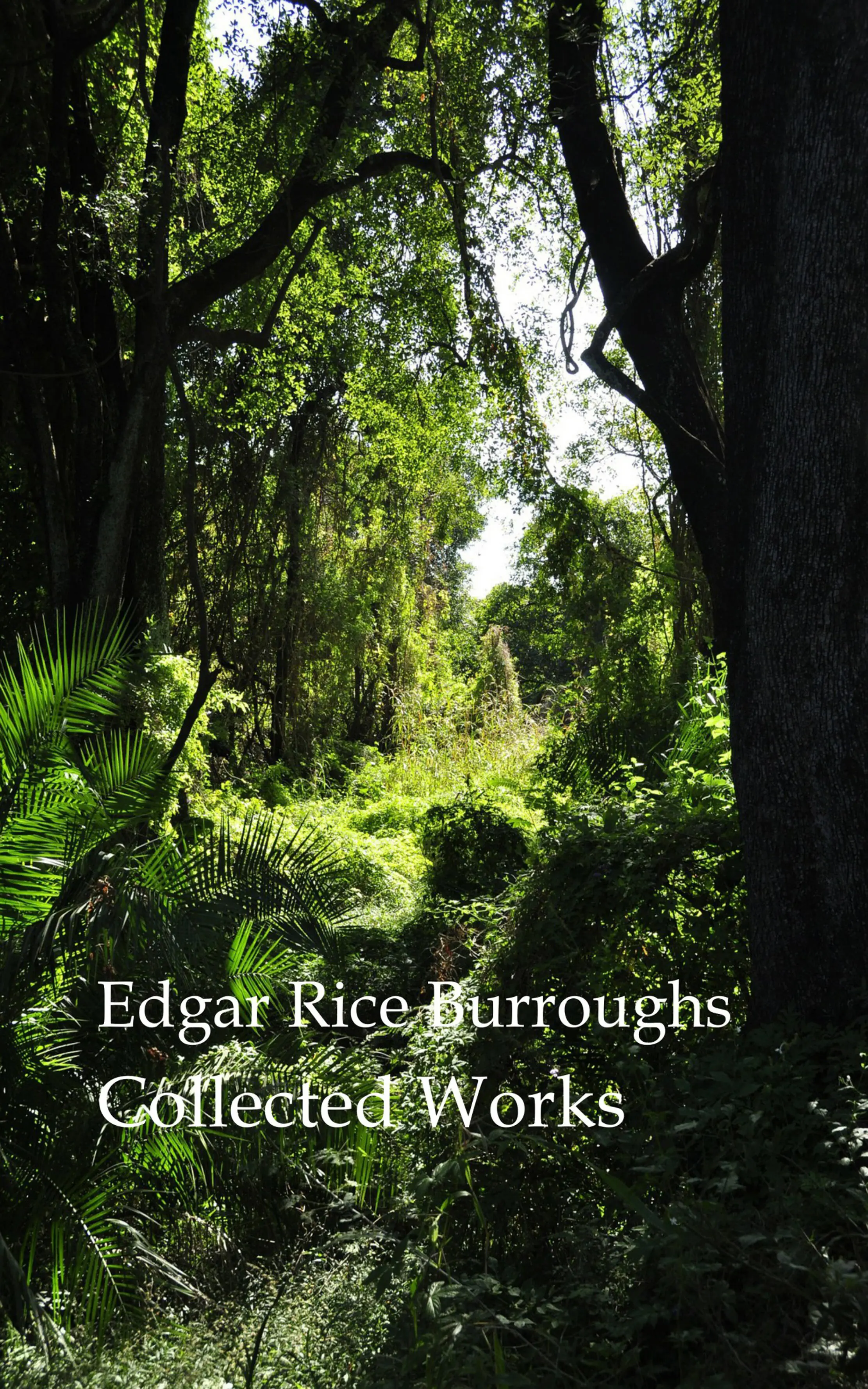
Edgar Burroughs - Collected Works
Здесь есть возможность читать онлайн «Edgar Burroughs - Collected Works» — ознакомительный отрывок электронной книги совершенно бесплатно, а после прочтения отрывка купить полную версию. В некоторых случаях можно слушать аудио, скачать через торрент в формате fb2 и присутствует краткое содержание. Жанр: unrecognised, на английском языке. Описание произведения, (предисловие) а так же отзывы посетителей доступны на портале библиотеки ЛибКат.
- Название:Collected Works
- Автор:
- Жанр:
- Год:неизвестен
- ISBN:нет данных
- Рейтинг книги:5 / 5. Голосов: 1
-
Избранное:Добавить в избранное
- Отзывы:
-
Ваша оценка:
Collected Works: краткое содержание, описание и аннотация
Предлагаем к чтению аннотацию, описание, краткое содержание или предисловие (зависит от того, что написал сам автор книги «Collected Works»). Если вы не нашли необходимую информацию о книге — напишите в комментариях, мы постараемся отыскать её.
A Princess of Mars
At the Earth's Core
Jungle Tales of Tarzan
Out of Time's Abyss
Pellucidar
Tarzan and the Ant Men
Tarzan and the Golden Lion
Tarzan and the Jewels of Opar
Tarzan of the Apes
Tarzan the Terrible
Tarzan the Untamed
The Beasts of Tarzan
The Chessmen of Mars
The Efficiency Expert
The Girl from Hollywood
The Gods of Mars
The Land That Time Forgot
The Lost Continent
The Mad King
The Monster Men
The Moon Maid
The Mucker
The Oakdale Affair
The Outlaw of Torn
The People That Time Forgot
The Return of Tarzan
The Son of Tarzan
Thuvia, Maid of Mars
Warlord of Mars
Edgar Rice Burroughs, American speculative fiction writer, best known for his prolific output in the adventure, science fiction and fantasy genres. His most well-known creations include Tarzan of the Apes, John Carter of Mars (Barsoom series) and Carson Napier of Venus (Amtor series).
Collected Works — читать онлайн ознакомительный отрывок
Ниже представлен текст книги, разбитый по страницам. Система сохранения места последней прочитанной страницы, позволяет с удобством читать онлайн бесплатно книгу «Collected Works», без необходимости каждый раз заново искать на чём Вы остановились. Поставьте закладку, и сможете в любой момент перейти на страницу, на которой закончили чтение.
Интервал:
Закладка:
He had seen Tarzan bring down a buck, just as Numa, the lion, might have done, leaping upon its back and fastening his fangs in the creature's neck. Tibo had shuddered at the sight, but he had thrilled, too, and for the first time there entered his dull, Negroid mind a vague desire to emulate his savage foster parent. But Tibo, the little black boy, lacked the divine spark which had permitted Tarzan, the white boy, to benefit by his training in the ways of the fierce jungle. In imagination he was wanting, and imagination is but another name for super-intelligence.
Imagination it is which builds bridges, and cities, and empires. The beasts know it not, the blacks only a little, while to one in a hundred thousand of earth's dominant race it is given as a gift from heaven that man may not perish from the earth.
While Tarzan pondered his problem concerning the future of his balu, Fate was arranging to take the matter out of his hands. Momaya, Tibo's mother, grief-stricken at the loss of her boy, had consulted the tribal witch-doctor, but to no avail. The medicine he made was not good medicine, for though Momaya paid him two goats for it, it did not bring back Tibo, nor even indicate where she might search for him with reasonable assurance of finding him. Momaya, being of a short temper and of another people, had little respect for the witch-doctor of her husband's tribe, and so, when he suggested that a further payment of two more fat goats would doubtless enable him to make stronger medicine, she promptly loosed her shrewish tongue upon him, and with such good effect that he was glad to take himself off with his zebra's tail and his pot of magic.
When he had gone and Momaya had succeeded in partially subduing her anger, she gave herself over to thought, as she so often had done since the abduction of her Tibo, in the hope that she finally might discover some feasible means of locating him, or at least assuring herself as to whether he were alive or dead.
It was known to the blacks that Tarzan did not eat the flesh of man, for he had slain more than one of their number, yet never tasted the flesh of any. Too, the bodies always had been found, sometimes dropping as though from the clouds to alight in the center of the village. As Tibo's body had not been found, Momaya argued that he still lived, but where?
Then it was that there came to her mind a recollection of Bukawai, the unclean, who dwelt in a cave in the hillside to the north, and who it was well known entertained devils in his evil lair. Few, if any, had the temerity to visit old Bukawai, firstly because of fear of his black magic and the two hyenas who dwelt with him and were commonly known to be devils masquerading, and secondly because of the loathsome disease which had caused Bukawai to be an outcast—a disease which was slowly eating away his face.
Now it was that Momaya reasoned shrewdly that if any might know the whereabouts of her Tibo, it would be Bukawai, who was in friendly intercourse with gods and demons, since a demon or a god it was who had stolen her baby; but even her great mother love was sorely taxed to find the courage to send her forth into the black jungle toward the distant hills and the uncanny abode of Bukawai, the unclean, and his devils.
Mother love, however, is one of the human passions which closely approximates to the dignity of an irresistible force. It drives the frail flesh of weak women to deeds of heroic measure. Momaya was neither frail nor weak, physically, but she was a woman, an ignorant, superstitious, African savage. She believed in devils, in black magic, and in witchcraft. To Momaya, the jungle was inhabited by far more terrifying things than lions and leopards—horrifying, nameless things which possessed the power of wreaking frightful harm under various innocent guises.
From one of the warriors of the village, whom she knew to have once stumbled upon the lair of Bukawai, the mother of Tibo learned how she might find it—near a spring of water which rose in a small rocky cañon between two hills, the easternmost of which was easily recognizable because of a huge granite boulder which rested upon its summit. The westerly hill was lower than its companion, and was quite bare of vegetation except for a single mimosa tree which grew just a little below its summit.
These two hills, the man assured her, could be seen for some distance before she reached them, and together formed an excellent guide to her destination. He warned her, however, to abandon so foolish and dangerous an adventure, emphasizing what she already quite well knew, that if she escaped harm at the hands of Bukawai and his demons, the chances were that she would not be so fortunate with the great carnivora of the jungle through which she must pass going and returning.
The warrior even went to Momaya's husband, who, in turn, having little authority over the vixenish lady of his choice, went to Mbonga, the chief. The latter summoned Momaya, threatening her with the direst punishment should she venture forth upon so unholy an excursion. The old chief's interest in the matter was due solely to that age-old alliance which exists between church and state. The local witch-doctor, knowing his own medicine better than any other knew it, was jealous of all other pretenders to accomplishments in the black art. He long had heard of the power of Bukawai, and feared lest, should he succeed in recovering Momaya's lost child, much of the tribal patronage and consequent fees would be diverted to the unclean one. As Mbonga received, as chief, a certain proportion of the witch-doctor's fees and could expect nothing from Bukawai, his heart and soul were, quite naturally, wrapped up in the orthodox church.
But if Momaya could view with intrepid heart an excursion into the jungle and a visit to the fear-haunted abode of Bukawai, she was not likely to be deterred by threats of future punishment at the hands of old Mbonga, whom she secretly despised. Yet she appeared to accede to his injunctions, returning to her hut in silence.
She would have preferred starting upon her quest by day-light, but this was now out of the question, since she must carry food and a weapon of some sort—things which she never could pass out of the village with by day without being subjected to curious questioning that surely would come immediately to the ears of Mbonga.
So Momaya bided her time until night, and just before the gates of the village were closed, she slipped through into the darkness and the jungle. She was much frightened, but she set her face resolutely toward the north, and though she paused often to listen, breathlessly, for the huge cats which, here, were her greatest terror, she nevertheless continued her way staunchly for several hours, until a low moan a little to her right and behind her brought her to a sudden stop.
With palpitating heart the woman stood, scarce daring to breathe, and then, very faintly but unmistakable to her keen ears, came the stealthy crunching of twigs and grasses beneath padded feet.
All about Momaya grew the giant trees of the tropical jungle, festooned with hanging vines and mosses. She seized upon the nearest and started to clamber, apelike, to the branches above. As she did so, there was a sudden rush of a great body behind her, a menacing roar that caused the earth to tremble, and something crashed into the very creepers to which she was clinging—but below her.
Momaya drew herself to safety among the leafy branches and thanked the foresight which had prompted her to bring along the dried human ear which hung from a cord about her neck. She always had known that that ear was good medicine. It had been given her, when a girl, by the witch-doctor of her town tribe, and was nothing like the poor, weak medicine of Mbonga's witch-doctor.
All night Momaya clung to her perch, for although the lion sought other prey after a short time, she dared not descend into the darkness again, for fear she might encounter him or another of his kind; but at daylight she clambered down and resumed her way.
Читать дальшеИнтервал:
Закладка:
Похожие книги на «Collected Works»
Представляем Вашему вниманию похожие книги на «Collected Works» списком для выбора. Мы отобрали схожую по названию и смыслу литературу в надежде предоставить читателям больше вариантов отыскать новые, интересные, ещё непрочитанные произведения.







Обсуждение, отзывы о книге «Collected Works» и просто собственные мнения читателей. Оставьте ваши комментарии, напишите, что Вы думаете о произведении, его смысле или главных героях. Укажите что конкретно понравилось, а что нет, и почему Вы так считаете.