Rafael Bienia - Role Playing Materials
Здесь есть возможность читать онлайн «Rafael Bienia - Role Playing Materials» — ознакомительный отрывок электронной книги совершенно бесплатно, а после прочтения отрывка купить полную версию. В некоторых случаях можно слушать аудио, скачать через торрент в формате fb2 и присутствует краткое содержание. Жанр: unrecognised, на английском языке. Описание произведения, (предисловие) а так же отзывы посетителей доступны на портале библиотеки ЛибКат.
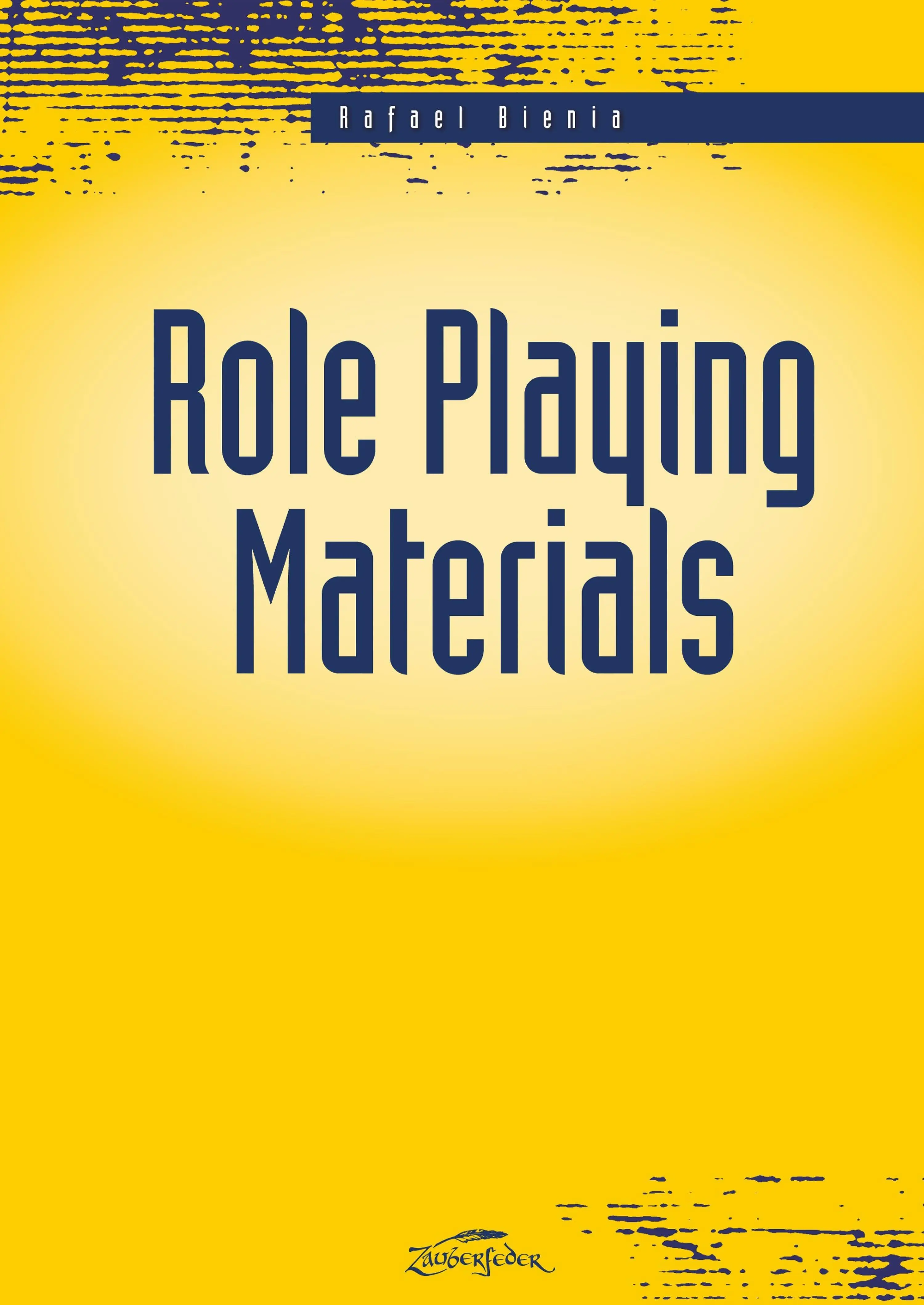
- Название:Role Playing Materials
- Автор:
- Жанр:
- Год:неизвестен
- ISBN:нет данных
- Рейтинг книги:4 / 5. Голосов: 1
-
Избранное:Добавить в избранное
- Отзывы:
-
Ваша оценка:
Role Playing Materials: краткое содержание, описание и аннотация
Предлагаем к чтению аннотацию, описание, краткое содержание или предисловие (зависит от того, что написал сам автор книги «Role Playing Materials»). Если вы не нашли необходимую информацию о книге — напишите в комментариях, мы постараемся отыскать её.
Role Playing Materials examines how larp, mixed and tabletop role-playing games work. Costumes, computers, pen and paper are not passive elements. Materials change and are changed during role-playing game sessions, because they work together with narrative and ludic elements. If we think about materials as social elements, how do they make role-playing games work? To answer this question, Role Playing Materials draws on ethnographic fieldwork among role-playing communities in Germany. The analysis draws upon the fields of game studies, and science, technology and society studies.
Role Playing Materials — читать онлайн ознакомительный отрывок
Ниже представлен текст книги, разбитый по страницам. Система сохранения места последней прочитанной страницы, позволяет с удобством читать онлайн бесплатно книгу «Role Playing Materials», без необходимости каждый раз заново искать на чём Вы остановились. Поставьте закладку, и сможете в любой момент перейти на страницу, на которой закончили чтение.
Интервал:
Закладка:
For Chapter 4, I followed two material actors, a smartphone and a virtual reality headset. With the smartphone, I explored the larp Obscurus 2 in Spaarnwoude, the Netherlands, which took place in a contemporary world (2012) ruled by criminals. The mixed reality technology involved was a banking software that players could access with their smartphones. It served as an example for augmented reality technology, because it added a digital layer of information to the location of the larp. With the virtual reality headset Oculus Rift DK2 , I explored role playing in computer role-playing games in 2014. The virtual reality headset replaces the monitor with a 360° display. Additionally, I interviewed a designer of the augmented reality role-playing game DSA Hexenwald (sprylab, 2013) and Dutch larp organizers who have used mixed reality technology before. Similar to the methods in the larp chapter, I wrote field notes during Obscurus 2 and while playing with the virtual reality headset. I participated as a player and followed how both material actors co-operate with the heterogeneous sites. Additionally, I took videos of myself role-playing with the headset. Here too, the perspectives changed, from complete participant to complete observer.
For Chapter 5, I examined six materials that produce role playing in tabletop role-playing games taking place at different locations in Germany and at my home in Maastricht, the Netherlands from 2010 through 2014. The game system that I focused on was Dungeons & Dragons 3.5 (Cook et al., 2003), but I also participated in sessions of Vampire: The Requiem (Marmell et al., 2004), Call of Cthulhu (Petersen & Willis, 2004), and Das Schwarze Auge (Herz et al., 2005). In this chapter, I relied less on field notes than on interviews with other players. The reason was that I changed my perspective one step further for this chapter, to that of role-playing materials. Letting materials speak allowed me to take ethnographic role playing further by role-playing non-human elements. I explain this experiment in more detail in Chapter 5.
As all of the chapters draw upon interviews, I will explain my use of interviews in more detail before I discuss the ethical questions involved in this study.
2.3.2 From semi-structured interviews to transcripts.I reflected on my observations by interviewing participants and designers after each of the game sessions. Semi-structured interviews helped me to reflect by mirroring my understanding with what players and producers said. Producers include people who produce these games for others, such as organizers in larp, designers in computer role-playing games, and game masters in tabletop role-playing games.
Semi-structured interviews engage the interviewer and interviewee in a formal interview situation. Each of the interviews took 60 minutes via online voice communication. This type of qualitative interview connects a list of open questions prepared before the interview with the opportunity to explore further certain themes that emerge during the interview (Kruse, 2011; Kvale & Brinkmann, 2009; Silverman, 1985). As interviewer, I had prepared six questions and let the conversation follow the interviewee’s answers. Thus, I could follow the topic of “role playing and materials” and let the interviewee lead. Beside technical difficulties that might occur when establishing an online voice communication, I had positive experiences regarding online interviews. Similarly to Michielse (2015), my interviewees preferred this form of communication, because it was natural to them, and because they could share visual information. Some send me pictures of their living room where they play tabletop role-playing games, while one interview partner showed me his game master screen while using the camera of his laptop. This procedure resulted in reliable and comparable qualitative data. After transcription, I translated the interviews from German into English. The final number of interviews was 10 for larp, three for mixed reality role-playing games, and 14 for tabletop role-playing games. In addition to formal interviews, I talked informally with role players on various occasions. In this regard, I balanced the small number of interviewees for Chapter 4. I have added the most relevant correspondence to the list of interviews. See Appendix Bfor the list of interviewees and correspondence.
2.3.3 Ethical considerations.Regarding research ethics, I followed the considerations laid out by the Chicago School of Writing (Booth et al., 2003; Williams & Colomb, 2007). I share with them the “belief that [research] is a profoundly social activity that connects you both to those who will use your research and to those who might benefit—or suffer—from that use” (Booth et al., 2003, p. 273). My field work brought me to different sites of play and discussion. In regard of time, the principle “follow the actors” connects my book with those to whom I talked during my field work in the past, with readers who hold this book in their hands now, and with colleagues who might use it in the future.
The Chicago School ties two conceptions to ethics, “the forging of bonds that create a community” and “moral choices we face when we act in that community” (Booth et al., 2003, p. 273). I forged bonds with players, designers, and scholars over the past five years as I participated in games and discussions about games at conventions and at online sites. Aside from playing, I read and wrote blog posts, forum threads, and discussions on social media sites. At these online sites, I found additional volunteers for interviews, who are included in the number of interviewees above. When working with online sites as part of the field work, it is probable that the amount of data is overwhelming. Michielse (2015) suggests to focus on “a specific part of the community” website, such as the frontpage (p. 35). In my case, I focused on discussions and online texts about crafting role-playing materials, but since there were few, I needed a further step. Throughout the time, I made my research project on materials public on my private blog ( bienia.wordpress.com), on my profiles at social media sites (Facebook, Twitter, YouTube, reddit), and on my profiles in specific online communities (inlarp.de, larperning.com, forums.oculus.com). In this way, I have stimulated the necessary amount of response, either directly via text messages or by generating discussion on the sites. Some responses were online while some happened in person during conventions and conferences. While maintaining contact with the communities, I kept my research work transparent. I agree with Michielse (2015) about transparency as an important moral choice, and would like to add that it is also a practical choice, because it generates opportunities to attract correspondence and interview partners.
I informed my interviewees about my intention to summarize the results and make them visible within an academic study. Interviewees provided consent in advance to be recorded and quoted. Some interviewees offered their real name for use (i.e., Walter) while others chose nicknames (i.e., Section31). When the chapters were finished I sent them to all the interviewees whom I quoted, for a final check. I treated most correspondence at online forums, social media sites, and via chat anonymously. In referring to such correspondence I do not usually cite names, but the game and form of communication, for example: SVA larp, E-mail, 2011. All in all, the study followed Maastricht University’s “Code of Conduct, Scientific Research” (2012).
Being in touch with the community discourse, I learned more about the three role-playing game forms, the (in)visibility of materials, and the latest developments, such as crowdfunding and crowdsourcing, for example for Dungeons & Dragons 5 (in 2012), Oculus Rift (in 2012), and College of Wizardry (in 2014). More importantly, with the help of online communication and online sites, I stayed in touch with fellow players and interview partners.
Читать дальшеИнтервал:
Закладка:
Похожие книги на «Role Playing Materials»
Представляем Вашему вниманию похожие книги на «Role Playing Materials» списком для выбора. Мы отобрали схожую по названию и смыслу литературу в надежде предоставить читателям больше вариантов отыскать новые, интересные, ещё непрочитанные произведения.









Обсуждение, отзывы о книге «Role Playing Materials» и просто собственные мнения читателей. Оставьте ваши комментарии, напишите, что Вы думаете о произведении, его смысле или главных героях. Укажите что конкретно понравилось, а что нет, и почему Вы так считаете.