Jeffrey McCullough - Transfusion Medicine
Здесь есть возможность читать онлайн «Jeffrey McCullough - Transfusion Medicine» — ознакомительный отрывок электронной книги совершенно бесплатно, а после прочтения отрывка купить полную версию. В некоторых случаях можно слушать аудио, скачать через торрент в формате fb2 и присутствует краткое содержание. Жанр: unrecognised, на английском языке. Описание произведения, (предисловие) а так же отзывы посетителей доступны на портале библиотеки ЛибКат.
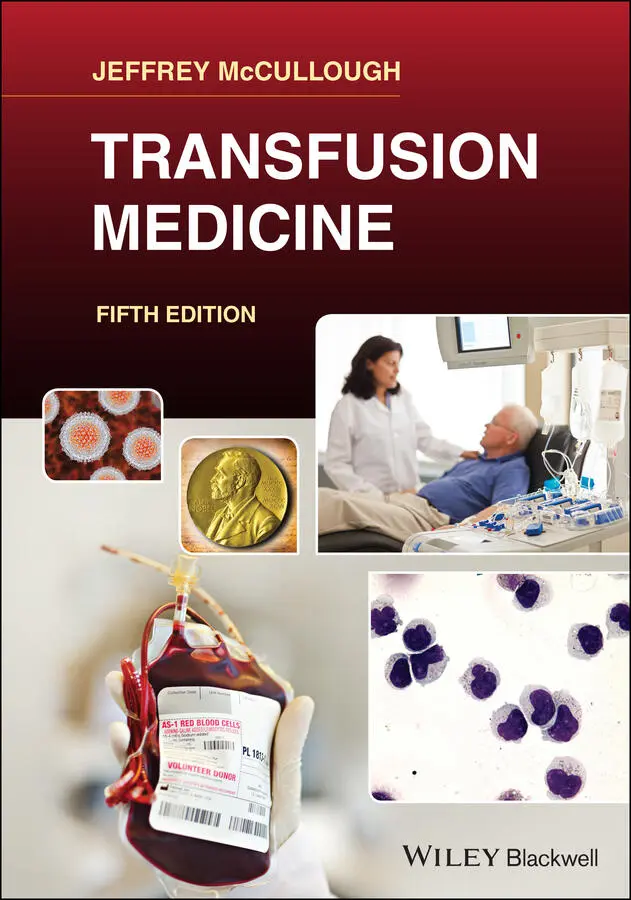
- Название:Transfusion Medicine
- Автор:
- Жанр:
- Год:неизвестен
- ISBN:нет данных
- Рейтинг книги:3 / 5. Голосов: 1
-
Избранное:Добавить в избранное
- Отзывы:
-
Ваша оценка:
Transfusion Medicine: краткое содержание, описание и аннотация
Предлагаем к чтению аннотацию, описание, краткое содержание или предисловие (зависит от того, что написал сам автор книги «Transfusion Medicine»). Если вы не нашли необходимую информацию о книге — напишите в комментариях, мы постараемся отыскать её.
The Fifth Edition of
delivers a succinct, thorough, clinically focused, practical and authoritative treatment of a full range of topics in transfusion therapy. This ranges from issues with the blood supply, recruitment of both whole blood and apheresis donors, blood collection and storage, blood testing, blood safety, and transmissible diseases. This edition has been fully updated and revised to include exciting cellular therapies for cancer, transplantation of both hematopoietic cells and solid organs, infectious diseases and regenerative medicine.
The Fifth Edition includes new authors with highly relevant content that provides a solid grounding for readers in the field. The book:
Is an approachable comprehensive guide to the field of blood banking and transfusion medicine Provides complete and timely perspective on crucial topics, including the HLA system in transfusion medicine and transplantation and quality programs in blood banking and transfusion medicine Is extensively referenced, making it simple for readers to conduct further research on the topics of interest to them Includes new chapters on pediatric transfusion medicine and pathogen reduction Has an expended chapter on patient blood management Provides extensive discussions of the clinical use of blood transfusion in a wide variety of clinical situations including recent development In the management of acute traumatic blood loss Provides updated information about blood groups and molecular testing making inroads into clinical practice along with discussions of laboratory detection of blood groups and provision of red cells Perfect for all those working in the field of blood banking, transfusion medicine and hematology or oncology and fellows in pathology, hematology, surgery and anesthesiology.
is a good introduction for technologists specializing in blood banking and non-medical personnel working in areas related to hematology and transfusion medicine. Transfusion Medicine will also earn a place in the libraries of practicing pathologists with responsibility for blood banks.
Transfusion Medicine — читать онлайн ознакомительный отрывок
Ниже представлен текст книги, разбитый по страницам. Система сохранения места последней прочитанной страницы, позволяет с удобством читать онлайн бесплатно книгу «Transfusion Medicine», без необходимости каждый раз заново искать на чём Вы остановились. Поставьте закладку, и сможете в любой момент перейти на страницу, на которой закончили чтение.
Интервал:
Закладка:
22 22. Fantus B. The therapy of the Cook County Hospital: blood transfusion. JAMA 1937; 109:128–133.
23 23. Yudin SS. Transfusion of cadaver blood. JAMA 1936; 106:997–999.
24 24. Levine P, Newark NJ, Stetson RE. An unusual case of intra‐group agglutination. JAMA 1939; 113:126–127.
25 25. Levine P, Katzin EM, Newark NJ, et al. Isoimmunization in pregnancy—its possible bearing on the etiology of erythroblastosis foetalis. JAMA 1941; 116:825–827.
26 26. Freda VJ, Gorman JG, Pollack W. Successful prevention of experimental Rh sensitization in man with an anti‐Rh gamma 2‐globulin antibody preparation: a preliminary report. Transfusion 1964; 4:26.
27 27. Clarke CA, Donohoe WTA, McConnell RB, et al. Further experimental studies in the prevention of Rh‐haemolytic disease. Br Med J 1963; 1:979.
28 28. Moreschi C. Neue tatsachen uber die blutkorperchen‐agglutination. Zentralbl Bakt 1908; 46:49–51.
29 29. Coombs RRA, Mourant AE, Race RR. A new test for the detection of weak and “incomplete” Rh agglutinins. Br J Exp Pathol 1945; 26:225.
30 30. Loutit JF, Mollison PL. Advantages of disodium‐citrate‐glucose mixture as a blood preservative. Br Med J 1943; 2:744.
31 31. Elliott J, Tatum WL, Nesset N. Use of plasma as a substitute for whole blood. N C Med J 1940; 1:283–289.
32 32. Elliott J. A preliminary report of a new method of blood transfusion. South Med Surg 1936; 98:643–645.
33 33. Cohn EJ, Oncley JL, Strong LE, et al. Chemical, clinical, and immunological studies on the products of human plasma fractionation. J Clin Invest 1944; 23:417–606.
34 34. Starr D. Again and again in World War II, blood made the difference. J Am Blood Resources Assoc 1995; 4:15–20.
35 35. Kendrick DB. Blood Program in World War II. 14–5, Washington, DC: US Government Printing Office, 1964, p. 922.
36 36. Pool JG, Shannon AE. Simple production of high potency anti‐hemophilic globulin (AHG) concentrates in a closed bag system. Transfusion 1965; 5:372.
37 37. Benesh R, Benesh RE. The influence of organic phosphates on the oxygenation of hemoglobin. Fed Proc 1967; 26:673.
38 38. Chanutin A, Curnish RR. Effect of organic and inorganic phosphates on the oxygen equilibrium of human erythrocytes. Arch Biochem Biophys 1967; 121:96.
39 39. Nakao M, Nakao T, Arimatsu Y, Yoshikawa H. A new preservative medium maintaining the level of adenosine triphosphate and the osmotic resistance of erythrocytes. Proc Jpn Acad 1960; 36:43.
40 40. Hogman CF, Hedlund K, Zetterstrom H. Clinical usefulness of red cells preserved in protein‐poor media. N Engl J Med 1978; 299:1377.
41 41. Doan CA. The recognition of a biological differentiation in the white blood cells with a specific reference to blood transfusion. JAMA 1926; 86:1593–1597.
42 42. van Rood JJ, van Leeuwen A. Leukocyte grouping: a method and its application. J Clin Invest 1963; 42:1382–1390.
43 43. Lalezari P, Radel E. Neutrophil‐specific antigens: immunology and clinical significance. Sem Hematol 1974; 11:281–290.
44 44. Perkins HA, Payne R, Ferguson J, et al. Nonhemolytic febrile transfusion reactions: quantitative effects of blood components with emphasis on isoantigenic incompatibility of leukocytes. Vox Sang 1966; 11:578.
45 45. Greenwalt TJ, Gajewski M, McKenna JL. A new method for preparing buffy coat‐poor blood. Transfusion 1962; 2:221–229.
46 46. Fleming A. A simple method of removing leukocytes from blood. Br J Exp Pathol 1926; 7:282–286.
47 47. Freireich EJ, Kliman A, Gaydos LA, et al. Response to repeated platelet transfusion from the same donor. Ann Intern Med 1963; 50:277.
48 48. Murphy S, Gardner FH. Platelet preservation—effect of storage temperature on maintenance of platelet viability—deleterious effect of refrigerated storage. N Engl J Med 1969; 380:1094–1098.
49 49. Abel JJ, Rowntree LC, Turner BB. Plasma removal with return of corpuscles. J Pharmacol Exp Ther 1914; 5:625–641.
50 50. McCullough J. Introduction to apheresis donations including history and general principles. In: McLeod B, ed. Apheresis: Principles and Practice. Bethesda, MD: AABB Press, 2003, pp. 29–47.
51 51. Tullis JL, Eberle WG, Baudanza P. Platelet‐pheresis: description of a new technique. Transfusion 1968; 8:154–164.
52 52. Tullis JL, Tinch RJ, Baudanza P, et al. Plateletpheresis in a disposable system. Transfusion 1971; 11:368–377.
53 53. Freireich EJ, Judson G, Levin RH. Separation and collection of leukocytes. Cancer Res 1965; 25:1517–1520.
54 54. Buckner D, Eisel R, Perry S. Blood cell separation in the dog by continuous flow centrifugation. Blood 1968; 31:653–672.
55 55. Morse EE, Carbone PP, Freireich EJ, et al. Repeated leukapheresis of patients with chronic myelocytic leukemia. Transfusion 1996; 6:175–192.
56 56. Morse EE, Freireich EJ, Carbone PP, et al. The transfusion of leukocytes from donors with chronic myelocytic leukemia to patients with leukopenia. Transfusion 1966; 6:183–192.
57 57. Freireich EJ, Levin RH, Wang J. The function and gate of transfused leukocytes from donors with chronic myelocytic leukemia in leukopenic recipients. Ann NY Acad Sci 1965; 113:1081.
58 58. McCullough J. Leukapheresis and granulocyte transfusion. CRC Crit Rev Clin Lab Sci 1979; 10:275.
2 The Blood Supply
Jeffrey McCullough MD
2.1 Worldwide blood supply
Blood transfusion occurs in all parts of the world, but the availability, quality, and safety of the blood depends on the general status of medical care in that area. Approximately 1,215,000 units of blood are collected annually worldwide [1]. The amount of blood collected in relation to the population ranges from 50 donations per 1,000 population in industrialized countries to 0.3 donation per 1,000 in the least developed countries [1]. Thus, there is a concentration of blood transfusions in industrialized countries, with 15% of the world’s population receiving approximately 48% of the world blood supply [1]. Lack of blood is a major problem in many parts of the world.
Blood services are best provided if there is a national, or at least regional, organization [2]. It is important that the government makes a commitment to the nation’s blood supply ( Table 2.1). Blood may be collected by individual hospitals, private blood banks, the Red Cross, Ministries of Health, or some other part of the national government. The number of units of blood collected at individual centers can range from a few hundred to thousands per year, and there may be extensive or little coordination and standardization. The adoption of a national blood policy is recommended, along with establishing a national organization [2]. This has been achieved in the developed world, where virtually all countries operate a national blood supply system as part of their public health structure as recommended by the World Health Organization (WHO) [2–5], and is beginning in other parts of the world [6–13]. The United States is essentially the only developed country without a single unified national blood supply organization.
Table 2.1 Key elements of a nationally coordinated blood transfusion service.
| Government commitment |
| A national blood policy |
| Formation or designation with responsibility to operate the program |
| Appointment of a suitable director |
| Appointment of qualified staff |
| Development of partnerships with appropriate nongovernment organizations |
| National guidelines for the clinical use of blood |
| Identification of low‐risk donor populations and development of strategies to promote blood donation |
| Education programs for physicians, nurses, and other appropriate staff regarding transfusion therapy |
| Systems for donor notification and counseling |
Blood transfusion safety: voluntary blood donation, national blood transfusion services, and safe and appropriate use; World Health Organization website programs and projects.
Читать дальшеИнтервал:
Закладка:
Похожие книги на «Transfusion Medicine»
Представляем Вашему вниманию похожие книги на «Transfusion Medicine» списком для выбора. Мы отобрали схожую по названию и смыслу литературу в надежде предоставить читателям больше вариантов отыскать новые, интересные, ещё непрочитанные произведения.









Обсуждение, отзывы о книге «Transfusion Medicine» и просто собственные мнения читателей. Оставьте ваши комментарии, напишите, что Вы думаете о произведении, его смысле или главных героях. Укажите что конкретно понравилось, а что нет, и почему Вы так считаете.