Andrew Carnie - The Syntax Workbook
Здесь есть возможность читать онлайн «Andrew Carnie - The Syntax Workbook» — ознакомительный отрывок электронной книги совершенно бесплатно, а после прочтения отрывка купить полную версию. В некоторых случаях можно слушать аудио, скачать через торрент в формате fb2 и присутствует краткое содержание. Жанр: unrecognised, на английском языке. Описание произведения, (предисловие) а так же отзывы посетителей доступны на портале библиотеки ЛибКат.
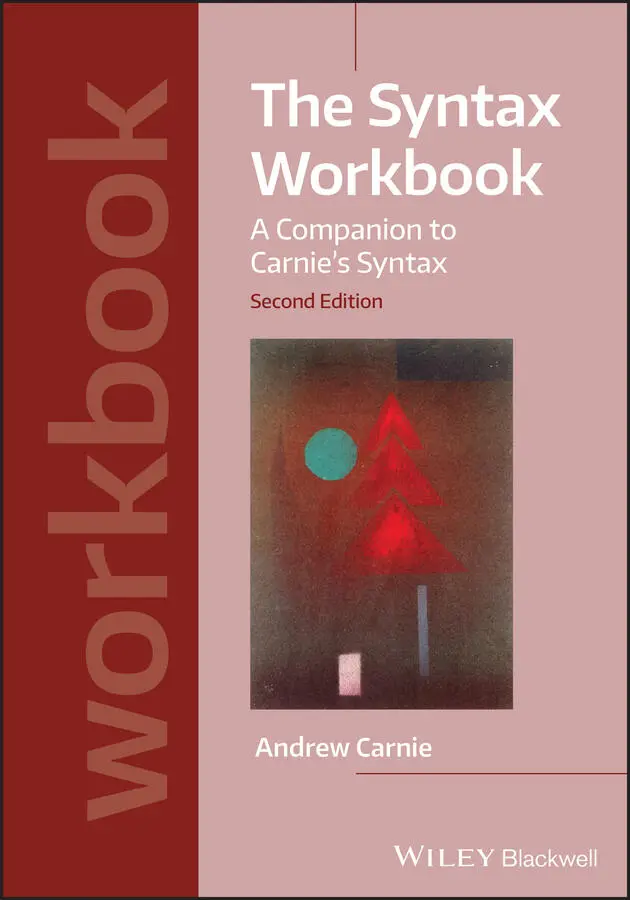
- Название:The Syntax Workbook
- Автор:
- Жанр:
- Год:неизвестен
- ISBN:нет данных
- Рейтинг книги:5 / 5. Голосов: 1
-
Избранное:Добавить в избранное
- Отзывы:
-
Ваша оценка:
The Syntax Workbook: краткое содержание, описание и аннотация
Предлагаем к чтению аннотацию, описание, краткое содержание или предисловие (зависит от того, что написал сам автор книги «The Syntax Workbook»). Если вы не нашли необходимую информацию о книге — напишите в комментариях, мы постараемся отыскать её.
Syntax: A Generative Introduction, 4th Edition, Syntax: A Generative Introduction, Fourth Edition,
.
Syntax
The Syntax Workbook
The Syntax Workbook
Includes exercises, practice questions, data analysis, and knowledge application questions for each section in
Features exercises and questions with full answers and explanations to assist students in learning to apply theory to practice Has been authored by leading figure in syntax Andrew Carnie to support classroom usage of
Works in concert with a student companion website, offering a robust selection of learning tools for the classroom Ideal for undergraduate courses in syntax,
and
together offer a perfect combination of thorough coverage and valuable practice. The workbook can be purchased on its own or in a set with the textbook. Available as a set with
The Syntax Workbook — читать онлайн ознакомительный отрывок
Ниже представлен текст книги, разбитый по страницам. Система сохранения места последней прочитанной страницы, позволяет с удобством читать онлайн бесплатно книгу «The Syntax Workbook», без необходимости каждый раз заново искать на чём Вы остановились. Поставьте закладку, и сможете в любой момент перейти на страницу, на которой закончили чтение.
Интервал:
Закладка:
Part 3:Now let’s think about the features for the plural usage of they . Does they have a value for [±feminine]? What about [±animate]? Why or why not?
Part 4: Consider singular uses of they , used either when you don’t know the gender of the person or when the person being referred to prefers non-binary pronouns. Does this pronoun have a value for [±feminine]? What about [±animate]? Why or why not?
Part 5:When talking about a non-binary person or other people who use they as their preferred pronoun, it’s considered to be very rude to refer to them with it . Instead using they is really the only non-rude option. Referring to the grammatical features you have described in parts 4, 5, and 6 explain why using it is inappropriate for a non-binary person and they is a better choice.
WBE14. SUBCATEGORIES OF VERBS
[Data Analysis; Intermediate]
Try to determine what subcategory the following verbs belong to. Use the categories in
(32) in the main textbook.
1 sleep
2 rub
3 demand
ANSWERS
WBE1. LUMMI
Both (b) and (c) are also verbs. We can tell this by virtue of the fact that they bear the same basic inflection as the verb. This tells us that semantic definitions aren’t valid, because presumably the words that mean the same thing in English are nouns and adjectives respectively.
WBE2. IRISH MORPHOLOGY
Modern Irish - eoir /-ó ir attaches to verbs and changes them into nouns. This suffix is a distributional marker of the noun part of speech
WBE3. ABAZA
The words čʷəməɤ, mgʷadəw , and ǰʲmaxčʲa are all verbs. They appear with the subject agreement marker d- and the present tense suffix -b . They also appear in the same position in the sentence: at the end of the work.
WBE4. EDO
The word né!né can appear before nouns, but not adjectives.
WBE5. IDENTIFYING PARTS OF SPEECH
Nouns: The following are pronouns, which are a kind of noun: you(’ll), my, I, she, her, his, he, him, they . Clear nouns are feet, skirt, ankles, floor, tiptoe, fawn, Sidney Trove, creature, muscles, form, school, work, feats, strength, equal, trickery, music, everything, beauty, delight, life, regret, ignorance . Play and dancing are also nouns in this sentence even though they express actions.
Verbs: For the moment, I’ll leave auxiliary verbs like will or had out of the list. We’ll return to these later. The following are clear verbs: watch, see, do, said, lifting, glided, was, developed, met, (were,) loved, increased, filled .
Adjectives: dainty, graceful, lithe, deep . Untrained is also an adjective, but this may not be obvious from the criteria listed in the main textbook.
Adverbs: lightly . How is also an adverb, but this may not be obvious from the criteria listed in the main textbook.
WBE6. FUNCTIONAL PARTS OF SPEECH
if, (’ll for will), do, above, across, and, on, as, a, was, not, the, in, the, of, or, at, which, had, no, were, all, that, but, with .
Yes, they are all closed class.
WBE7. PREPOSITIONS
1 to
2 from
3 under
4 over
5 without
6 by
7 above
8 before
9 after
10 through
11 near
12 off
13 for
14 into
15 during
16 across
17 since
18 until
19 at
WBE8. DETERMINERS
Articles: the 4, a 3; deictic articles0; quantifiers: all 1, every(thing) 1, no 1.
WBE9. CONJUNCTIONS AND COMPLEMENTIZERS
1 and or or; Conj;
2 if or whether; C;
3 that; C;
4 either … or or neither … nor; Conj;
5 if or whether; C;
6 if … then or either … or or … nor; Conj;
7 but; Conj
WBE10. TENSE CATEGORIES
1 will
2 was
3 has
4 did
5 to (and tense is also indicated on wants).
6 could (note that always is an adverb not T; you can put it at the end of the sentence, unlike normal T elements).
7 is (again note that usually is not of category T; it’s an adverb; you can put it at the end of the sentence, unlike normal T elements).
8 might
9 should
10 There is no independent T category here. Tense is indicated on the verb uses. Often is not a T element, it’s an adverb. You can tell this because it can be shifted to the end of the sentence (Connie uses email often). You can’t do that with normal T elements (*Maria found a new obsession has). We will return to what happens to T in sentences like this in chapter 9.
WBE11. COUNT VS. MASS NOUNS I
Much can appear with ineptitude, air, sugar , and water ; these are all mass nouns. Many can appear with pencils and cats ; these are count nouns.
WBE12. COUNT VS. MASS NOUNS II
1 Cow is a singular count noun in its usual usage. It might be used in a mass context with enough imagination (i.e., there is a horrible highway accident and the mangled remains of several cows are scattered everywhere, and the police say "We really have to clean all this cow off the road”.)
2 People is a plural count noun. It cannot be a mass noun (*much people).
3 Corn can be both a count noun (Pass me a corn (on the cob)) and a mass noun (Corn is used to make corn syrup. Is there much corn in that soup?).
4 Dogs is a plural count noun.
5 Cattle is a mass noun. In standard usage it cannot be used as a count noun, although for many Americans a count noun usage (synonymous with singular cow or head of cattle) is coming into use.
WBE13. ENGLISH PRONOUNS.
Part 1:
| [participant] | [speaker] | |
| 1st person | + | + |
| 2nd person | + | - |
| 3rd person | - | - |
| I, we | [+participant, +speaker] |
| you | [+participant, -speaker] |
| he , she, it, they | [-participant, -speaker] |
Part 2:
| he | [-feminine, +animate] |
| she | [+feminine, +animate] |
| it | [-animate] (no specification for [±feminine]) |
Part 3:Like it , they isn't specified for gender, so it has no specification for [±feminine]. It also doesn't show an animacy distinction – it can be used for both animates and inanimates, so it doesn't have a specification for [±animate] either.
Part 4: Singular they has the same basic distribution as plural they , so has no specification for [±feminine] or [±animate]
Part 5:
Consider the following complete feature specifications for the pronouns
| he | [-participant, -speaker, -feminine, +animate] |
| She | [-participant, -speaker, +feminine, +animate] |
| it | [-participant, -speaker, -animate] |
| they | [-participant, -speaker] |
Neither they nor it have a specification for the [±feminine] gender feature so either pronoun is a plausible candidates for non-binary people on that ground. But it is [- animate], this makes it wholly inappropriate for a human being. This is a reason why they is preferred and much more polite. Using it implies the referent isn't alive and that's just rude.
Читать дальшеИнтервал:
Закладка:
Похожие книги на «The Syntax Workbook»
Представляем Вашему вниманию похожие книги на «The Syntax Workbook» списком для выбора. Мы отобрали схожую по названию и смыслу литературу в надежде предоставить читателям больше вариантов отыскать новые, интересные, ещё непрочитанные произведения.

Обсуждение, отзывы о книге «The Syntax Workbook» и просто собственные мнения читателей. Оставьте ваши комментарии, напишите, что Вы думаете о произведении, его смысле или главных героях. Укажите что конкретно понравилось, а что нет, и почему Вы так считаете.