Andrew Carnie - The Syntax Workbook
Здесь есть возможность читать онлайн «Andrew Carnie - The Syntax Workbook» — ознакомительный отрывок электронной книги совершенно бесплатно, а после прочтения отрывка купить полную версию. В некоторых случаях можно слушать аудио, скачать через торрент в формате fb2 и присутствует краткое содержание. Жанр: unrecognised, на английском языке. Описание произведения, (предисловие) а так же отзывы посетителей доступны на портале библиотеки ЛибКат.
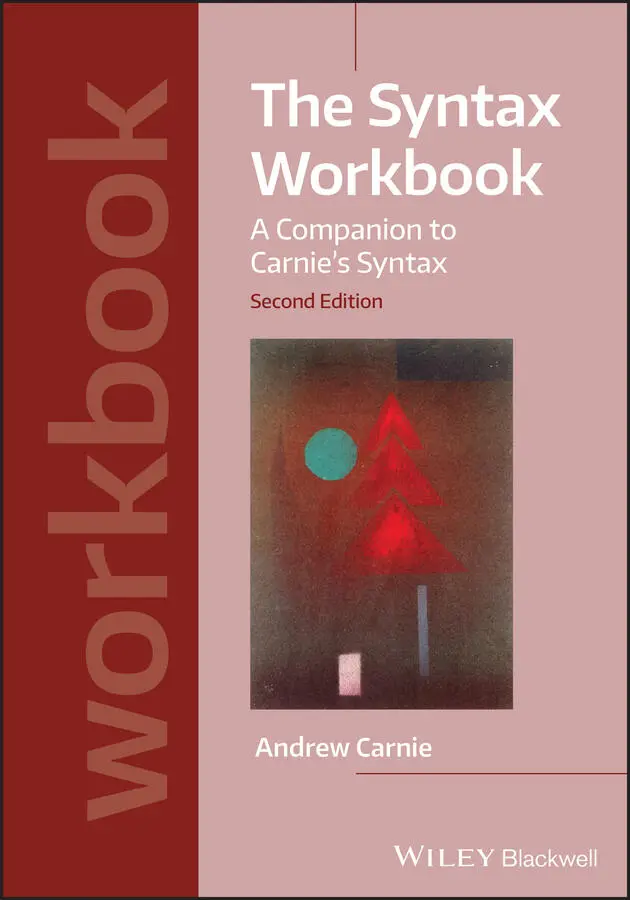
- Название:The Syntax Workbook
- Автор:
- Жанр:
- Год:неизвестен
- ISBN:нет данных
- Рейтинг книги:5 / 5. Голосов: 1
-
Избранное:Добавить в избранное
- Отзывы:
-
Ваша оценка:
The Syntax Workbook: краткое содержание, описание и аннотация
Предлагаем к чтению аннотацию, описание, краткое содержание или предисловие (зависит от того, что написал сам автор книги «The Syntax Workbook»). Если вы не нашли необходимую информацию о книге — напишите в комментариях, мы постараемся отыскать её.
Syntax: A Generative Introduction, 4th Edition, Syntax: A Generative Introduction, Fourth Edition,
.
Syntax
The Syntax Workbook
The Syntax Workbook
Includes exercises, practice questions, data analysis, and knowledge application questions for each section in
Features exercises and questions with full answers and explanations to assist students in learning to apply theory to practice Has been authored by leading figure in syntax Andrew Carnie to support classroom usage of
Works in concert with a student companion website, offering a robust selection of learning tools for the classroom Ideal for undergraduate courses in syntax,
and
together offer a perfect combination of thorough coverage and valuable practice. The workbook can be purchased on its own or in a set with the textbook. Available as a set with
The Syntax Workbook — читать онлайн ознакомительный отрывок
Ниже представлен текст книги, разбитый по страницам. Система сохранения места последней прочитанной страницы, позволяет с удобством читать онлайн бесплатно книгу «The Syntax Workbook», без необходимости каждый раз заново искать на чём Вы остановились. Поставьте закладку, и сможете в любой момент перейти на страницу, на которой закончили чтение.
Интервал:
Закладка:
Questions: What part of speech are čʷəməɤ, mgʷadəw and ǰʲmaxčʲa in this data? How can you tell? What tests did you use to figure out what part of speech they were?
WBE4. EDO 4
[Data Analysis; Intermediate]
Consider the following data from Edo. The data have been slightly modified from the original for pedagogical reasons.
| a) | Úyì | òré | né!né | òkhaèmwèn. | |
| Uyi | is | the | chief | ||
| “Uyi is the chief.” | |||||
| b) | *Né!né | òkpìá | yè | né!né | mòsèmòsè. |
| The | man | is | the | beautiful | |
| “The man is beautiful.” | |||||
| c) | Né!né | òkpìá | yè | mòsèmòsè. | |
| The | man | is | beautiful | ||
| “The man is beautiful.” |
Think about the word meaning “the” né!né . It can be used as a distributional test for parts of speech. Based on this limited data, what parts of speech can né!né appear with and what parts of speech does it not appear with?
WBE5. IDENTIFYING PARTS OF SPEECH
[Data Analysis; Basic]
In the following passage, 5underline all the nouns, circle all the verbs, put a box around all the adjectives, and put a dotted underline under any adverbs.
“If you’ll watch my feet, you’ll see how I do it,” said she; and lifting her skirt above her dainty ankles, glided across the floor on tiptoe, as lightly as a fawn at play. But Sidney Trove was not a graceful creature. The muscles on his lithe form, developed in the school of work or in feats of strength, at which he had met no equal, were untrained in all graceful trickery. He loved dancing and music and everything that increased the beauty and delight of life, but they filled him with a deep regret of his ignorance.
WBE6. FUNCTIONAL PARTS OF SPEECH
[Data Analysis; Basic]
Go through the passage in WBE5 above and see if you can tell what words are functional words. Are they all closed class?
WBE7. PREPOSITIONS
[Data Analysis; Basic]
Identify the prepositions in the following sentences:
1 Dave ran to the cave.
2 Sumayya hid her taxes from the federal government.
3 Jeff put his paper under my coffee cup.
4 Maggie saw the tall-ships over the horizon.
5 Lori cleaned the pipe without an air compressor.
6 Jennifer likes to sit by the seashore.
7 Heidi bobbed above the waterline.
8 Leila presented her paper before the princess.
9 Jerid smoked every day after work.
10 Sylvia trudged through the bog.
11 Jorge was seen near the student union building.
12 Calvin knocked the clock off the bedside table.
13 Shannon bought a piano for his son.
14 Jabril jumped head first into the hot tub.
15 Alex gasped during the shocking concert.
16 Jenny jumped across the lobby.
17 Kimberley hasn’t eaten since Friday.
18 Alina didn’t wait until 5 pm.
19 Chantal got sick at the hot dog stand.
WBE8. DETERMINERS
[Data Analysis; Basic]
Go back to the passage in WBE5 above. How many articles, quantifiers, and deictic markers can you find? Be very careful: the that in the last sentence is not a deictic marker (it is a complementizer – which we return to below).
WBE9. CONJUNCTIONS AND COMPLEMENTIZERS
[Data Analysis; Basic]
In each of the following sentences there is a blank. Fill in the appropriate conjunction or complementizer. More than one form is possible for many of the sentences. Indicate whether the form you used is a conjunction (Conj) or complementizer (C).
1 Mark Jadyn cut down the tree.
2 I wonder Mark cut down the tree.
3 I’m sure Mark cut down the tree.
4 ____ Mark didn't cut down the tree Jadyn did.
5 Bill asked Mark cut down the tree.
6 ____ Mark cut down the tree____ I’ll be really angry.
7 Mark cut down the tree Jadyn didn’t.
WBE10. TENSE CATEGORIES
[Data Analysis; Basic]
Identify any modals, infinitive markers, or auxiliaries in the following sentences. In at least one sentence there is no modal/infinitive marker/auxiliary category; instead, the tense is marked directly on the verb.
1 Alicia will make the coffee.
2 Mary-Lou was plotting a new adventure.
3 Maria has found a new obsession.
4 Dorian did not order his usual.
5 Muriel wants to eat very soon.
6 Vaneeta could always trick us.
7 Rajesh is usually doing his syntax readings around this time of day.
8 I might need a new computer monitor.
9 Holly should answer her phone when I call.
10 Connie often uses email.
WBE11. COUNT VS. MASS NOUNS I
[Data Analysis; Basic]
For each of the words below indicate whether it can occur with the quantifier much or the quantifier many .
1 pencils
2 ineptitude
3 air
4 cats
5 water
6 sugar
WBE12. COUNT VS. MASS NOUNS II
[Data Analysis; Intermediate]
Determine whether the following nouns are mass nouns, plural count nouns, or singular count nouns. Some of these may fall into more than one category, but don’t change the endings of the words (i.e., do not turn cow into cows ).
1 cow
2 people
3 corn
4 dogs
5 cattle
WBE13. ENGLISH PRONOUNS 6
[Application of Knowledge; Advanced]
In subject position, English pronouns show up with the following forms:
a)
| singular | plural | |
| 1 | I | We |
| 2 | You | |
| 3 masculine | He | |
| 3 feminine | She | They |
| 3 neuter | It |
1 stands for “first person” (the speaker), 2 stands for “second person” (the listener), 3 stands for “third person” (someone else). Masculine, feminine, and neuter are genders. We abbreviate these as m, f, n respectively. Singular and plural are numbers, which are abbreviated s and p .
PART 1:Assume that person is captured with the features [±participant] (which refers to those that are actually participants in the conversation) and [±speaker]. Give the features that define each of the persons. Then give the features for each of the pronouns in the table above.
PART 2:Now let’s consider the 3rd person forms. Let’s assume that [±feminine] defines the distinction between he and she . What about it ? The strange thing about it is that it has an additional restriction upon it: It cannot be used to refer to people. It seems to only be ok when referring to things.
e) The book is on the couch. Could you bring it to me?
c) The girl is on the couch. *Could you bring it to me?
One hypothesis about this is that it isn’t defined with a feature like [neuter] but instead with a feature [±animate]. Give the features for he/she/it . Ask yourself if the pronoun it is even specified for the feature [±feminine] (i.e. does it have a value for this feature or is the feature simply absent).
Читать дальшеИнтервал:
Закладка:
Похожие книги на «The Syntax Workbook»
Представляем Вашему вниманию похожие книги на «The Syntax Workbook» списком для выбора. Мы отобрали схожую по названию и смыслу литературу в надежде предоставить читателям больше вариантов отыскать новые, интересные, ещё непрочитанные произведения.





Обсуждение, отзывы о книге «The Syntax Workbook» и просто собственные мнения читателей. Оставьте ваши комментарии, напишите, что Вы думаете о произведении, его смысле или главных героях. Укажите что конкретно понравилось, а что нет, и почему Вы так считаете.