Andrew Carnie - The Syntax Workbook
Здесь есть возможность читать онлайн «Andrew Carnie - The Syntax Workbook» — ознакомительный отрывок электронной книги совершенно бесплатно, а после прочтения отрывка купить полную версию. В некоторых случаях можно слушать аудио, скачать через торрент в формате fb2 и присутствует краткое содержание. Жанр: unrecognised, на английском языке. Описание произведения, (предисловие) а так же отзывы посетителей доступны на портале библиотеки ЛибКат.
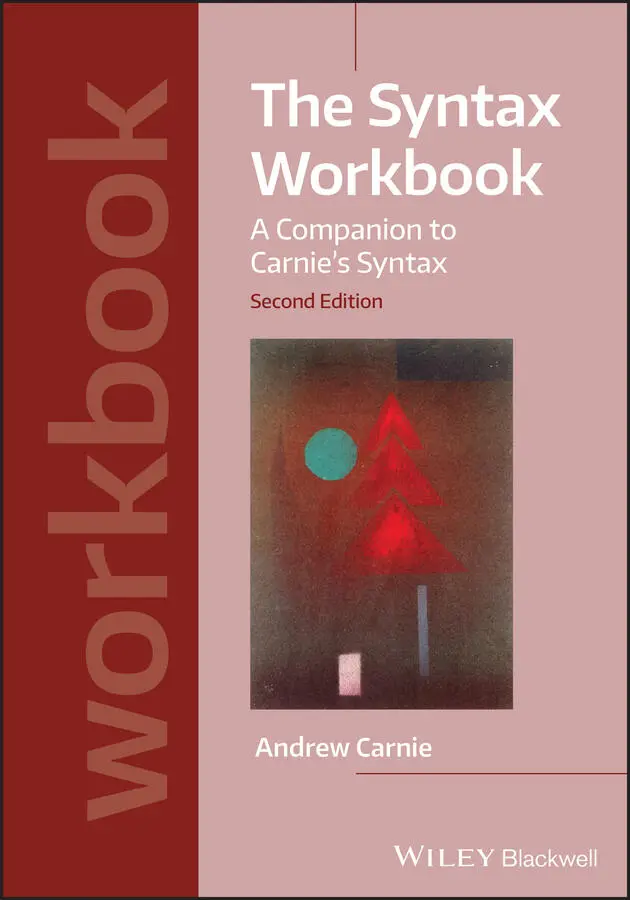
- Название:The Syntax Workbook
- Автор:
- Жанр:
- Год:неизвестен
- ISBN:нет данных
- Рейтинг книги:5 / 5. Голосов: 1
-
Избранное:Добавить в избранное
- Отзывы:
-
Ваша оценка:
The Syntax Workbook: краткое содержание, описание и аннотация
Предлагаем к чтению аннотацию, описание, краткое содержание или предисловие (зависит от того, что написал сам автор книги «The Syntax Workbook»). Если вы не нашли необходимую информацию о книге — напишите в комментариях, мы постараемся отыскать её.
Syntax: A Generative Introduction, 4th Edition, Syntax: A Generative Introduction, Fourth Edition,
.
Syntax
The Syntax Workbook
The Syntax Workbook
Includes exercises, practice questions, data analysis, and knowledge application questions for each section in
Features exercises and questions with full answers and explanations to assist students in learning to apply theory to practice Has been authored by leading figure in syntax Andrew Carnie to support classroom usage of
Works in concert with a student companion website, offering a robust selection of learning tools for the classroom Ideal for undergraduate courses in syntax,
and
together offer a perfect combination of thorough coverage and valuable practice. The workbook can be purchased on its own or in a set with the textbook. Available as a set with
The Syntax Workbook — читать онлайн ознакомительный отрывок
Ниже представлен текст книги, разбитый по страницам. Система сохранения места последней прочитанной страницы, позволяет с удобством читать онлайн бесплатно книгу «The Syntax Workbook», без необходимости каждый раз заново искать на чём Вы остановились. Поставьте закладку, и сможете в любой момент перейти на страницу, на которой закончили чтение.
Интервал:
Закладка:
WBE2. SCIENTIFIC METHOD PRACTICE
Question 1:Sentence (d) is predicted by the hypothesis: The first word in the declara- tive/statement form is the second word in the yes/no question, and vice versa.
Question 2:Sentence (f), however, is not predicted: it is the fourth word of sentence (e) that appears first in the question.
Question 3:Hypothesis 1 predicts that the yes/no question form of sentence (9) would be *Old the hobbit will eat the magic beans . The second word ( old ) is inverted with the first ( the ).
Question 4:Hypothesis 2 should be something like “ Yes/no questions are formed by moving the auxiliary of the equivalent declarative sentence to the front” or “ Yes/no questions are formed by reversing the positions of the subject and the auxiliary.” Your wording may vary.
WB3. USING CORPORA FOR DOING SYNTACTIC RESEARCH
Question 1: For me, sentence (d) is only grammatical with a lot of context (see the sentences in answer to Question 4 below), but to the extent it’s okay, it has to mean that Sean puffed air across him. Sentence (c) by contrast is completely grammatical and can mean either “Sean didn’t show up for their meeting” or “Sean used a puff of air to clear all the dust off of him”.
Question 2: Because of the way Google and search engines like it work, the exact numbers for this experiment will vary from day to day. But the general pattern of effect should be found no matter when the experiment is done. Here are the results I got on June 4th, 2019. The numbers are not exact, as Google only offers an approximation once the numbers get large enough.
i) blow me off 0000007474% ngrams
ii) blow off me no valid ngrams
The fact that (ii) doesn’t even show up in the database is telling.
Question 3:There seems to be a correspondence between our judgments of meaning and the statistics here. The form most English speakers either find ungrammatical or consider to have a very limited and non-idiomatic meaning, i.e. (iv), is absent from the google books database.
Question 4: On June 10, 2019, the top hits were:
e) Time to let the stink blow off me.
f) …doing blow off me.
Example (e) clearly has the “puff of air” meaning. I’ve edited the context for (f), because some readers may find the original tweet offensive, but in this case blow is not being used as a verb, but as a noun referring to the drug cocaine. In neither case does it have the “didn’t show up” reading.
What does this mean for us as syntacticians? Sometimes corpora can be used to verify judgments we have about structure. But the statistics don’t get at one important fact about the sentences above: The rare form is restricted in meaning as well.
WBE4. SEMANTIC VS. SYNTACTIC JUDGMENTS
1 Semantically odd. Sausages don’t have mothers-in-law (among other strange things about this sentence).
2 This is semantically hard to understand, but it’s probably due to a syntactic effect. English doesn’t typically allow you to have multiply displaced questions words like what and who.
3 Syntactic. The order of the words is clearly wrong.
4 Semantically strange. This is a contradiction. Andrew can’t both be professor and not a professor at the same time. (Although I’m not always doing syntax in real life!)
5 There are a couple of syntactic peculiarities here. Danced is either a past tense or a past participle and shouldn’t appear as the subject of the sentence (we might expect dancing instead). In English (but not in many other languages), you don’t “have tired”; you “are tired”. Finally, make typically doesn’t take a non-finite clause (marked by the to). We expect something more like dancing makes me tired. Note that the sentence is perfectly comprehensible and meaningful, even though it’s not a sentence that any native speaker of English would ever utter.
WBE5. I-LANGUAGE VS. E-LANGUAGE
This exercise is pretty tricky. That’s because e-languages can’t exist without a population of people who have the i-language, and people’s i-language exists because they are exposed to the e-language by their parents or caregivers. So, I’ve couched my answers in terms of probability, rather than absolutes. If you got a different answer, it doesn’t mean you were wrong.
1 Primarily e-language. We are talking about how a particular code is spoken in various places, by many people. We’re talking about the thing outside the human consciousness.
2 This is primarily i-language. We are talking about Maggie’s internal thought processes.
3 This is primarily e-language. We’re talking about the use of language on signs rather than in the mind of a speaker.
4 This one is tricky and there are arguments that it could be either i-language or e-language. If a syntactician said this, then they probably were talking about the internal grammar of a speaker. But if anyone else said it, they were probably talking about a collective agreement of French speakers about the order of words.
5 I think this is primarily i-language. We’re talking about Suzette’s mental ability to understand certain accents.
Notes
1 1. Loosely based on an exercise in Carnie (2011).
2 2. It can also have a third, sexually charged, meaning. I emphatically want you to ignore that possibility here.
Chapter 2 Parts of Speech
WORKBOOK EXERCISES 1
WBE1. LUMMI 2
[Data Analysis: Intermediate]
Consider the following data from Lummi (Straits Salish). Assume that (a) t’il?m-l?-sxw is a verb. What part of speech are the (b) and (c) forms? Don’t worry about all the unusual letters and diacritics; they are irrelevant to your answer. Pay attention to the meaning of the suffixes that are attached to each word (-l ʔ, which means past, and -sxw , which means second person singular subject).
1 t’ilʔm-lʔ-sxwsing-PAST-2SG.NOM“You sang.” verb
2 si’em-lʔ-sxwchief-PAST-2SG.NOM“You were a chief.”
3 sey’si-lʔ-sxwafraid-PAST-2SG.NOM“You were afraid.”
WBE2. IRISH MORPHOLOGY
[Data Analysis; Basic]
Consider the following forms from Modern Irish. The difference between - eoir and -ó ir is irrelevant to the problem set—they are the same suffix
1 Balsam “to embalm”
2 Balsamóir “An embalmer”
3 Caint “to speak”
4 Cainteoir “A speaker”
5 Foghlaim “to learn”
6 Foghlaimeoir “A learner”
The examples above exhibit a pattern that helps us to identify parts of speech. Explain what that pattern is, and how it fits into our notion of distributional definitions for parts of speech.
WBE3. ABAZA 3
[Data Analysis; Intermediate]
Consider the following data from Abaza a language of the Caucasus mountains. The glosses have been slightly modified to make this problem set easier to follow.
1 Awəy ḍ-s-čʷəməɤ-b3SF 3S-1S-hate-PRESI hate her.
2 Awəy d-mgʷadəw-b3SF 3S-pregnant-PRESShe is pregnant. (Literally “She pregnants.”)
3 Y-aba də-ǰʲmaxčʲa-b3SM-father 3S-goatherd-PRESHis father is a goatherd. (literally “His father goatherds.”)
In the data above PRES means “present tense”, 3S means “third person singular” (i.e., he, she or it ). 3SM means “third person singular masculine” (i.e., He, him, or his ), and 3SF means “Third person singular feminine" (i.e., her, she or hers )
Читать дальшеИнтервал:
Закладка:
Похожие книги на «The Syntax Workbook»
Представляем Вашему вниманию похожие книги на «The Syntax Workbook» списком для выбора. Мы отобрали схожую по названию и смыслу литературу в надежде предоставить читателям больше вариантов отыскать новые, интересные, ещё непрочитанные произведения.








Обсуждение, отзывы о книге «The Syntax Workbook» и просто собственные мнения читателей. Оставьте ваши комментарии, напишите, что Вы думаете о произведении, его смысле или главных героях. Укажите что конкретно понравилось, а что нет, и почему Вы так считаете.