Andrew Carnie - The Syntax Workbook
Здесь есть возможность читать онлайн «Andrew Carnie - The Syntax Workbook» — ознакомительный отрывок электронной книги совершенно бесплатно, а после прочтения отрывка купить полную версию. В некоторых случаях можно слушать аудио, скачать через торрент в формате fb2 и присутствует краткое содержание. Жанр: unrecognised, на английском языке. Описание произведения, (предисловие) а так же отзывы посетителей доступны на портале библиотеки ЛибКат.
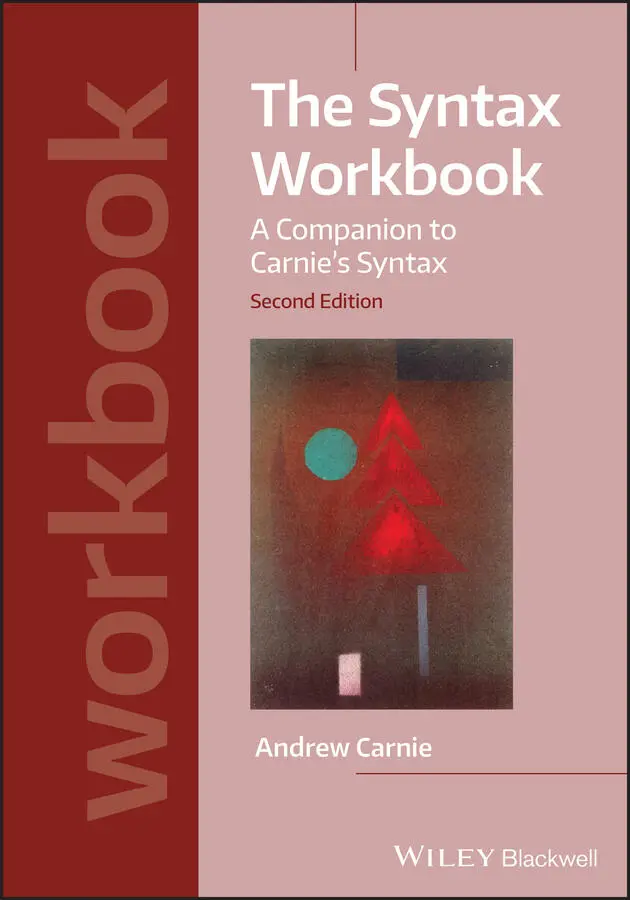
- Название:The Syntax Workbook
- Автор:
- Жанр:
- Год:неизвестен
- ISBN:нет данных
- Рейтинг книги:5 / 5. Голосов: 1
-
Избранное:Добавить в избранное
- Отзывы:
-
Ваша оценка:
The Syntax Workbook: краткое содержание, описание и аннотация
Предлагаем к чтению аннотацию, описание, краткое содержание или предисловие (зависит от того, что написал сам автор книги «The Syntax Workbook»). Если вы не нашли необходимую информацию о книге — напишите в комментариях, мы постараемся отыскать её.
Syntax: A Generative Introduction, 4th Edition, Syntax: A Generative Introduction, Fourth Edition,
.
Syntax
The Syntax Workbook
The Syntax Workbook
Includes exercises, practice questions, data analysis, and knowledge application questions for each section in
Features exercises and questions with full answers and explanations to assist students in learning to apply theory to practice Has been authored by leading figure in syntax Andrew Carnie to support classroom usage of
Works in concert with a student companion website, offering a robust selection of learning tools for the classroom Ideal for undergraduate courses in syntax,
and
together offer a perfect combination of thorough coverage and valuable practice. The workbook can be purchased on its own or in a set with the textbook. Available as a set with
The Syntax Workbook — читать онлайн ознакомительный отрывок
Ниже представлен текст книги, разбитый по страницам. Система сохранения места последней прочитанной страницы, позволяет с удобством читать онлайн бесплатно книгу «The Syntax Workbook», без необходимости каждый раз заново искать на чём Вы остановились. Поставьте закладку, и сможете в любой момент перейти на страницу, на которой закончили чтение.
Интервал:
Закладка:
188 180
189 181
190 182
191 183
192 184
193 185
194 186
195 187
196 188
197 189
198 190
199 191
200 192
201 193
202 194
203 195
204 196
205 197
206 198
207 199
208 200
209 201
210 202
211 203
212 204
213 205
214 206
215 207
216 208
217 209
218 210
219 211
220 212
221 213
222 214
223 215
224 216
225 217
226 218
227 219
228 220
229 221
230 222
231 223
232 224
233 225
234 226
235 227
236 228
237 229
238 230
239 231
240 232
241 233
242 234
243 235
244 236
245 237
246 238
247 239
248 240
249 241
250 242
251 243
252 244
253 245
254 246
255 247
256 248
257 249
258 250
259 251
260 252
261 253
262 254
263 255
264 256
265 257
266 258
267 259
268 260
269 261
270 262
271 263
272 264
273 265
274 266
275 267
276 268
277 269
278 270
279 271
280 272
281 273
282 274
283 275
284 276
285 277
286 278
287 279
288 280
289 281
290 282
291 283
Preface
Welcome!
Thank you for purchasing The Syntax Workbook, 2nd Edition which goes along with the fourth edition of Syntax: A Generative Introduction . This workbook is designed to give you further practice beyond the presentation and exercises in the main text. Syntax often uses big tree diagrams, and the constant cry I’ve heard from students using the first and second editions is that there aren’t enough example diagrams or practice. On the other hand, adding practice exercises with answers would make the main text too big and expensive. So I’ve settled on this optional workbook as an alternative.
You have three different opportunities to practice now:
1 Workbook Exercises (WBE): This workbook contains enrichment and additional practice exercises that go along with each chapter in the book. You can check your own answers against the answer key at the end of each chapter.
2 General Problem Sets (GPS) (in the main textbook): You can do the general problem sets at the end of each chapter in the main textbook. I’m sorry but the answers to these questions are not made available to students. The reason for this is that many instructors use these problem sets as a means for student evaluation. Providing the answers to these would be counterproductive! If you are using the textbook for self-study or your instructor isn’t using the problem sets for evaluation, I encourage you to find a linguistics professor or linguistics (post-)graduate student who can help you with determining if you are on the right track with these.
3 If you are an advanced student or a graduate student, I strongly encourage you to try the Challenge Problem Sets (CPS) at the end of each chapter in the main textbook. These problem sets are designed to make you think critically about the presentation in the text and to think about alternatives and problems that exist for the theory. Again the answers to these cannot be distributed to students.
I hope that you find that the addition of this workbook enriches your syntactic studies and gives you more opportunities to master the material.
This is the second version of this workbook and while we’ve done our best at quality control, it’s possible that some errors have slipped through the student testing, copy- editing, and proofreading processes. I welcome any corrections or suggestions at carnie@arizona.edu. Many people helped produce this book and the textbook, a list of people can be found in the preface to the main textbook. A thank you to them all!
Andrew Carnie
Tucson
Chapter 1 Generative Grammar
WORKBOOK EXERCISES
WBE1. PRESCRIPTIVE RULES
[Critical Thinking; Basic]
Part 1 : All of the sentences below are prescriptively “wrong” according to many so-called language experts. Can you identify what’s supposed to be wrong with them (i.e., what prescriptive rule do they violate?). If you’re not familiar with prescriptive rules you may have to search around on the Web a bit to figure this out, but if you’ve been trained to write in the American or British University tradition, most (or many) of these should stand out as “poor grammar” or “poor style”. Certainly, Microsoft Word’s grammar- checking program is flagging many of these sentences as I write them!
1 What did you put the present in?
2 She’s smarter than him.
3 To boldly go where no one has gone before!
4 He walks too slow.
5 Hopefully, the weather will turn sunny soon.
6 I found out something which will disturb you greatly.
7 Who did you see?
8 I can’t hardly sleep.
9 10 items or less [a sign above a register in the grocery store]
10 My view of grammar is different than yours.
11 I will not enjoy it.
12 If I was a linguist, then I wouldn’t have to study prescriptive rules.
13 The homework wasn’t done completely.
14 All of the linguists at the conference congratulated each other.
15 Me and John are going to the movies later.
16 I want to learn a new language like French.
Part 2 : Consider each of the sentences above and evaluate whether or not they are really unacceptable for you. Try to ignore what you were taught in school was right and focus instead on whether you might actually utter one of these sentences, or if you’d actually blink if you heard one of them produced by someone else. Listen to your inner voice rather than relying on what you have learned is “correct”.
WBE2. SCIENTIFIC METHOD PRACTICE 1
[Critical Thinking Practice; Basic]
Background: One particular kind of question in English is called a “ Yes/No question”. These questions can typically be answered with either Yes, No , or Maybe . The standard strategy for forming Yes/No questions is to change the order of the words at the beginning of the sentence from the equivalent statement:
1 Grizelda hasn’t eaten anything. Statement
2 Hasn’t Grizelda eaten anything? Yes/No question
With this background about Yes/No and declarative sentences in mind, consider the fol- lowing hypothesis:
Hypothesis 1 : Yes/No questions are formed by moving the second word in the equivalent statement to the front .
Now look at the following sentences:
c) Bilbo will eat chocolate-covered sausage. Statement
d) Will Bilbo eat chocolate-covered sausage? Yes/No question
Question 1: Are sentences (c) and (d) consistent with hypothesis 1? (Pay careful attention to the wording of the hypothesis!)
Now consider the next two sentences
e) The old hobbit will eat the chocolate-covered sausage. Statement
f) Will the old hobbit eat the chocolate-covered sausage? Yes/No question
Question 2:Are sentences (e) and (f) consistent with hypothesis 1?
Question 3: Instead of (f), what sentence does hypothesis 1 actually predict to be the grammatical Yes/No question equivalent to (e)?
Question 4:Try to come up with a hypothesis that accounts for the grammaticality of (e). (Hint #1: words such as will are called auxiliaries. Hint #2: use as much of the language in hypothesis 1 as you can, making only minimal changes.)
Читать дальшеИнтервал:
Закладка:
Похожие книги на «The Syntax Workbook»
Представляем Вашему вниманию похожие книги на «The Syntax Workbook» списком для выбора. Мы отобрали схожую по названию и смыслу литературу в надежде предоставить читателям больше вариантов отыскать новые, интересные, ещё непрочитанные произведения.


Обсуждение, отзывы о книге «The Syntax Workbook» и просто собственные мнения читателей. Оставьте ваши комментарии, напишите, что Вы думаете о произведении, его смысле или главных героях. Укажите что конкретно понравилось, а что нет, и почему Вы так считаете.