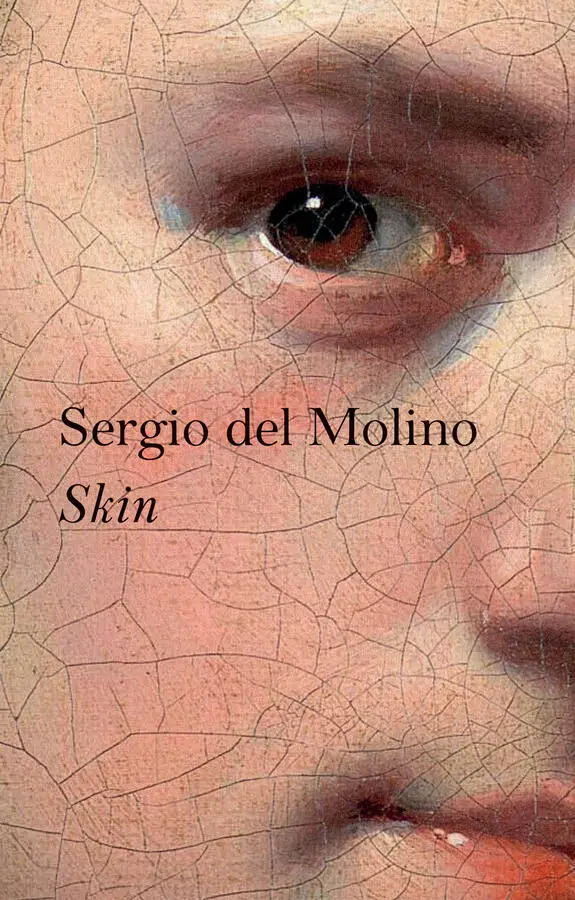
Sergio del Molino - Skin
Здесь есть возможность читать онлайн «Sergio del Molino - Skin» — ознакомительный отрывок электронной книги совершенно бесплатно, а после прочтения отрывка купить полную версию. В некоторых случаях можно слушать аудио, скачать через торрент в формате fb2 и присутствует краткое содержание. Жанр: unrecognised, на английском языке. Описание произведения, (предисловие) а так же отзывы посетителей доступны на портале библиотеки ЛибКат.
- Название:Skin
- Автор:
- Жанр:
- Год:неизвестен
- ISBN:нет данных
- Рейтинг книги:5 / 5. Голосов: 1
-
Избранное:Добавить в избранное
- Отзывы:
-
Ваша оценка:
Skin: краткое содержание, описание и аннотация
Предлагаем к чтению аннотацию, описание, краткое содержание или предисловие (зависит от того, что написал сам автор книги «Skin»). Если вы не нашли необходимую информацию о книге — напишите в комментариях, мы постараемся отыскать её.
In
, Sergio del Molino speaks of these monsters in history and literature, whose lives have been tormented by bad skin: Stalin secretly taking a bath in his dacha, Pablo Escobar getting up late and shutting himself in the shower, Cyndi Lauper performing a commercial for a medicine promising relief from skin disease, John Updike sunburned in the Caribbean, Nabokov writing to his wife from exile, ‘Everything would be fine, if it weren’t for the damned skin.’ As a psoriasis sufferer, Sergio del Molino includes himself in this gallery of monsters through whose stories he delves into the mysteries of skin. What is for some a badge of pride and for others a source of anguish and shame, skin speaks of us and for us when we don’t speak with words.
Skin — читать онлайн ознакомительный отрывок
Ниже представлен текст книги, разбитый по страницам. Система сохранения места последней прочитанной страницы, позволяет с удобством читать онлайн бесплатно книгу «Skin», без необходимости каждый раз заново искать на чём Вы остановились. Поставьте закладку, и сможете в любой момент перейти на страницу, на которой закончили чтение.
Интервал:
Закладка:
Cold water makes flaky skin turn red, and then when it dries, it goes white, and with a day of summer sun it will be camouflaged against the rest of the skin. Only by looking extremely closely when it’s dry can the decolouration be appreciated; but water lights up the blemishes, making the ailment stand out a mile off. It is a brief flash that, in reality, announces that you’re cured – or the pretence that you’re cured, and that is known to those of us with psoriasis as the summer break. The radiation from the sun, the iodine, the salt and minerals in the seawater all combine to set siege to and diminish the plaques, which return only after bathing, between the wrinkles that come from being in the water for a long time. The benefits to the skin of exposure to the sun disappear in the water. We suddenly remember the forgotten curse. In the pool, the monster remembers what it is.
And it is this cardinal iridescence, this way the afflicted person’s skin will throb and importune, that pushes a person to wish for revenge. Only those who are also unwell in this way, like Vishinski, like Yezhov, can understand this unstoppable instinct to exterminate all those smooth-skins, all those who join the throngs in swimming pools and sunbathe without a care that people might stare, all of those who may run their fingers over their skin, from their feet to their faces, without lighting up any prohibited region, and of those small gulags where the most miserable embarrassment is concentrated. From the swimming pool in Sochi, the red throbbing of the wet blemishes transmitted a paranoic code, like the inner voices of the schizophrenic, which gave the order to do away with them all, not to leave a single one alive, until the whole world was crushed together in the already cooling water of that very shallow pool, with the sky above receiving the never-ending smoke from his pipe.
I don’t want you to understand, son, and this is why I don’t dare tell you, that that brilliant red monster in the swimming pool in Sochi is also me.
The Magic Mountain
The story of Stalin in his Sochi swimming pool gives the lie to any hope we might have for the goodness of monsters. In humanity’s efforts to become more civilised, people with deformities have been integrated into society. Monsters have gone from being demons to being creatures in need of more than mere affection. They are to be admired, they’re heroes, the Achilleses of these times of reduced sugar and reduced saturated fats. Poor Frankenstein’s monster, poor Quasimodo, the poor Phantom of the Opera, even poor Freddy Krueger. Misunderstood, marginalised, and nursing wounds, they show us that it’s society that is actually evil and they only act in self-defence, bound to commit the crime like a wild animal at the zoo turning on the children taunting it from beyond the bars. If we’d left them in peace, they wouldn’t have been forced to come and kill us.
Not all of these monsters want for lovers. One of my favourite films is a love story between a female nurse and a lycanthrope. In An American Werewolf in London , David and Jack, two backpackers from the US, are attacked by a werewolf on the English moors. Jack dies, but David survives, and takes on the curse. At the next full moon, he transforms into a bestial creature and begins attacking and devouring people on the streets of London. In the interim, he has fallen in love with Nurse Price (played by the unforgettable Jenny Agutter – also the love of my life), who gradually has to yield to the evidence that her boyfriend is a lycanthrope and not just slightly traumatised by his friend’s death. What makes the film modern, and elucidates the interaction between monsters and my world, is depicted in the final sequence. After a failed suicide attempt, David takes refuge in a porno cinema in Piccadilly Circus, where he turns into the wolf. After a brief killing spree, the police manage to corner him in an alleyway but, before they riddle him with bullets, Nurse Price has a chance to try and save him. She climbs over the police cordon and puts herself between the marksmen and the creature, into whose eyes she looks. For an instant, the wolf seems to recognise her, and hesitates. It’s possible that Nurse Price has penetrated the beast-like exterior and reached into David’s human core. Fortunately, the director of this gem of a film, John Landis, is clever enough to leave the mystery unsolved. The beast dies in the alleyway without our finding out if love could have redeemed it.
Landis, an old soul like me, believes monsters ought to die because they are monsters, and not as some version of the final stage in the hero’s quest, when the clouds part and all humanity’s sins are absolved. Nurse Price’s infatuation is neither lucid nor virginal, but depraved – like all good infatuations – and David is a cowardly egoist who knows full well that the only way to put an end to his homicidal tendencies is to slit his own wrists, and yet he doesn’t dare; he is incapable of sacrificing himself for the common good. There is nothing admirable about him; the wolf dies, and good riddance. And yet, those looking on can’t avoid the thought that the beast is the only true victim of the piece. All those mauled and killed by him deserve it, in some way; they are pathetic types, caught out at unfortunate moments in their lives. The lycanthrope almost does them a favour by rubbing them out of a picture in which they don’t fit, and there is something of the comic skit about their murders. The death of the wolf, however, is tragic, perhaps the only tragic moment in the film. And this is because Landis knows very well that, in order for us to live, we need these critters. We can’t kill them without feeling that we are killing ourselves and that all this evil is actually our own fault.
This is what makes Stalin’s story so dazzling: he is one monster beyond redemption. No Nurse Price is there to look into his eyes during his dying moments, her tears stirring the gentlest parts of his humanity. Stalin reminds us that monsters exist whose evil nature isn’t down to social ills. Teratology – the study of congenital abnormalities – has for centuries been trying to separate physical ugliness from questions of morality, and this has ended up soaking through into literature: monsters with their curses and afflictions have gradually been relegated to pulp and outré forms of fiction, but they have disappeared from the films young lovers go to see at the cinema. There are still the deformed baddies of the Batman franchise, but these are so stylised and metaphorical that we don’t associate them with people who suffer actual deformities. It’s no longer allowed for a dwarf, giant, hunchback, lycanthrope or elephant man to feature in any story, without their being assigned a good or even heroic part.
We can agree that people with skin conditions form a minor chapter in the history of teratology, and that we are able to make our particular monstrousness go unnoticed, but we at the same time comprise one of the most common kinds of monstrousness, and few storytellers have been able to resist adorning their villains with some cutaneous mark, whether it be a scar, a blotch, or some discoloration. Darth Vader is perhaps the last great evil figure with completely obliterated skin, forced to hide it beneath helmet and black cape, but even he redeems himself by saving his son, Luke Skywalker. Not Stalin. Stalin liquidates people in their millions while paddling about in his private pool.
Not only do I find it impossible to separate Stalin’s skin condition from his amoral wickedness; his story forces me to consider my own monstrous condition. What if there is a correlation between the patches of psoriasis on my skin and the way I am in the world? If I believe that Stalin set about slaughtering healthy people after losing the only healthy person he allowed to see him in all his monstrousness – his beloved Kirov – could I not also be an avenger? Of course, I’m no killer, but there are forms of evil that are less crude, subtle and painful, and that don’t lead to a criminal record. Those of us with psoriasis have mastered the art of camouflaging ourselves to ward off unwelcome interest in our plaques. I don’t do it so much out of shame as in order to save others the discomfort and to force them to look me in the eye. Put like this, it almost makes it seem a kind gesture, but what I’m looking for when making others feel comfortable is also a way to make them keep their distance. Very few people are able to penetrate the monster’s carapace and give me the kind of look Nurse Price gives at the end of American Werewolf . Politeness is almost never a building block for trust, and over time I notice myself beginning to comfort myself with a kind of soft misanthropy that could end up becoming cruelty. As I add layers of cotton and fibres over my skin to hide it, my sensitivity to the world is muffled and other people’s problems sound ridiculous to me, strange and minuscule. Anyone wrapped up in their own problems is always a potential mass murderer: if the fate of the world is of no interest to you, you can sign off on its extinction without the slightest quiver, completely guilt-free.
Читать дальшеИнтервал:
Закладка:
Похожие книги на «Skin»
Представляем Вашему вниманию похожие книги на «Skin» списком для выбора. Мы отобрали схожую по названию и смыслу литературу в надежде предоставить читателям больше вариантов отыскать новые, интересные, ещё непрочитанные произведения.












Обсуждение, отзывы о книге «Skin» и просто собственные мнения читателей. Оставьте ваши комментарии, напишите, что Вы думаете о произведении, его смысле или главных героях. Укажите что конкретно понравилось, а что нет, и почему Вы так считаете.