Tommaso Venturini - Controversy Mapping
Здесь есть возможность читать онлайн «Tommaso Venturini - Controversy Mapping» — ознакомительный отрывок электронной книги совершенно бесплатно, а после прочтения отрывка купить полную версию. В некоторых случаях можно слушать аудио, скачать через торрент в формате fb2 и присутствует краткое содержание. Жанр: unrecognised, на английском языке. Описание произведения, (предисловие) а так же отзывы посетителей доступны на портале библиотеки ЛибКат.
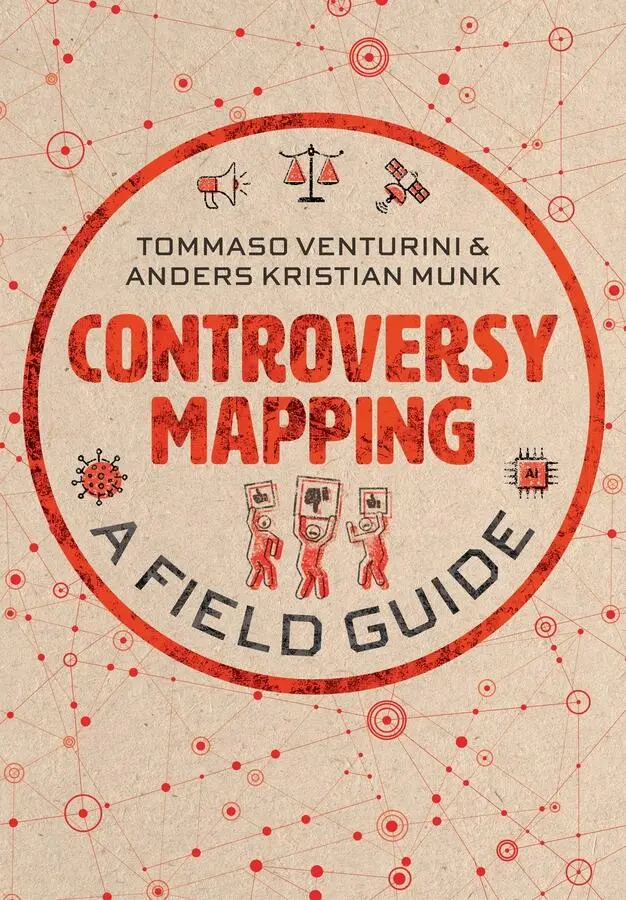
- Название:Controversy Mapping
- Автор:
- Жанр:
- Год:неизвестен
- ISBN:нет данных
- Рейтинг книги:4 / 5. Голосов: 1
-
Избранное:Добавить в избранное
- Отзывы:
-
Ваша оценка:
Controversy Mapping: краткое содержание, описание и аннотация
Предлагаем к чтению аннотацию, описание, краткое содержание или предисловие (зависит от того, что написал сам автор книги «Controversy Mapping»). Если вы не нашли необходимую информацию о книге — напишите в комментариях, мы постараемся отыскать её.
Controversy Mapping A crucial field guide and hands-on companion for the digital age,
is an indispensable resource for students and scholars of media and communication, as well as activists, journalists, citizens, and decision makers.
Controversy Mapping — читать онлайн ознакомительный отрывок
Ниже представлен текст книги, разбитый по страницам. Система сохранения места последней прочитанной страницы, позволяет с удобством читать онлайн бесплатно книгу «Controversy Mapping», без необходимости каждый раз заново искать на чём Вы остановились. Поставьте закладку, и сможете в любой момент перейти на страницу, на которой закончили чтение.
Интервал:
Закладка:
In practice, this often translates into prioritizing issues that are hot at the moment the mapping takes place. It is not impossible to study past disputes by drawing on archives and documents, but it is generally more difficult both conceptually and practically. Conceptually, because once an issue is closed it is difficult to resist the temptation to “naturalize” its outcome and believe that the dispute could not have played out differently. Practically, because the actors will be less willing to offer their testimonies: those who “won” the conflict will present the conclusion as unavoidable; those who lost may prefer to forget about it. The black boxes are closed and few people are motivated to reopen them. Cartographers, in this situation, cannot just “follow” or “monitor” their objects, but are forced to “excavate” and “reconstruct” them.
The same is true, a fortiori, for upcoming issues: everyone expects some new product to revolutionize the market; some new law to wreak havoc once adopted by parliament; some new technology to incur moral objections when developed. Yet, until this actually happens there is little for the controversy mapper to do. The temperature only rises when actors become “sufficiently affected by what is at issue” (Whatmore & Landström, 2011, p. 583).
Commonplace and specialized controversies
While one might be tempted to pick issues that are trending over the media and on everybody’s lips, it is important not to mistake the liveliness of a controversy with its popularity . The mere number of people interested in a debate is not necessarily an indicator of its quality as a mapping subject. In fact, it is often better to stay clear of debates that are too commonplace and instead seek out more specialized discussions, in particular those with an expert component.
This penchant for scientific quarrels is not only a legacy of the STS origins of controversy mapping. Controversies are easier to follow in scholarly disputes than in other arenas. The quarrel about gravitational waves (Collins, 1975) lends itself more easily to the prying eyes of a controversy mapper than, for instance, the quarrel about the complicity of paparazzi and the sensationalist press in the death of Princess Diana (Bishop, 1999). True, one must pay the price of learning the specialized jargon of theoretical physics, but the very specificity of this jargon and the strict definitions of what counts as a valid argument can facilitate the analysis. This does not necessarily mean that scientific discussions are more rational or coherent , but it does mean they tend to abide by more formalized and disciplined rules of argumentation.
“Scientific” should here be understood in the widest possible sense and certainly not restricted to the natural sciences. Disciplines such as ecclesiology, art history, and pedagogy offer great and feasible topics for controversy analysis (see, respectively, Flesseman-van Leer, 1962 on the dispute between Thomas More and William Tyndale; Senie & Webster, 1992 for a whole anthology of controversies surrounding public art; Dworkin & Block, 1976 on the longstanding debate about IQ measures) because they mobilize specialized knowledge, a well-defined research community, and a specific set of actions and arguments. Furthermore, scientific controversies do not necessarily happen within the walls of a laboratory and are not limited to “white coats” (see Lorenzet, 2013, pp. 47–51).
The advice to privilege controversies with an expert component, therefore, is less strict than it sounds. In fact, it is difficult to find a debate that does not concern, at least in part, some field of expertise. We mentioned the coverage of Princess Diana’s death as a “commonplace controversy,” but also provided a reference – Bishop (1999) – proving that even popular debate is indeed studied (and thereby made more legible) by an academic discipline (in this case, Bishop analyzed the debate from the viewpoint of journalism studies, to show how the discussion became the occasion for mainstream journalists to distance themselves from the tabloid press).
Secret and accessible controversies
To be mapped, a dispute must be available for observation. Sensitive or classified issues that have been purposely removed from public scrutiny therefore make difficult topics. This does not mean they are not interesting. It simply means that their investigation would have to overcome some overwhelming odds (Galison, 2005). The discussions around the September 11 attacks, for instance, may be fascinating, but if you do not have access to classified sources, there is little chance that you could study them seriously. If a debate does not disclose new information, then its investigation risks degenerating into a conspiracy theory in which collective dynamics are explained through the deployment of some surreptitious plan rather than as the outcome of many diverging and mutually interfering agendas. As Karl Popper beautifully puts it:
It is one of the striking things about social life that nothing ever comes off as intended. Things always turn out a little bit differently. We hardly ever produce in social life precisely the effect that we wish to produce, and we usually get things that we do not want into the bargain … the people who approach the social sciences with a readymade conspiracy theory thereby deny themselves the possibility of ever understanding what the task of the social sciences is, for they assume that we can explain practically everything in society by asking who wanted it, whereas the real task of the social sciences is to explain those things which nobody wants. (Popper, 2002 [1963], pp. 165–8)
On the contrary, considering controversies that are accessible because close at hand is always a smart move. Controversy mapping is a sort of “secondary analysis” of the scientific debates that other researchers are engaged in. Hence, controversy mappers who work in academia can find great subjects just by interviewing their teachers and colleagues. Likewise, local controversies (e.g., connected to architectural projects; Yaneva, 2011) are often attractive choices, especially if they take place nearby.
Finally, and for reasons directly connected to the point we just made, controversies that develop online are cartographically convenient because they leave digital traces readily at hand for everyone who has a computer. As in the advice to privilege scientific controversies, digital should here be taken in the widest possible sense, and certainly not only limited to dominant platforms. In the last few years, these platforms have grown especially popular among social scientists (and even more among commercial and political marketers) for the way in which their APIs (application programming interfaces) redistribute some of the records they collect. Yet, platforms are by no means the only digital sources that controversy mappers can and should exploit and, depending on the object of research, other datasets may be more interesting.
We are not saying that social media records are useless for social investigation. Quite the contrary! Google, for example, can be suitable for studying the cycles of online attention (Choi & Varian, 2012); Facebook can offer a decent proxy of Web sociability (Rieder, 2013); YouTube can be interesting for comparing mainstream and marginal media discourses (Arthurs et al., 2018; Rieder et al., 2018); Wikipedia is great for studying knowledge debates (Niederer & Van Dijck, 2010; Borra et al., 2014, 2015). Still, digital mapping can and should extend further than social media. It is one of our duties as critical scholars to interrogate and oppose the project of Silicon Valley giants to claim online sociality as their fiefdom. One way we can do this is by refusing to consider the data collected by these corporations as the gold standard of digital traceability and engage in other forms of digital fieldwork (Venturini & Rogers, 2019; Perriam et al., 2020), another is to critically examine the consequences of repurposing their APIs for online controversy mapping (Munk & Olesen, 2020).
Читать дальшеИнтервал:
Закладка:
Похожие книги на «Controversy Mapping»
Представляем Вашему вниманию похожие книги на «Controversy Mapping» списком для выбора. Мы отобрали схожую по названию и смыслу литературу в надежде предоставить читателям больше вариантов отыскать новые, интересные, ещё непрочитанные произведения.







Обсуждение, отзывы о книге «Controversy Mapping» и просто собственные мнения читателей. Оставьте ваши комментарии, напишите, что Вы думаете о произведении, его смысле или главных героях. Укажите что конкретно понравилось, а что нет, и почему Вы так считаете.