Tommaso Venturini - Controversy Mapping
Здесь есть возможность читать онлайн «Tommaso Venturini - Controversy Mapping» — ознакомительный отрывок электронной книги совершенно бесплатно, а после прочтения отрывка купить полную версию. В некоторых случаях можно слушать аудио, скачать через торрент в формате fb2 и присутствует краткое содержание. Жанр: unrecognised, на английском языке. Описание произведения, (предисловие) а так же отзывы посетителей доступны на портале библиотеки ЛибКат.
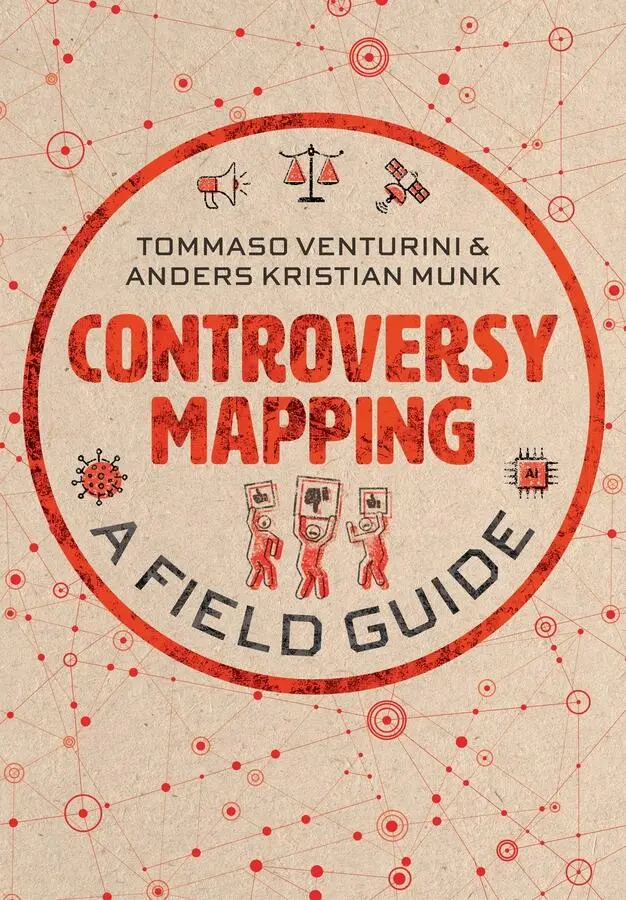
- Название:Controversy Mapping
- Автор:
- Жанр:
- Год:неизвестен
- ISBN:нет данных
- Рейтинг книги:4 / 5. Голосов: 1
-
Избранное:Добавить в избранное
- Отзывы:
-
Ваша оценка:
Controversy Mapping: краткое содержание, описание и аннотация
Предлагаем к чтению аннотацию, описание, краткое содержание или предисловие (зависит от того, что написал сам автор книги «Controversy Mapping»). Если вы не нашли необходимую информацию о книге — напишите в комментариях, мы постараемся отыскать её.
Controversy Mapping A crucial field guide and hands-on companion for the digital age,
is an indispensable resource for students and scholars of media and communication, as well as activists, journalists, citizens, and decision makers.
Controversy Mapping — читать онлайн ознакомительный отрывок
Ниже представлен текст книги, разбитый по страницам. Система сохранения места последней прочитанной страницы, позволяет с удобством читать онлайн бесплатно книгу «Controversy Mapping», без необходимости каждый раз заново искать на чём Вы остановились. Поставьте закладку, и сможете в любой момент перейти на страницу, на которой закончили чтение.
Интервал:
Закладка:
The public does not know in most crises what specifically is the truth or the justice of the case, and men are not agreed on what is beautiful and good … if it had seriously to crusade for justice in every issue it touches, the public would have to be dealing with all situations at the time. That is impossible. (pp. 56, 57)
This is why the public is only the court of “last resort.” Whenever possible, issues should be composed by the actors directly involved. If the actors succeed in reaching a compromise, then their disagreements can be happily ignored by the rest of the world. If they fail, then institutions should step in and facilitate a conciliation. After all, maintaining peace and order is one of the functions of public officers and administrators. However, some controversies are so thorny (and some institutions so inefficient), that no administrative solution succeeds in settling them. It is in these cases that the public, “in all its unfitness,” is called in to arbitrate (with no warranty that its arbitration will be particularly just or enlightened).
Too often such an argument is read as a case against public participation (for example in Schudson, 2008). It is not . It is a heartfelt acknowledgement of the paradox of democracy and of the unfair but necessary burden that it puts on its citizens. The public is a “phantom,” a cohort of men and women called in to judge not because they are in the best position to do so, but because everyone else has failed. Experts cannot agree, decision makers cannot decide, administrations are jammed by conflict. So, the public is dragged in to arbitrate. But the public cannot devote much time to each controversy. Our collective debates are too many and too complicated. It would be illusory to hope that citizens could get to the bottom of all of them. The best the public can do is align its forces behind those actors that appear less partisan and more capable of solving the crises, for “the public will arrive in the middle of the third act and will leave before the last curtain, having stayed just long enough perhaps to decide who is the hero and who the villain of the piece” (Lippmann, 1927, p. 55).
Called in to judge on the most intricate affairs without the necessary time or resources to become experts in them, citizens need brief but accurate cues to detect “the hero and the villain” of the play. According to Lippmann, providing such cues is the ultimate mission of journalism, a mission that, according to Bruno Latour, is shared by controversy mapping.
Can we organize our public life in order to facilitate, through simple and robust signals, the detection of those who, engaged in the inevitable controversies, are the most able to justify their positions or, conversely those who demand that we rely on their arbitrary judgement. If these signals exist, can we multiply them, make them more prominent, learn about them and learn how to maintain them? We have no choice: if these signals are deleted, fade or disappear, there will be no more public life. Democracy will be impossible. The very meaning of politics will disappear for good. (Latour, 2008b, pp. 21–22, our translation)
The third reason for mapping controversies is, then, to help their publics to take sides, not by proposing simple solutions, but by patiently unfolding the multitude of issues and voices that articulate them. We will discuss different political agendas for cartographic interventions in chapter 9; for the moment we will just note that mapmakers can assume different postures. According to authors such as Callon (1999a), Callon et al. (2009) and Latour (2003, 2010b), a good map should facilitate the composition of divergent interests and social programs into a common world. According to others, such as Haraway (1989, 1991) and Law (2004, 2009), such an agenda is too conservative and risks favoring those already in charge instead of empowering those at the margins of the political arena (Munk & Abrahamsson, 2012). Sometimes we might want to denounce the injustices of the status quo and even put up a fight against them. Other times, the best we can do is to help actors work out a more reflexive and inclusive compromise (Dryzek, 2002).

Figure 9 Four criteria for estimating the feasibility of a controversy mapping project. The slider indicates controversies that are easier to map (created by the authors; released by the authors under CC BY-SA 4.0).
Choosing a good controversy
Readers may have noticed that, apart from pointing out how contemporary controversies are related to science and technology and made public through media, we have so far abstained from providing a more precise definition. Controversy mapping is a pragmatic method. It cares less about separating what is controversial from what is not, and more about offering ways to study collective phenomena through the tensions that animate them. Anything in social life that cannot be settled by reference to matters of fact can in principle be described as a controversy and studied through controversy mapping (see, for example, Munk & Ellern, 2015). Any newspaper or scientific journal contains dozens of controversial topics and so do blogs and specialized websites, such as those of engineering associations or scientific societies. Wikipedia has several pages dedicated to controversial subjects, which list thousands of articles. It doesn’t really matter if the topic has already been mapped: controversies are fertile research objects that change across different contexts, evolve over time and can be charted in multiple ways.
However, the fact that almost any situation has a controversial angle does not mean that controversy mapping is equally suited to deal with all of them. In order to choose a good controversy to map, we suggest four criteria, illustrated in figure 9.
Binary and multiple controversies
A place to start when choosing a controversy is to consider the number of positions around which the actors coalesce and the balance between these positions. Sociotechnical debates span a continuum from binary and unbalanced discussions (where an established position is challenged by a skeptic minority) to proliferating debates (where a multitude of different positions oppose each other with no one gaining the upper hand). It is advisable to stay clear of both extremes, but for different reasons.
Controversies that are both binary and very unbalanced can put the map-maker in a particularly difficult position. These are situations in which a small group of actors has an interest in keeping a controversy alive and thereby prevent everyone else from reaching closure and moving on. Here, your complicity as a mapmaker involves favoring that small group of actors by giving the controversy visibility. As STS has long shown, there is no such thing as complete consensus in science and technology. No matter how solid a fact appears to be, there will always be actors contesting it. Think, for instance, of flat-earthers who stubbornly maintain their conviction even in the absence of the smallest shred of evidence (Bach, 2018). In most cases, the existence of such minority reports is happily ignored in view of the significant advantages of keeping black boxes shut. Yet, in some cases, well-organized and well-resourced groups have succeeded in keeping a discussion alive despite the marginality of their position. We alluded to this in the introduction when we argued that the increased visibility of technoscientific controversies derives in part from the effort of industrial lobbies to stall legal regulation by the perpetual mediatization of controversies long since closed in the scientific community. The tobacco-cancer connection (Michaels, 2008) or global warming (Oreskes & Conway, 2008) are classic examples of such strategies, but other cases can be found in Agnotology by Robert Proctor and Londa Schiebinger (2008).
Читать дальшеИнтервал:
Закладка:
Похожие книги на «Controversy Mapping»
Представляем Вашему вниманию похожие книги на «Controversy Mapping» списком для выбора. Мы отобрали схожую по названию и смыслу литературу в надежде предоставить читателям больше вариантов отыскать новые, интересные, ещё непрочитанные произведения.








Обсуждение, отзывы о книге «Controversy Mapping» и просто собственные мнения читателей. Оставьте ваши комментарии, напишите, что Вы думаете о произведении, его смысле или главных героях. Укажите что конкретно понравилось, а что нет, и почему Вы так считаете.