John O'Brien - Earth Materials
Здесь есть возможность читать онлайн «John O'Brien - Earth Materials» — ознакомительный отрывок электронной книги совершенно бесплатно, а после прочтения отрывка купить полную версию. В некоторых случаях можно слушать аудио, скачать через торрент в формате fb2 и присутствует краткое содержание. Жанр: unrecognised, на английском языке. Описание произведения, (предисловие) а так же отзывы посетителей доступны на портале библиотеки ЛибКат.
- Название:Earth Materials
- Автор:
- Жанр:
- Год:неизвестен
- ISBN:нет данных
- Рейтинг книги:5 / 5. Голосов: 1
-
Избранное:Добавить в избранное
- Отзывы:
-
Ваша оценка:
Earth Materials: краткое содержание, описание и аннотация
Предлагаем к чтению аннотацию, описание, краткое содержание или предисловие (зависит от того, что написал сам автор книги «Earth Materials»). Если вы не нашли необходимую информацию о книге — напишите в комментариях, мы постараемся отыскать её.
Earth Materials,
Earth Materials,
Earth Materials — читать онлайн ознакомительный отрывок
Ниже представлен текст книги, разбитый по страницам. Система сохранения места последней прочитанной страницы, позволяет с удобством читать онлайн бесплатно книгу «Earth Materials», без необходимости каждый раз заново искать на чём Вы остановились. Поставьте закладку, и сможете в любой момент перейти на страницу, на которой закончили чтение.
Интервал:
Закладка:
Let us first examine the behavior of silica oversaturated systems with between 78 and 100% silica component. If a cooling melt with silica content between 89 and 100% intersects the liquidus, the first crystals to separate are composed of the high temperature silica polymorph called cristobalite. With continued cooling ( Figure 3.10), more cristobalite separates from the melt, causing its composition to evolve down the liquidus toward lower percentages of silica as the proportion of melt decreases. As the system reaches a temperature of 1470 °C, cristobalite becomes unstable and inverts isothermally to the stable, low temperature polymorph of silica called tridymite. This ideal inversion temperature is shown by the phase boundary between cristobalite and tridymite in the silica plus melt field. With continued cooling below 1470 °C, more tridymite separates from the melt, and melt compositions continue to evolve (with progressively lower silica concentrations) down the liquidus toward the eutectic (E 1) at 1060 °C. Upon reaching the eutectic, both albite and tridymite crystallize simultaneously until the melt is used up and the system enters the solid albite plus tridymite field. For compositions between 78 and 89% silica component, the behavior is similar except that the first crystals to form are tridymite. Final rock compositions can be calculated using the lever rule.
For compositions between ~67% and 78% SiO 2( Figure 3.10), albite crystallizes when the system cools to the liquidus temperature. Continued separation of albite on cooling causes the liquid composition to move down the liquidus toward increasing silica content. As the system cools to the eutectic temperature of 1060 °C, albite and tridymite crystallize simultaneously and isothermally until the melt is used up. The final rock contains both albite and a silica mineral in proportions that can be determined by the lever rule.
Let us now examine the behavior of so‐called silica undersaturated systems with between 0 and 67% silica component. For compositions between 62 and 67% silica, cooling of the system to the liquidus temperature causes albite crystals to separate from the melt ( Figure 3.10). Continued cooling below the liquidus temperature causes further separation of albite from the melt which causes melt compositions to change down the liquidus to the left toward decreasing silica content. As the eutectic temperature (E 2) is reached at 1070 °C, both albite and nepheline crystallize isothermally until the melt is used up. The final rock contains percentages of both albite and nepheline that can be determined by the lever rule. Lastly, for those compositions with 50–62% silica component addressed in the diagram (additional complexities, not shown, exist for systems with lower amounts of silica component), the first crystals to separate are nepheline crystals. Continued separation of silica‐poor nepheline causes melt compositions to change down the liquidus toward the eutectic at 1070 °C. At the eutectic, both albite and nepheline crystallize isothermally until the melt is used up. Once again the final rock is composed of albite and nepheline, and their percentages can be calculated using the lever rule.
3.2.7 Two component phase diagram: forsterite–silica
Another set of mineral relationships is well illustrated by the two‐component system forsterite–silica( Figure 3.11). Forsterite (Mg 2SiO 4) is the magnesium end member of the olivine solid solution series, and the silica mineral is commonly quartz (SiO 2). As in the nepheline–silica system discussed above, this system contains an intermediate compound, in this case the orthopyroxene mineral enstatite (MgSi 2 O 6 ), that can be thought of as being composed of one molecular unit of each of the two end member components (MgSiO 4+ SiO 2= MgSi 2O 6). The horizontal axis in this phase diagram is weight % silica end member component (weight % SiO 2), rather than the molecular proportions used in the nepheline–silica diagram. Temperature increases on the vertical axis. Six phase stability fields are defined: (1) 100% melt, (2) melt + quartz, (3) melt + enstatite, (4) melt + forsterite, (5) forsterite + enstatite, and (6) enstatite + quartz. No solid solution exists between the three minerals in this system (forsterite, enstatite, and quartz). Instead, a discontinuous reactionoccurs between forsterite and enstatite in which early formed minerals react with the melt to produce new minerals at a specific temperature. These reactions occur when the system reaches point P on the liquidus line, the peritectic pointat 1585 °C and 35% silica component. There is also a eutectic point (E) located in the trough in the liquidus where it intersects the solidus at 1540 °C and 46% silica. Let us examine four selected compositions in this system during crystallization, each of which demonstrates different behaviors and/or results.For compositions of >46% silica component by weight, the system behaves as a simple eutectic system. As melts cool to the liquidus, silica (quartz) begins to separate from the melt and continues to separate as the system cools further ( Figure 3.11). This causes the composition of the melt to evolve down the liquidus toward lower silica contents. Upon reaching the eutectic at 1540 °C, both quartz and enstatite crystallize simultaneously until the melt is used up. For compositions of ~35–46% silica that are richer in silica component than the peritectic (P) composition, the system also behaves as a simple eutectic. The only change is that enstatite crystallizes first, causing the liquid to evolve down the solidus toward increasing silica content until it reaches the eutectic. There enstatite and quartz crystallize simultaneously until the system is 100% crystalline. The lever rule can be used to determine phase percentages and compositions for any composition in which two phases coexist.
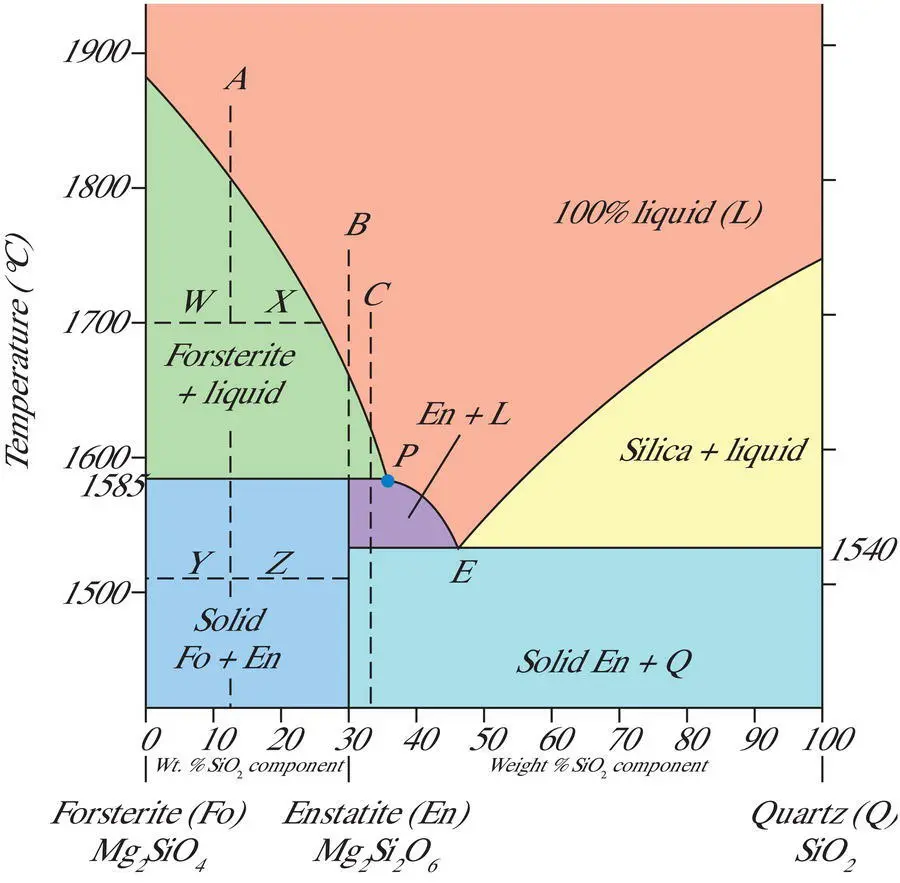
Figure 3.11 Phase diagram for the system forsterite–silica with the intermediate compound enstatite, at atmospheric pressure.
Systems of between 0 and 35% silica component behave somewhat differently because they pass through the peritectic point where reactions occur between forsterite, enstatite, and melt. During cooling and crystallization, three fundamentally different situations can be recognized. For example, with a composition of 12% silica component (dashed line A, Figure 3.11), the system cools to the liquidus at 1810 °C, where forsterite begins to separate. Continued cooling causes additional forsterite to separate from the melt, which causes the melt composition to evolve down the liquidus toward the peritectic. At 1700 °C, the system consists of 50% forsterite crystals (line segment x) and 50% melt (line segment w) with a composition of ~24% silica component as inferred from the lever rule. Further cooling and separation of forsterite crystals cause the melt composition to approach the peritectic point at 1585 °C, where the lever rule shows that the system contains ~66% forsterite and ~34% melt of the peritectic composition 35% silica component. Below this temperature the system enters the 100% solid forsterite plus enstatite field with ~60% forsterite olivine line, as shown by tie‐line segment z) and ~40% enstatite, as shown by tie‐line segment y). So what happens when the melt reaches the peritectic? The percentage of solids increases as the melt is used up, and the percentage of solid forsterite decreases while the percentage of solid enstatite increases dramatically. The percentage of forsterite decreases because some of the forsterite reacts with some of the remaining melt to produce enstatite. Simultaneously the percentage of enstatite increases dramatically because as some olivine is converted to enstatite, new enstatite crystallizes simultaneously from the remaining melt until it is used up. More generally, for all compositions of <30% silica component (enstatite composition), the equilibrium behavior is (1) forsterite crystallization as the melt cools below the liquidus; (2) increasing proportions of olivine and decreasing proportions of melt as the melt cools; (3) evolution of the remaining silica‐enriched melt down the liquidus toward the peritectic; and (4) isothermal conversion of some forsterite to enstatite by discontinuous reaction with the remaining melt at the peritectic accompanied by additional isothermal crystallization of enstatite until the melt is used up. Some forsterite always remains because there is insufficient silica component to convert all of it into the intermediate compound enstatite. This indicates that the system was undersaturated with respect to silica. The peritectic reaction that converts the olivine mineral forsterite to the pyroxene mineral enstatite, as note previously, is called a discontinuous reaction. This phase diagram provides an excellent example of how early formed crystals can react with remaining melt to produce an entirely different mineral. These reactions are characteristic of the minerals in the discontinuous reaction series of Bowen's reaction series ( Chapter 8).
Читать дальшеИнтервал:
Закладка:
Похожие книги на «Earth Materials»
Представляем Вашему вниманию похожие книги на «Earth Materials» списком для выбора. Мы отобрали схожую по названию и смыслу литературу в надежде предоставить читателям больше вариантов отыскать новые, интересные, ещё непрочитанные произведения.










Обсуждение, отзывы о книге «Earth Materials» и просто собственные мнения читателей. Оставьте ваши комментарии, напишите, что Вы думаете о произведении, его смысле или главных героях. Укажите что конкретно понравилось, а что нет, и почему Вы так считаете.