Hermann Dr. Rochholz - Germany's Freefall
Здесь есть возможность читать онлайн «Hermann Dr. Rochholz - Germany's Freefall» — ознакомительный отрывок электронной книги совершенно бесплатно, а после прочтения отрывка купить полную версию. В некоторых случаях можно слушать аудио, скачать через торрент в формате fb2 и присутствует краткое содержание. Жанр: unrecognised, на английском языке. Описание произведения, (предисловие) а так же отзывы посетителей доступны на портале библиотеки ЛибКат.
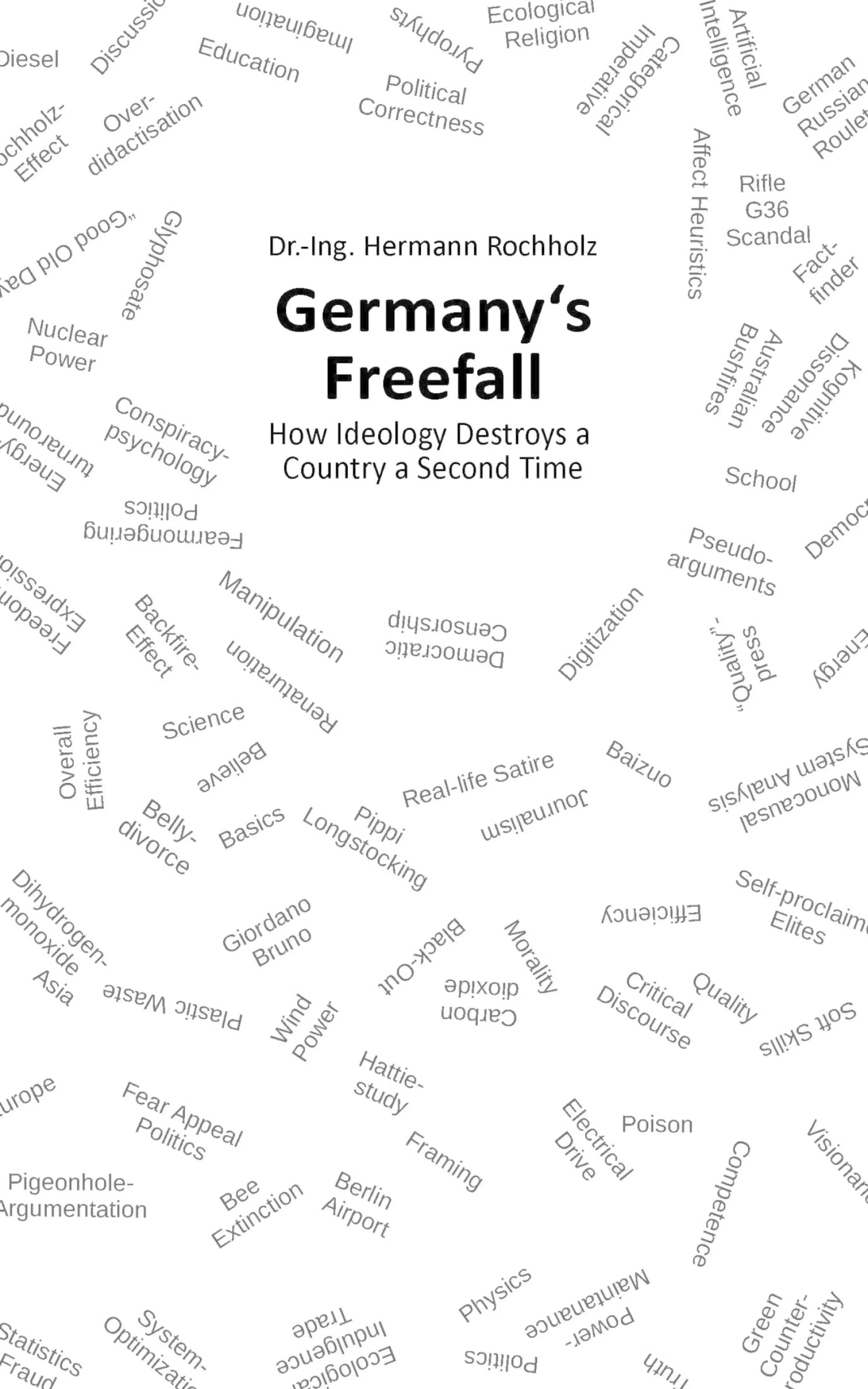
- Название:Germany's Freefall
- Автор:
- Жанр:
- Год:неизвестен
- ISBN:нет данных
- Рейтинг книги:5 / 5. Голосов: 1
-
Избранное:Добавить в избранное
- Отзывы:
-
Ваша оценка:
Germany's Freefall: краткое содержание, описание и аннотация
Предлагаем к чтению аннотацию, описание, краткое содержание или предисловие (зависит от того, что написал сам автор книги «Germany's Freefall»). Если вы не нашли необходимую информацию о книге — напишите в комментариях, мы постараемся отыскать её.
It provides proof with official figures that none of this can work. Several examples with their pitfalls are explained.
Some small calculations are made to show all this (1 page).
Because all this can only be done with ideology, the psychology behind it is unraveled.
Magazine articles are used as examples to show the enormous effort that goes into manipulating the population in Germany.
It is a bit like a textbook explaining how to evaluate «innovations» which are shown as a silver bullet to save the world.
In summary, it shows the means by which Germany is systematically being driven to ruin by green ideology.
Energy is theorized and education is destroyed. Natural sciences are no longer part of German education.
The new democratic censorship is, that journalists modify stories acording their morality.
Engineering basics are already missing in all topics.
To show one result: «renewables» cannot work in Germany because
of the high population density and because of lack of lossless energy storage.
Therefore it makes no sense to compare Germany with other countries with different conditions.
Germany's Freefall — читать онлайн ознакомительный отрывок
Ниже представлен текст книги, разбитый по страницам. Система сохранения места последней прочитанной страницы, позволяет с удобством читать онлайн бесплатно книгу «Germany's Freefall», без необходимости каждый раз заново искать на чём Вы остановились. Поставьте закладку, и сможете в любой момент перейти на страницу, на которой закончили чтение.
Интервал:
Закладка:
The raspberry is a rose plant. If you were to take a blender and examine it for poisons in the laboratory, its sale would be prohibited because it exceeds any poison thresholds [80]. Strange, isn’t it?
The subject of poisons is complex, both from a legislative and a chemical point of view. Actually, you need a chemistry degree to evaluate these. For example, the press wrote that glyphosate was discovered in milk and even in breast milk. An indignant outcry was the response. What I was told, however, was that’s there’s no way (i.e. no metabolism) that glyphosate can get into milk. The mistake, not to overexcite you, was in the detection method: it hadn’t detected glyphosate but its breakdown product, AMPA (aminomethylphosphonic acid). AMPA is an industrial cleaning agent as well. AMPA was detected in micro traces and was thought to come from glyphosate. Milk contains phosphorus as well (by the way, it has more phosphorus than Coca Cola, which is allegedly poisonous from the E150 dye). Hence, a measuring error may have possibly been involved. The detection methods had to be developed first.
How do you arrive at AMPA?
Normally – not at all. This crazy logic is stunning when it comes to abdominal fat: For years, people theorized that the fat that you ingest is deposited directly into the body as abdominal fat. But when you eat something, it first passes through the digestive tract (stomach, intestine) where it’s broken down by enzymes, absorbed by the intestinal wall, then enters the blood to be finally stored as abdominal fat when the energy isn’t required. There’s no metabolism of how glyphosate gets into milk because it would have to float around in the blood and then get into the milk from the mammary glands.
Meanwhile, glyphosate can, as far as I know, be detected directly. Since then, nothing has been detected in milk. No press release corrects these false reports.
As a “normal person”, you have to trust the press releases, which do not report that you can end up in hospital after two glasses of goji berry juice. The “normal” name of the goji berry is “common wolfberry”. That’s a bad sell, like the kiwi. When it began its triumphal march from New Zealand forty years ago, my father exclaimed: “I know that one”, then checked his “Parey” horticultural dictionary and stated: “You see – it’s called a prickly fruit!” A kiwi is a bird. It’s certainly edible, too. But that wouldn’t be politically correct.
The “Poison” Glyphosate
The German press reports that Monsanto was convicted of using glyphosate in America. That’s incorrect: Monsanto was convicted because the company failed to warn the American public in time about the dangers of “Roundup”.
Roundup contains glyphosate as the herbicidal active ingredient. According to Wikipedia, the lethal dose in rats is up to > 5 g per kilogram body weight. 13An 80 kg (176 lb) man would have to consume 400 g (almost 1 lb) to kill himself. In order for glyphosate to be better absorbed by the plant, it needs a wetting agent. The wetting agent, tallowamine, which is only found in the original, American Roundup, has a lethal dose of about 0.9 g per kilogram of body weight. It’s thus about six times more toxic than glyphosate itself.
It’s obvious that excessive use doesn’t make sense because the weeds will become resistant as well, like penicillin. Since glyphosate has a slight antibiotic effect, any excessive use will destroy soil life as well. But this is probably the case with any fertilizer. Glyphosate is an alternative to plowing. This, in turn, is not optimal for soil life either. No system is without its disadvantages.
The German Railway uses tons of glyphosate to keep its tracks free of weeds. It’s the last approved highly effective herbicide. But a problem crops up even here: Applying glyphosate to sealed surfaces isn’t allowed. For example, it’s prohibited to apply glyphosate to paved cycling paths, which develop slits through which a lot of weeds can grow, especially on street corners, which become hazardous when it rains. This increases the risk of falls for cyclists who are on the road in an eco-friendly manner. In track beds, however, glyphosate is only sprayed on the stones. The ban on applying glyphosate to sealed surfaces doesn’t apply here.
The opponents of glyphosate don’t ask what to use instead when it’s prohibited. Since about 2010, when the Monsanto patents expired, it had “become” a poison. In mid-2017, it was discovered that the Deutsche Bahn is its biggest single customer in Germany. On South Tyrolean cycle paths, the agent is used to suppress Mexican grass that destroys the asphalt surface. The choice here is between using glyphosate and re-asphalting the paths every fifteen or eight years – without glyphosate. German vacationers can be seen taking pictures of the apple orchards there. Often, no green stems can be found under these trees. It’s all sprayed away with glyphosate.
Glyphosate hasn’t killed a single person yet in Germany; the risk of cancer is theorized here without one single piece of evidence, although many other substances are considered “probably carcinogenic” as well, and hundreds of people had died from the insecticide E605 in the past.
Psychological Tricks and Manipulations
The following is an example of the methods being currently applied. Science is being misused since valid scientific results are mixed with opinions and psychological tricks. This can be seen in the case of the environmental protection association “Bund e.V.” when it discusses the subject “glyphosate” a.k.a. “Roundup”. The difference isn’t quite clear, which is probably intentional.
The Bund e.V. writes (April 2019):
»What is glyphosate? Glyphosate is the world’s best-selling weed killer and a so-called “total herbicide”. It kills any plant that has not been genetically engineered to survive its use as a herbicide.«
That’s not correct: plants do exist that are not genetically manipulated and don’t react to it.
»Glyphosate is the most widely used herbicide in Germany and the world; it is used on 40 percent of Germany’s arable land.«
That’s correct. But the argument implies that only farmers use this herbicide. It fails to mention that others like Deutsche Bahn is using it to keep the tracks clear.
The statement that glyphosate is the most commonly used herbicide has “wicked industry” undertones. Since glyphosate is the last cheap herbicide ever approved, it should come as no surprise that it’s the most widely used. The passage implies that real alternatives are available, which isn’t correct.
»70 percent of Germans are in favor of a ban on glyphosate. It can be detected in the urine of over 70 percent of Germans.«
Prevailing opinion is of no relevance whatsoever for the evaluation. In a technically oriented society, decisions must be based on facts that represent the best compromise. The argument that 70% of all Germans would be against glyphosate is therefore a pseudo-argument. Glyphosate has not been detectable for a long time, only its degradation product AMPA. It’s a cleaner as well, and a drug against osteoporosis. False reports are thus disseminated in order to argue with public opinion.
Urine is relatively rich in phosphorus. The first synthesis of phosphorus took place with urine when alchemists wanted to produce gold. They discovered the element phosphorus. In AMPA, the “P” stands for phosphorus. This indicates that something incorrect may have been measured here since micro traces of a simple phosphorus compound are supposed to have been detected in urine with its inherently high phosphorus content.
»The German authorities lack the necessary critical distance to the pesticide manufacturers.«
Читать дальшеИнтервал:
Закладка:
Похожие книги на «Germany's Freefall»
Представляем Вашему вниманию похожие книги на «Germany's Freefall» списком для выбора. Мы отобрали схожую по названию и смыслу литературу в надежде предоставить читателям больше вариантов отыскать новые, интересные, ещё непрочитанные произведения.








Обсуждение, отзывы о книге «Germany's Freefall» и просто собственные мнения читателей. Оставьте ваши комментарии, напишите, что Вы думаете о произведении, его смысле или главных героях. Укажите что конкретно понравилось, а что нет, и почему Вы так считаете.