Alan Gunn - Parasitology
Здесь есть возможность читать онлайн «Alan Gunn - Parasitology» — ознакомительный отрывок электронной книги совершенно бесплатно, а после прочтения отрывка купить полную версию. В некоторых случаях можно слушать аудио, скачать через торрент в формате fb2 и присутствует краткое содержание. Жанр: unrecognised, на английском языке. Описание произведения, (предисловие) а так же отзывы посетителей доступны на портале библиотеки ЛибКат.
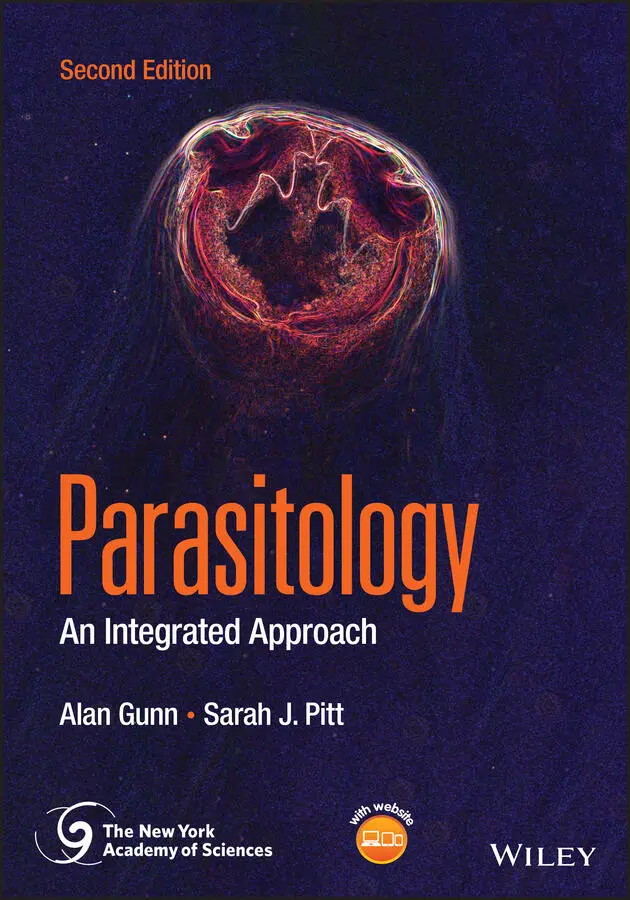
- Название:Parasitology
- Автор:
- Жанр:
- Год:неизвестен
- ISBN:нет данных
- Рейтинг книги:3 / 5. Голосов: 1
-
Избранное:Добавить в избранное
- Отзывы:
-
Ваша оценка:
Parasitology: краткое содержание, описание и аннотация
Предлагаем к чтению аннотацию, описание, краткое содержание или предисловие (зависит от того, что написал сам автор книги «Parasitology»). Если вы не нашли необходимую информацию о книге — напишите в комментариях, мы постараемся отыскать её.
Highly detailed textbook on parasites and parasite relationships Parasitology: An Integrated Approach
Parasitology: An Integrated Approach, 2nd edition
Parasitology — читать онлайн ознакомительный отрывок
Ниже представлен текст книги, разбитый по страницам. Система сохранения места последней прочитанной страницы, позволяет с удобством читать онлайн бесплатно книгу «Parasitology», без необходимости каждый раз заново искать на чём Вы остановились. Поставьте закладку, и сможете в любой момент перейти на страницу, на которой закончили чтение.
Интервал:
Закладка:
There are isolated case reports of Chlorella spp. infecting wounds in humans and other mammals. There are also accounts of fatal disseminated infections in sheep that were presumably acquired via the digestive tract after consuming contaminated drinking water (Ramírez‐Romero et al. 2010). These, presumably, represent rare opportunistic infections. Some species of algae lost their chloroplasts during evolution. Amongst these are members of the genus Prototheca, which includes species that parasitize mammals and the genus Helicosporidium that are parasitic in insects.
4.3.1 Genus Prototheca
Members of this genus are closely related to the well‐known alga Chlorella , but they lack chloroplasts, and most species survive as saprophytes feeding on dead organic matter in a similar manner to free‐living fungi. They are found throughout the world and can be isolated from the soil, slime, sludge, gut contents, faeces, marine and freshwater, swimming pools, and virtually anywhere which has high organic matter content (Kano 2020). Some species are facultative parasites that infect various animal species with consequences that range from mild disease to fatalities. Prototheca wickerhamii and Prototheca zopfii are responsible for most human infections. These are usually associated with patients who are immunocompromised through disease (e.g., HIV infection) or medical treatment (e.g., chemotherapy/ corticosteroid therapy). A new species, Prototheca cutis , was described from a patient in Japan (Satoh et al. 2010) and further species will probably be discovered in the future now that the genus is receiving more attention. In 2018, an outbreak occurred in a cancer chemotherapy unit in India that resulted in 12 patients becoming infected with P. wickerhamii (Khan et al. 2018).
The algae gain entry to the body via the skin – usually through an existing wound – and cause a localised cutaneous infection. This often manifests as dermatitis with the formation of pustules, ulcers, and erythematous plaques. Occasionally, the infection becomes disseminated throughout the body and causes potentially fatal meningitis (Joerger et al. 2020).
There are isolated but increasing case reports of dogs and cats suffering from illnesses caused by Prototheca . These often take the form of gastrointestinal infections that cause diarrhoea, but they can become disseminated elsewhere in the body with often fatal results. In cows, P. wickerhamii , P. zopfii , and Prototheca blaschkeae are responsible for sporadic cases of mastitis in many parts of the world. Protothecosis is not a commonly recognised cause of mastitis, and therefore, it often remains undiagnosed because vets do not think to test for it. This can cause problems because the algae do not respond to normal treatments for mastitis. Indeed, at the time of writing, there was no effective treatment available. Consequently, the course of the disease can be prolonged, and there is a potential for severe economic losses in dairy herds (Jagielski et al. 2019).
4.4 Kingdom Fungi
Some estimates suggest that there may be over a million species of fungi although less than 10% of these have so far been described. Unlike plants, fungi are heterotrophs – that is, they cannot make their own food and must gain their nutrients by breaking down existing organic matter. Most fungi do this by acting as saprophytes, that is, they break down dead organic matter. In addition, many species are in symbiotic relationships with plants and invertebrates, whilst some are parasites of other fungi, plants, and invertebrate and vertebrate animals. Some of these parasitic species are important in human and veterinary medicine, as well as wildlife ecology. For example, Pneumocystis (which was once thought to be a protozoan) is a major cause of morbidity and mortality in AIDS patients (Gilroy and Bennett 2011), the skin disease ‘ringworm’ in cattle is caused not by a helminth but fungi such as Trichophyton verrucosum (Pier et al. 1994), and chytridiomycota fungi are responsible for widespread and catastrophic levels of mortality among amphibians in many parts of the world (Fisher and Garner 2020). However, only the Microsporidia will be covered here.
4.4.1 Phylum Microspora
The Microsporidia are a cosmopolitan group of obligate intracellular parasites that infect many invertebrates and vertebrates. There are even accounts of them infecting protozoa but apparently not plants or fungi. Over 1,200 species have been described, but the majority of these are parasites of invertebrates and fish. Several species are of medical, veterinary, and commercial importance. For example, Nosema apis and Nosema ceranae are major causes of disease in honeybees whilst several species such as Nosema locustae ( vs locusts) and Nosema algerae ( vs mosquitoes) have potential as biological control agents.
Up until the AIDS epidemic, there were few accounts of human infections by microsporidian parasites. However, they subsequently became identified as important causes of morbidity and mortality amongst those suffering from AIDS and other immunosuppressive illnesses. Fourteen species have so far been found to infect humans although Enterocytozoon bieneusi is responsible for most clinical cases. It should be noted that there is considerable genetic variation within individual species that influences their host range (Heyworth 2017). Nevertheless, some microsporidia are undoubtedly zoonotic and infect both humans and other mammals and birds. Indeed, some commentators consider them to be extremely important emerging pathogens (Stentiford et al. 2019). This is particularly the case now that global food chains mean that foodstuffs are rapidly transported around the world.
Initially designated as protozoa, subsequent molecular evidence indicated that microsporidia are fungi. Precisely where they fit within the taxonomy of fungi is uncertain although they show some resemblance to the zygomycetes. The zygomycetes also have relevance to parasitologists since they include genera such as Pilobolus that helps to spread the infective larvae of the lungworm Dictyocaulus viviparus (Doncaster 1981) and Entomophthora that have potential as biological control agents of insect vectors. However, the taxonomic status of the microsporidia is far from settled and Ruggiero et al. (2015) consider that the phylum Microspora belongs back within the kingdom Protista.
As with Entamoeba histolytica , the microsporidia were once thought to have split off from other organisms at an early stage in their evolution because they did not appear to contain mitochondria. However, they too were subsequently found to contain genes with mitochondrial functions and mitosomes (putative relict mitochondria). They also have some of the smallest genome sizes and the fewest protein coding genes of all the eukaryotic organisms; in Encephalitozoon intestinalis the genome is only 2.3 megabases (Mb) in size although in Glugea atherinae , a fish parasite, it is almost ten times larger at ~20 Mb.
The spore is the only microsporidian life cycle stage capable of surviving in the external environment. Immediately above the spore’s plasma membrane are two protective layers, the first of these is the ‘endospore’ which contains chitin and is electron luscent when viewed with a transmission electron microscope and above this is the ‘exospore’ that contains glycoprotein and is electron dense, so it appears dark in transmission electron micrographs ( Figure 4.11). The spore walls must provide excellent protection because in some species they can remain infective for over a year.
Читать дальшеИнтервал:
Закладка:
Похожие книги на «Parasitology»
Представляем Вашему вниманию похожие книги на «Parasitology» списком для выбора. Мы отобрали схожую по названию и смыслу литературу в надежде предоставить читателям больше вариантов отыскать новые, интересные, ещё непрочитанные произведения.










Обсуждение, отзывы о книге «Parasitology» и просто собственные мнения читателей. Оставьте ваши комментарии, напишите, что Вы думаете о произведении, его смысле или главных героях. Укажите что конкретно понравилось, а что нет, и почему Вы так считаете.