Alan Gunn - Parasitology
Здесь есть возможность читать онлайн «Alan Gunn - Parasitology» — ознакомительный отрывок электронной книги совершенно бесплатно, а после прочтения отрывка купить полную версию. В некоторых случаях можно слушать аудио, скачать через торрент в формате fb2 и присутствует краткое содержание. Жанр: unrecognised, на английском языке. Описание произведения, (предисловие) а так же отзывы посетителей доступны на портале библиотеки ЛибКат.
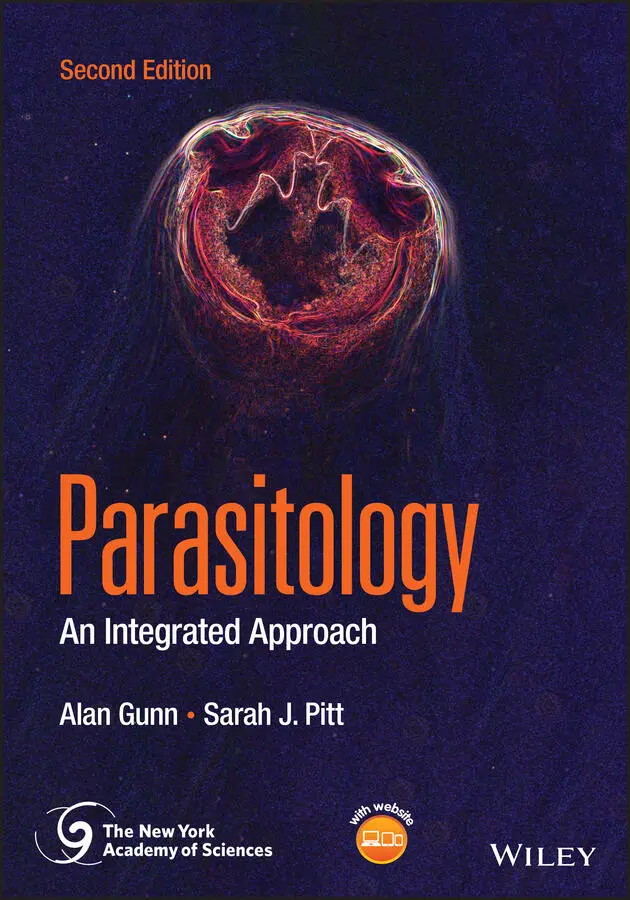
- Название:Parasitology
- Автор:
- Жанр:
- Год:неизвестен
- ISBN:нет данных
- Рейтинг книги:3 / 5. Голосов: 1
-
Избранное:Добавить в избранное
- Отзывы:
-
Ваша оценка:
Parasitology: краткое содержание, описание и аннотация
Предлагаем к чтению аннотацию, описание, краткое содержание или предисловие (зависит от того, что написал сам автор книги «Parasitology»). Если вы не нашли необходимую информацию о книге — напишите в комментариях, мы постараемся отыскать её.
Highly detailed textbook on parasites and parasite relationships Parasitology: An Integrated Approach
Parasitology: An Integrated Approach, 2nd edition
Parasitology — читать онлайн ознакомительный отрывок
Ниже представлен текст книги, разбитый по страницам. Система сохранения места последней прочитанной страницы, позволяет с удобством читать онлайн бесплатно книгу «Parasitology», без необходимости каждый раз заново искать на чём Вы остановились. Поставьте закладку, и сможете в любой момент перейти на страницу, на которой закончили чтение.
Интервал:
Закладка:
At the time of writing, five drugs had approval for the treatment of HAT: pentamidine, suramin, melarsoprol, eflornithine, and nifurtimox. Pentamidine and suramin are used to treat first‐stage HAT whilst melarsoprol (Mel B), eflornithine, and nifurtimox are used for second‐stage HAT. None of the drugs is ideal, and some have serious side effects. For example, suramin can cause anaphylactic shock and kidney failure, whilst melarsoprol can cause seizures and kills 1 in 20 of the patients who receive it. Although the risks might sound unacceptable, in the absence of treatment, there is an extremely high chance that a patient with HAT will die of the disease. Nifurtimox has the advantages of being easier to administer and less toxic than the other drugs but is prescribed as a combination therapy with eflornithine rather than on its own.
A novel group of chemicals called the benzoxaboroles are highly effective at treating stage 2 HAT but currently they still require registration (Jacobs et al. 2011). They also show potential for the treatment of animal trypanosomiasis (Akama et al. 2018). Not only can benzoxaboroles be taken orally (suramin and melarsoprol must be given as a series of intravenous injections) but they also do not produce the harmful side effects of current drugs. The benzoxaboroles also include chemicals that show promise for the treatment of malaria, cryptosporidiosis, filarial nematodes, and bacteria (Lunde et al. 2019; Sonoiki et al. 2017). Consequently, it may eventually become possible to treat co‐infections with a single safe drug.
4.2.2.2 Trypanosoma congolense
Measuring only 9–18 μm in length, T. congolense is the smallest of the African trypanosomes. It is monomorphic although short and long strains also occur. One of its characteristic features is the absence of a free flagellum although the cell tapers finely at the anterior end, so it is possible to believe mistakenly that one is present. The posterior end is blunt and the kinetoplast marginal. The undulating membrane is not pronounced but this together with the absence of a free flagellum does not restrict its ability to move – although authors differ in their opinion about whether its activity is active or sluggish.
Within the blood and lymphatic system of their mammalian host, the trypomastigotes of T. congolense multiply by dividing by longitudinal fission. Several tsetse fly species (e.g., Glossina morsitans ) are responsible for transmitting T. congolense with different species being of particular importance in different areas. Following ingestion by a tsetse fly, the parasites differentiate into procyclic trypomastigotes and undergo a similar migration pattern a sequence of transformations to T. brucei . However, T. congolense does not invade the tsetse fly salivary glands. Instead, the epimastigotes attach themselves to the walls of the proboscis and after transforming into the metacyclic stage, the parasites migrate to the hypopharynx region. As in T. brucei , a form of sexual reproduction occurs in some strains of T. congolense .
Trypanosoma congolense occurs throughout southern, East and West Africa and infects many domestic mammals (e.g., cattle, sheep, horses, pigs, dogs) and wild game (e.g., antelopes, warthogs). Except in unusual circumstances, T. congolense does not present a risk to humans (Truc et al. 2013). In addition, although the trypanolytic activity of normal human serum normally kills T. congolense , some strains are resistant to it (Van Xong et al. 2002).
Trypanosoma congolense is of primary concern for its effect on domestic cattle, and it is a major cause of economic loss to cattle farmers throughout the affected regions. It is less harmful to other domestic animals and wild game. In susceptible cattle, T. congolense causes similar symptoms to T. brucei . Therefore, when farmers say that their animals are suffering from ‘ nagana ’, it could mean that either parasite is the cause. In addition, co‐infections are common. The disease may manifest itself in acute, chronic forms and mild forms. In the acute form, the disease causes anaemia, emaciation and a high parasitaemia in the peripheral circulation. The liver, lymph nodes and spleen enlarge, haemorrhages occur in the heart muscle and kidneys, and the infected animal may die in within 10 weeks of becoming infected. In the chronic form, the symptoms are less severe, and it may be difficult to find the parasites in the blood. There is enlargement of the lymph nodes and liver and signs of degeneration in the kidney, but the infected animal can recover after about a year. In mild infections, it may not be obvious that T. congolense is present. The pathology caused by T. congolense differs from that of T. brucei in that the parasites remain within the circulatory system and the central nervous system is not affected. Anaemia is the most characteristic feature of T. congolense infection and results from the destruction of red blood cells in the liver and spleen although other mechanisms (e.g., inflammatory processes) may also be involved (Noyes et al. 2009). Indigenous breeds of cattle, such as N’dama, are not resistant to T. congolense but have a genetic ability to limit the development of anaemia (Naessens 2006).
4.2.2.3 Trypanosoma evansi
Trypanosoma evansi is monomorphic, 14–33 μm in length and 1.5–2.2 μm in width and morphologically indistinguishable from Trypanosoma equinum , Trypanosoma equiperdum and the slender forms of T. brucei . Molecular evidence suggests that there are two distinct type strains of T. evansi , type A and type B, and there are further strains within each type. Types A and B are distinguished by differences in the minicircles in the kinetoplast DNA. Type A is the most common and widespread form whilst type B occurs in camels in Kenya and Ethiopia. Molecular analyses suggest that both strains probably arose independently from West African T. brucei brucei (Cuypers et al. 2017). If true, this is unexpected because currently, Type B T. evansi only occurs in Eastern Africa.
Trypanosoma evansi has an extremely wide distribution and occurs in Africa, Asia, and Central and South America. It is particularly pathogenic in horses, but it also causes considerable morbidity and mortality in camels, cattle, pigs, dogs, and cats. It also parasitizes many wild animals such as deer, tapir, and capybara. It is usually mechanically transmitted by biting flies such as tabanids and stable flies. Trypanosoma evansi does not reproduce in its insect vectors and they act only as a ‘dirty syringe’. In South America, vampire bats can act as both hosts and mechanical vectors of T. evansi . Under experimental conditions, Raina et al. (1985) infected both dogs and mice by feeding them meat containing T. evansi . The extent to which oral infections occur naturally is, however, uncertain. Reproduction takes place asexually by longitudinal binary fission within the mammalian host.
The disease caused by T. evansi is commonly known as ‘surra’ – which is the Hindi word for ‘rotten’ or ‘emaciated’ although other terms are also used such as el debab in many Arabic‐speaking countries. It causes the death of many thousands of animals every year and a great deal of morbidity (Aregawi et al. 2019). Horses are particularly susceptible to infections, and there are claims that the inoculation of even a single parasite can prove fatal. The disease is often acute in horses and the animal dies within a few weeks to 2 months. Chronic infections lasting over a year may also occur but also often end with the death of the horse. Surra causes anaemia, emaciation, and oedema that may vary from urticarial plaques on the neck and flanks to widespread swelling of the legs and lower body. The plaques may subsequently become necrotic and bleed whilst encephalitis and demyelination can occur in the brain and spinal cord that results in staggering and paralysis. Affected animals may also express abnormal behaviour such as hyperexcitability, head tilting, and circling.
Читать дальшеИнтервал:
Закладка:
Похожие книги на «Parasitology»
Представляем Вашему вниманию похожие книги на «Parasitology» списком для выбора. Мы отобрали схожую по названию и смыслу литературу в надежде предоставить читателям больше вариантов отыскать новые, интересные, ещё непрочитанные произведения.










Обсуждение, отзывы о книге «Parasitology» и просто собственные мнения читателей. Оставьте ваши комментарии, напишите, что Вы думаете о произведении, его смысле или главных героях. Укажите что конкретно понравилось, а что нет, и почему Вы так считаете.