Gerald Durrell - The Corfu Trilogy
Здесь есть возможность читать онлайн «Gerald Durrell - The Corfu Trilogy» весь текст электронной книги совершенно бесплатно (целиком полную версию без сокращений). В некоторых случаях можно слушать аудио, скачать через торрент в формате fb2 и присутствует краткое содержание. Год выпуска: 2006, ISBN: 2006, Издательство: Penguin Books, Жанр: Природа и животные, Биографии и Мемуары, на английском языке. Описание произведения, (предисловие) а так же отзывы посетителей доступны на портале библиотеки ЛибКат.
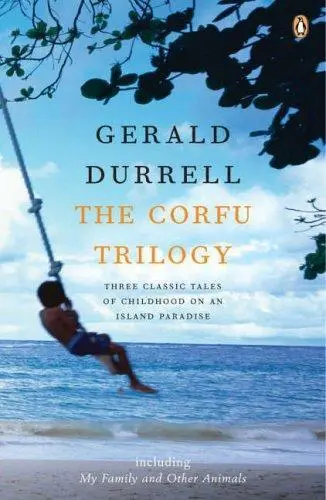
- Название:The Corfu Trilogy
- Автор:
- Издательство:Penguin Books
- Жанр:
- Год:2006
- ISBN:978–0–141–91113–7
- Рейтинг книги:4 / 5. Голосов: 3
-
Избранное:Добавить в избранное
- Отзывы:
-
Ваша оценка:
The Corfu Trilogy: краткое содержание, описание и аннотация
Предлагаем к чтению аннотацию, описание, краткое содержание или предисловие (зависит от того, что написал сам автор книги «The Corfu Trilogy»). Если вы не нашли необходимую информацию о книге — напишите в комментариях, мы постараемся отыскать её.
Durrell dedicated his life to the conservation of wildlife and it is through his efforts that creatures such as the Mauritius pink pigeon and the Mallorcan midwife toad have avoided extinction. Over his lifetime he wrote thirty-seven books, went on dozens of animal-collecting trips and presented numerous tv shows. He founded the Durrell Wildlife Conservation Trust in 1959 as a centre for the conservation of endangered species – of which his wife Lee is still Honorary Director. He was awarded the OBE in 1982.
The Corfu Trilogy
My Family and Other Animals
Birds, Beasts, and Relatives
The Garden of the Gods
The Corfu Trilogy — читать онлайн бесплатно полную книгу (весь текст) целиком
Ниже представлен текст книги, разбитый по страницам. Система сохранения места последней прочитанной страницы, позволяет с удобством читать онлайн бесплатно книгу «The Corfu Trilogy», без необходимости каждый раз заново искать на чём Вы остановились. Поставьте закладку, и сможете в любой момент перейти на страницу, на которой закончили чтение.
Интервал:
Закладка:
I would frown in a desperate attempt to remember something about that county. Kralefsky’s eyes would grow large with anxiety as he watched my mental struggle.
‘Well,’ he would say at length, when it became obvious that my knowledge of Somerset was non-existent – ‘well, let us leave Somerset and try Warwickshire. Now then, Warwickshire. County town? Warwick! That’s the ticket! Now, what do they produce in Warwick, eh?’
As far as I was concerned they did not produce anything in Warwick, but I would hazard a wild guess at coal. I had discovered that if one went on naming a product relentlessly (regardless of the county or town under discussion), sooner or later you would find the answer to be correct. Kralefsky’s anguish at my mistakes was very real; the day I informed him that Essex produced stainless steel there were tears in his eyes. But these long periods of depression were more than made up for by his extreme pleasure and delight when, by some strange chance, I answered a question correctly.
Once a week we tortured ourselves by devoting a morning to French. Kralefsky spoke French beautifully, and to hear me massacring the language was almost more than he could bear. He very soon found that it was quite useless to try to teach me from the normal text-books, so these were set aside in favour of a three-volume set of bird books; but even with these it was uphill going. Occasionally, when we were reading the description of the robin’s plumage for the twentieth time, a look of grim determination would settle on Kralefsky’s face. He would slam the book shut and rush out into the hall, to reappear a minute later wearing a jaunty panama.
‘I think it would freshen us up a little… blow the cobwebs away… if we went for a short walk ,’ he would announce, giving a distasteful glance at Les Petits Oiseaux de l’Europe . ‘I think we will make our way through the town and come back along the esplanade, eh? Excellent! Now, we must not waste time, must we? It will be a good opportunity for us to practise our conversational French, won’t it? So no English, please – everything to be said in French. It is in this way that we become familiar with a language.’
So, in almost complete silence, we would wend our way through the town. The beauty of these walks was that, no matter which direction we set out in, we invariably found ouselves, somehow or other, in the bird market. We were rather like Alice in the looking-glass garden: no matter how determinedly we strode off in the opposite direction, in no time at all we found ourselves in the little square where the stalls were piled high with wicker cages and the air rang with the song of birds. Here French would be forgotten; it would fade away into the limbo to join algebra, geometry, history dates, county towns, and similar subjects. Our eyes sparkling, our faces flushed, we would move from stall to stall, examining the birds carefully and bargaining fiercely with the vendors, and gradually our arms would become laden with cages.
Then we would be brought suddenly back to earth by the watch in Kralefsky’s waistcoat pocket, chiming daintily, and he would almost drop his tottering burden of cages in his efforts to extract the watch and stop it.
‘By Jove! Twelve o’clock! Who would have thought it, eh? Just hold this linnet for me, will you, while I stop the watch… Thank you… We will have to be quick, eh? I doubt whether we can make it on foot, laden as we are. Dear me! I think we had better have a cab. An extravagance, of course, but needs must where the devil drives, eh?’
So we would hurry across the square, pile our twittering, fluttering purchases into a cab and be driven back to Kralefsky’s house, the jingle of the harness and the thud of hooves mingling pleasantly with the cries of our bird cargo.
I had worked for some weeks with Kralefsky before I discovered that he did not live alone. At intervals during the morning he would pause suddenly, in the middle of a sum or a recitation of county towns, and cock his head on one side, as if listening.
‘Excuse me a moment,’ he would say. ‘I must go and see Mother.’
At first this rather puzzled me, for I was convinced that Kralefsky was far too old to have a mother still living. After considerable thought, I came to the conclusion that this was merely his polite way of saying that he wished to retire to the lavatory, for I realized that not everyone shared my family’s lack of embarrassment when discussing this topic. It never occurred to me that, if this was so, Kralefsky closeted himself more often than any other human being I had met. One morning I had consumed for breakfast a large quantity of loquats, and they had distressing effects on me when we were in the middle of a history lesson. Since Kralefsky was so finicky about the subject of lavatories I decided that I would have to phrase my request politely, so I thought it best to adopt his own curious term. I looked him firmly in the eye and said that I would like to pay a visit to his mother.
‘My mother?’ he repeated in astonishment. ‘Visit my mother? Now?’
I could not see what the fuss was about, so I merely nodded.
‘Well,’ he said doubtfully, ‘I’m sure she’ll be delighted to see you, of course, but I’d better just go and see if it’s convenient.’
He left the room, still looking a trifle puzzled, and returned after a few minutes.
‘Mother would be delighted to see you,’ he announced, ‘but she says will you please excuse her being a little untidy?’
I thought it was carrying politeness to an extreme to talk about the lavatory as if it were a human being, but, since Kralefsky was obviously a bit eccentric on the subject, I felt I had better humour him. I said I did not mind a bit if his mother was in a mess, as ours frequently was as well.
‘Ah… er… yes, yes, I expect so,’ he murmured, giving me rather a startled glance. He led me down the corridor, opened a door, and, to my complete surprise, ushered me into a large shadowy bedroom. The room was a forest of flowers; vases, bowls, and pots were perched everywhere, and each contained a mass of beautiful blooms that shone in the gloom like walls of jewels in a green-shadowed cave. At one end of the room was an enormous bed, and in it, propped up on a heap of pillows, lay a tiny figure not much bigger than a child. She must have been very old, I decided as we drew nearer, for her fine, delicate features were covered with a network of wrinkles that grooved a skin as soft and velvety-looking as a baby mushroom’s. But the astonishing thing about her was her hair. It fell over her shoulders in a thick cascade, and then spread half-way down the bed. It was the richest and most beautiful auburn colour imaginable, glinting and shining as though on fire, making me think of autumn leaves and the brilliant winter coat of a fox.
‘Mother dear,’ Kralefsky called softly, bobbing across the room and seating himself on a chair by the bed, ‘Mother dear, here’s Gerry come to see you.’
The minute figure on the bed lifted thin, pale lids and looked at me with great tawny eyes that were as bright and intelligent as a bird’s. She lifted a slender, beautifully shaped hand, weighed down with rings, from the depths of the auburn tresses and held it out to me, smiling mischievously.
‘I am so very flattered that you asked to see me,’ she said in a soft, husky voice. ‘So many people nowadays consider a person of my age a bore.’
Embarrassed, I muttered something, and the bright eyes looked at me, twinkling, and she gave a fluting blackbird laugh, and patted the bed with her hand.
‘Do sit down,’ she invited; ‘do sit down and talk for a minute.’
Gingerly I picked up the mass of auburn hair and moved it to one side so that I could sit on the bed. The hair was soft, silky, and heavy, like a flame-coloured wave swishing through my fingers. Mrs Kralefsky smiled at me, and lifted a strand of it in her fingers, twisting it gently so that it sparkled.
Читать дальшеИнтервал:
Закладка:
Похожие книги на «The Corfu Trilogy»
Представляем Вашему вниманию похожие книги на «The Corfu Trilogy» списком для выбора. Мы отобрали схожую по названию и смыслу литературу в надежде предоставить читателям больше вариантов отыскать новые, интересные, ещё непрочитанные произведения.


Обсуждение, отзывы о книге «The Corfu Trilogy» и просто собственные мнения читателей. Оставьте ваши комментарии, напишите, что Вы думаете о произведении, его смысле или главных героях. Укажите что конкретно понравилось, а что нет, и почему Вы так считаете.