Gerald Durrell - The Corfu Trilogy
Здесь есть возможность читать онлайн «Gerald Durrell - The Corfu Trilogy» весь текст электронной книги совершенно бесплатно (целиком полную версию без сокращений). В некоторых случаях можно слушать аудио, скачать через торрент в формате fb2 и присутствует краткое содержание. Год выпуска: 2006, ISBN: 2006, Издательство: Penguin Books, Жанр: Природа и животные, Биографии и Мемуары, на английском языке. Описание произведения, (предисловие) а так же отзывы посетителей доступны на портале библиотеки ЛибКат.
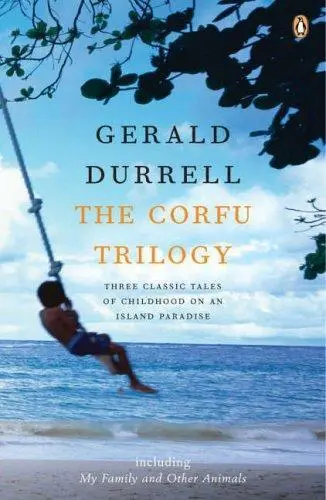
- Название:The Corfu Trilogy
- Автор:
- Издательство:Penguin Books
- Жанр:
- Год:2006
- ISBN:978–0–141–91113–7
- Рейтинг книги:4 / 5. Голосов: 3
-
Избранное:Добавить в избранное
- Отзывы:
-
Ваша оценка:
The Corfu Trilogy: краткое содержание, описание и аннотация
Предлагаем к чтению аннотацию, описание, краткое содержание или предисловие (зависит от того, что написал сам автор книги «The Corfu Trilogy»). Если вы не нашли необходимую информацию о книге — напишите в комментариях, мы постараемся отыскать её.
Durrell dedicated his life to the conservation of wildlife and it is through his efforts that creatures such as the Mauritius pink pigeon and the Mallorcan midwife toad have avoided extinction. Over his lifetime he wrote thirty-seven books, went on dozens of animal-collecting trips and presented numerous tv shows. He founded the Durrell Wildlife Conservation Trust in 1959 as a centre for the conservation of endangered species – of which his wife Lee is still Honorary Director. He was awarded the OBE in 1982.
The Corfu Trilogy
My Family and Other Animals
Birds, Beasts, and Relatives
The Garden of the Gods
The Corfu Trilogy — читать онлайн бесплатно полную книгу (весь текст) целиком
Ниже представлен текст книги, разбитый по страницам. Система сохранения места последней прочитанной страницы, позволяет с удобством читать онлайн бесплатно книгу «The Corfu Trilogy», без необходимости каждый раз заново искать на чём Вы остановились. Поставьте закладку, и сможете в любой момент перейти на страницу, на которой закончили чтение.
Интервал:
Закладка:
I was surprised, for I had never looked upon toads as being particularly long-lived creatures. I asked Theodore what the usual age was that they attained.
‘Well, it’s difficult to say… um… there are no statistics to go on,’ he pointed out, his eyes twinkling, ‘but I should imagine that ones as large as these might well be twelve or even twenty years old. They seem to have a great tenacity for life. I have read somewhere of toads being walled up in houses and so forth, and it appears that they must have been confined like that for a number of years. In one case I believe it was something like twenty-five years.’
He lifted the other toad out of the box and set it down beside its companion. They sat side by side, gulping and blinking, their flabby sides wobbling as they breathed. Theodore contemplated them fully for a moment, and then took a pair of forceps out of his waistcoat pocket. He strode into the garden and overturned several rocks until he found a large, moist, and liver-coloured earthworm. He picked it up neatly with his forceps and strode back to the veranda. He stood over the toads and dropped the writhing earthworm onto the stone flags. It coiled itself into a knot, and then slowly started to unravel itself. The nearest toad lifted its head, blinked its eyes rapidly, and turned slightly so that it was facing the worm. The worm continued to writhe like a piece of wool on a hot coal. The toad bent forward, staring down at it with an expression of extreme interest on its broad face.
‘Ah-ha!’ said Theodore, and smiled in his beard.
The worm performed a particularly convulsive figure eight, and the toad leaned farther forward with excitement. Its great mouth opened, the pink tongue flicked out, and the forepart of the worm was carried into the gaping maw. The toad shut its mouth with a snap, and most of the worm, which hung outside, coiled about wildly. The toad sat back and with great care proceeded to stuff the tail end of the worm into its mouth, using its thumbs. As each section of thrashing worm was pushed in, the toad would gulp hard, closing its eyes with an expression as if of acute pain. Slowly but surely, bit by bit, the worm disappeared between the thick lips, until at last there was only a fraction of an inch dangling outside, twitching to and fro.
‘Um,’ said Theodore in an amused tone of voice. ‘I always like watching them do that. It reminds me of those conjurers, you know, that pull yards and yards of tapes or coloured ribbons out of their mouths… er… only, of course, the other way round .’
The toad blinked, gulped desperately, its eyes screwed up, and the last bit of worm disappeared inside its mouth.
‘I wonder,’ said Theodore meditatively, his eyes twinkling – ‘I wonder if one could teach toads to swallow swords? It would be interesting to try.’
He picked up the toads carefully and replaced them in their box.
‘Not sharp swords, of course,’ he said, straightening up and rocking on his toes, his eyes gleaming. ‘If the swords were sharp you might get your toad in a hole .’
He chuckled quietly to himself, rasping the side of his beard with his thumb.
14
The Talking Flowers
It was not long before I received the unwelcome news that yet another tutor had been found for me. This time it was a certain individual named Kralefsky, a person descended from an intricate tangle of nationalities but predominantly English. The family informed me that he was a very nice man and was, moreover, interested in birds, so we should get on together. I was not, however, the least impressed by this last bit of information; I had met a number of people who professed to be interested in birds, and who had turned out (after careful questioning) to be charlatans who did not know what a hoopoe looked like, or could not tell the difference between a black redstart and an ordinary one. I felt certain that the family had invented this bird-loving tutor simply in an effort to make me feel happier about having to start work once again. I was sure that his reputation as an ornithologist would turn out to have grown from the fact that he once kept a canary when he was fourteen. Therefore I set off for town to my first lesson in the gloomiest possible frame of mind.
Kralefsky lived in the top two storeys of a square, mildewed old mansion that stood on the outskirts of the town. I climbed the wide staircase and, with disdainful bravado, rapped a sharp tattoo on the knocker that decorated the front door. I waited, glowering to myself and digging the heel of my shoe into the wine-red carpet with considerable violence; presently, just as I was about to knock again, there came the soft pad of footsteps, and the front door was flung wide to reveal my new tutor.
I decided immediately that Kralefsky was not a human being at all, but a gnome who had disguised himself as one by donning an antiquated but very dapper suit. He had a large, egg-shaped head with flattened sides that were tilted back against a smoothly rounded hump-back. This gave him the curious appearance of being permanently in the middle of shrugging his shoulders and peering up into the sky. A long, fine-bridged nose with widely flared nostrils curved out of his face, and his extremely large eyes were liquid and of a pale sherry colour. They had a fixed, faraway look in them, as though their owner were just waking up out of a trance. His wide, thin mouth managed to combine primness with humour, and now it was stretched across his face in a smile of welcome, showing even but discoloured teeth.
‘Gerry Durrell?’ he asked, bobbing like a courting sparrow, and flapping his large, bony hands at me. ‘Gerry Durrell, is it not? Come in, my dear boy, do come in.’
He beckoned me with a long forefinger, and I walked past him into the dark hall, the floorboards creaking protestingly under their mangy skin of carpet.
‘Through here; this is the room we shall work in,’ fluted Kralefsky, throwing open a door and ushering me into a small, sparsely furnished room. I put my books on the table and sat down in the chair he indicated. He leaned over the table, balancing on the tips of his beautifully manicured fingers, and smiled at me in a vague way. I smiled back, not knowing quite what he expected.
‘Friends!’ he exclaimed rapturously. ‘It is most important that we are friends. I am quite, quite certain we will become friends, aren’t you?’
I nodded seriously, biting the inside of my cheeks to prevent myself from smiling.
‘Friendship,’ he murmured, shutting his eyes in ecstasy at the thought, ‘friendship! That’s the ticket!’
His lips moved silently, and I wondered if he was praying, and if so whether it was for me, himself, or both of us. A fly circled his head and then settled confidently on his nose. Kralefsky started, brushed it away, opened his eyes, and blinked at me.
‘Yes, yes, that’s it,’ he said firmly; ‘I’m sure we shall be friends. Your mother tells me that you have a great love of natural history. This, you see, gives us something in common straight away… a bond, as it were, eh?’
He inserted a forefinger and thumb into his waistcoat pocket, drew out a large gold watch, and regarded it reproachfully. He sighed, replaced the watch, and then smoothed the bald patch on his head that gleamed like a brown pebble through his licheny hair.
‘I am by way of being an aviculturist, albeit an amateur,’ he volunteered modestly. ‘I thought perhaps you might care to see my collection. Half an hour or so with the feathered creatures will, I venture to think, do us no harm before we start work. Besides, I was a little late this morning, and one or two of them need fresh water.’
Читать дальшеИнтервал:
Закладка:
Похожие книги на «The Corfu Trilogy»
Представляем Вашему вниманию похожие книги на «The Corfu Trilogy» списком для выбора. Мы отобрали схожую по названию и смыслу литературу в надежде предоставить читателям больше вариантов отыскать новые, интересные, ещё непрочитанные произведения.


Обсуждение, отзывы о книге «The Corfu Trilogy» и просто собственные мнения читателей. Оставьте ваши комментарии, напишите, что Вы думаете о произведении, его смысле или главных героях. Укажите что конкретно понравилось, а что нет, и почему Вы так считаете.