Mary Roach - Stiff
Здесь есть возможность читать онлайн «Mary Roach - Stiff» весь текст электронной книги совершенно бесплатно (целиком полную версию без сокращений). В некоторых случаях можно слушать аудио, скачать через торрент в формате fb2 и присутствует краткое содержание. Город: New York, Год выпуска: 2003, ISBN: 2003, Издательство: Viking, Жанр: sci_popular, История, на английском языке. Описание произведения, (предисловие) а так же отзывы посетителей доступны на портале библиотеки ЛибКат.
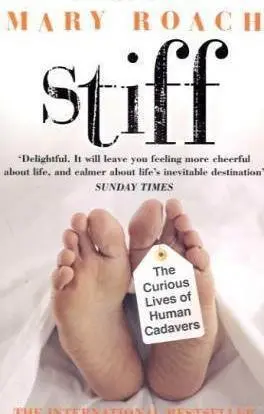
- Название:Stiff
- Автор:
- Издательство:Viking
- Жанр:
- Год:2003
- Город:New York
- ISBN:0-670-91217-4
- Рейтинг книги:4 / 5. Голосов: 2
-
Избранное:Добавить в избранное
- Отзывы:
-
Ваша оценка:
Stiff: краткое содержание, описание и аннотация
Предлагаем к чтению аннотацию, описание, краткое содержание или предисловие (зависит от того, что написал сам автор книги «Stiff»). Если вы не нашли необходимую информацию о книге — напишите в комментариях, мы постараемся отыскать её.
—
Stiff In this fascinating, ennobling account, Mary Roach visits the good deeds of cadavers over the centuries—from the anatomy labs and human-sourced pharmacies of medieval and nineteenth-century Europe to a human decay research facility in Tennessee, to a plastic surgery practice lab, to a Scandinavian funeral directors’ conference on human composting. In her droll, inimitable voice, Roach tells the engrossing story of our bodies when we are no longer with them.
Stiff — читать онлайн бесплатно полную книгу (весь текст) целиком
Ниже представлен текст книги, разбитый по страницам. Система сохранения места последней прочитанной страницы, позволяет с удобством читать онлайн бесплатно книгу «Stiff», без необходимости каждый раз заново искать на чём Вы остановились. Поставьте закладку, и сможете в любой момент перейти на страницу, на которой закончили чтение.
Интервал:
Закладка:
With improvements in stethoscopes and gains in medical knowledge, physicians began to trust themselves to be able to tell when a heart had stopped, and medical science came to agree that this was the best way to determine whether a patient had checked out for good or was merely down the hall getting ice. Placing the heart center stage in our definition of death served to give it, by proxy, a starring role in our definition of life and the soul, or spirit or self. It has long had this anyway, as evidenced by a hundred thousand love songs and sonnets and I ♥ bumper stickers.
The concept of the beating-heart cadaver, grounded in a belief that the self resides in the brain and the brain alone, delivered a philosophical curveball. The notion of the heart as fuel pump took some getting used to.
The seat-of-the-soul debate has been ongoing some four thousand years. It started out not as a heart-versus-brain debate, but as heart-versus-liver.
The ancient Egyptians were the original heart guys. They believed that the ka resided in the heart. Ka was the essence of the person: spirit, intelligence, feelings and passions, humor, grudges, annoying television theme songs, all the things that make a person a person and not a nematode. The heart was the only organ left inside a mummified corpse, for a man needed his ka in the afterlife. The brain he clearly did not need: cadaver brains were scrambled and pulled out in globs, through the nostrils, by way of a hooked bronze needle. Then they were thrown away. (The liver, stomach, intestines, and lungs were taken out of the body, but kept: They were stored in earthen jars inside the tomb, on the assumption, I guess, that it is better to overpack than to leave something behind, particularly when packing for the afterlife.)
The Babylonians were the original liver guys, believing the organ to be the source of human emotion and spirit. The Mesopotamians played both sides of the argument, assigning emotion to the liver and intellect to the heart. These guys clearly marched to the beat of a freethinking drummer, for they assigned a further portion of the soul (cunning) to the stomach.
Similar freethinkers throughout history have included Descartes, who wrote that the soul could be found in the walnut-sized pineal gland, and the Alexandrian anatomist Strato, who decided it lived “behind the eyebrows.”
With the rise of classical Greece, the soul debate evolved into the more familiar heart-versus-brain, the liver having been demoted to an accessory role. [28] We are fortunate that this is so, for we would otherwise have been faced with Celine Dion singing “My Liver Belongs to You” and movie houses playing The Liver Is a Lonely Hunter . Every Spanish love song that contains the word corazon , which is all of them, would contain the somewhat less lilting higado , and bumper stickers would proclaim, “I [liver symbol] my Pekingese.”
Though Pythagorus and Aristotle viewed the heart as the seat of the soul—the source of “vital force” necessary to live and grow—they believed there to be a secondary, “rational” soul, or mind, located in the brain. Plato agreed that both the heart and the brain were soul terrain, but assigned primacy to the brain. Hippocrates, for his part, seemed confused (or perhaps it’s me). He noted the effects of a crushed brain upon speech and intelligence, yet referred to it as a mucus-secreting gland, and wrote elsewhere that intelligence and “heat,” which he said controlled the soul, were located in the heart.
The early anatomists weren’t able to shed much light on the issue, as the soul wasn’t something you could see or set your scalpel to. Lacking any scientific means of pinning down the soul, the first anatomists settled on generative primacy: What shows up first in the embryo must be most important and therefore most likely to hold the soul. The trouble with this particular avenue of learning, known as ensoulment, was that early first-trimester human embryos were difficult to come by. Classical scholars of ensoulment, Aristotle among them, attempted to get around the problem by examining the larger, more easily obtained poultry embryo. To quote Vivian Nutton, author of “The Anatomy of the Soul in Early Renaissance Medicine” in The Human Embryo , “Analogies drawn from the inspection of hen’s eggs foundered on the objection that man was not a chicken.”
According to Nutton, the man who came closest to actually examining a human embryo was an anatomist named Realdo Colombo, who, at the behest of the Renaissance philosopher Girolamo Pontano, [29] I’d never heard of him, either.
dissected a one-month-old fetus. Colombo returned from his lab—which in all likelihood was not equipped with a microscope, as the device had barely been invented—bearing the fascinating if flat-out wrong news that the liver formed before the heart.
Living amid our culture’s heart-centric rhetoric, the valentines and the pop song lyrics, it is hard to imagine assigning spiritual or emotional sovereignty to the liver. Part of the reason for its exalted status among the early anatomists was that they erroneously believed it to be the origin of all the body’s blood vessels. (William Harvey’s discovery of the circulatory system dealt the liver-as-seat-of-the-soul theory a final fatal blow; Harvey, you will not be surprised to hear, believed that the soul was carried in the blood.) I think it was something else too. The human liver is a boss-looking organ. It’s glossy, aerodynamic, Olympian. It looks like sculpture, not guts. I’ve been marveling at H’s liver, currently being prepped for its upcoming journey. The organs around it are amorphous and unappealing. Stomachs are flappy, indistinct; intestines, chaotic and soupy. Kidneys skulk under bundles of fat. But the liver gleams. It looks engineered and carefully wrought. Its flanks have a subtle curve, like the horizon seen from space. If I were an ancient Babylonian, I guess I might think God splashed down here too.
Dr. Posselt is isolating the vessels and connectors on the liver and kidneys, prepping them for the organs’ removal. The heart will go first—hearts remain viable only four to six hours; kidneys, by contrast, can be held in cold storage eighteen or even twenty-four hours—but the heart recovery surgeon hasn’t arrived. He’s flying in from Utah.
Minutes later a nurse puts her head through the OR doors. “Utah’s in the building.” People who work in ORs talk to each other in the truncated, slang-heavy manner of pilots and flight control types. The schedule on the OR wall lists today’s procedure—the removal of four vital organs in preparation for death-defying transplantation into three desperate human beings—as “Recovery abdm (liv/kid x2) ♥.” A few minutes ago, someone made reference to “the panky,” meaning “the pancreas.”
“Utah’s changing.”
Utah is a gentle-looking man of perhaps fifty, with graying hair and a thin, tanned face. He has finished changing and a nurse is snapping on his gloves. He looks calm, competent, even a little bored. (This just slays me. The man is about to cut a beating heart out of a human chest.) The heart has been hidden until now behind the pericardium, a thick protective sac which Dr. Posselt now cuts away.
There is her heart. I’ve never seen one beating. I had no idea they moved so much. You put your hand on your heart and you picture something pulsing slightly but basically still, like a hand on a desktop tapping Morse code. This thing is going wild in there. It’s a mixing-machine part, a stoat squirming in its burrow, an alien life form that’s just won a Pontiac on The Price Is Right . If you were looking for the home of the human body’s animating spirit, I could imagine believing it to be here, for the simple reason that it is the human body’s most animated organ.
Читать дальшеИнтервал:
Закладка:
Похожие книги на «Stiff»
Представляем Вашему вниманию похожие книги на «Stiff» списком для выбора. Мы отобрали схожую по названию и смыслу литературу в надежде предоставить читателям больше вариантов отыскать новые, интересные, ещё непрочитанные произведения.







Обсуждение, отзывы о книге «Stiff» и просто собственные мнения читателей. Оставьте ваши комментарии, напишите, что Вы думаете о произведении, его смысле или главных героях. Укажите что конкретно понравилось, а что нет, и почему Вы так считаете.