Clara Park - Exiting Nirvana
Здесь есть возможность читать онлайн «Clara Park - Exiting Nirvana» весь текст электронной книги совершенно бесплатно (целиком полную версию без сокращений). В некоторых случаях можно слушать аудио, скачать через торрент в формате fb2 и присутствует краткое содержание. ISBN: , Жанр: Психология, на английском языке. Описание произведения, (предисловие) а так же отзывы посетителей доступны на портале библиотеки ЛибКат.
- Название:Exiting Nirvana
- Автор:
- Жанр:
- Год:неизвестен
- ISBN:0-316-69117-8
- Рейтинг книги:4 / 5. Голосов: 1
-
Избранное:Добавить в избранное
- Отзывы:
-
Ваша оценка:
Exiting Nirvana: краткое содержание, описание и аннотация
Предлагаем к чтению аннотацию, описание, краткое содержание или предисловие (зависит от того, что написал сам автор книги «Exiting Nirvana»). Если вы не нашли необходимую информацию о книге — напишите в комментариях, мы постараемся отыскать её.
All illustrations are by Jessy Park.
Exiting Nirvana — читать онлайн бесплатно полную книгу (весь текст) целиком
Ниже представлен текст книги, разбитый по страницам. Система сохранения места последней прочитанной страницы, позволяет с удобством читать онлайн бесплатно книгу «Exiting Nirvana», без необходимости каждый раз заново искать на чём Вы остановились. Поставьте закладку, и сможете в любой момент перейти на страницу, на которой закончили чтение.
Интервал:
Закладка:
Even while admiring Jessy’s increasing competence, we mourned the vanished strangeness. But the art of normal children, too, loses its freshness when the demands of realism take over, and few children regain it. Perhaps, we reflected, we should welcome Jessy’s academic realism as normal development, not regret it as a sacrifice. After all, we had no plans to make her into an artist.
We couldn’t have guessed how time, and luck, would bring everything together — luck and the principle of numerical reinforcement. We took Jessy to an autism meeting where I was making a speech. She was already twenty-one, too old for the children’s activities provided, and I suggested she sketch to keep her busy. She made an accurate, ugly sketch of the ugly building we were meeting in, a man who’d heard my speech offered five dollars for it, and that’s what started her career. A later chapter will describe how in her teenage years she’d worked for «points» to build skills and improve behavior. Money worked the same way. For years she had had no reason to paint or draw. Concepts of creativity or fame, of course, were meaningless. Money didn’t mean much more. But numbers did, and she liked to see them rise in her checkbook. The staff at the Society for Autistic Children were very kind; they gave her a little exhibition, and sketches and school paintings were sold for small sums. The glorious colors began to come back, and then to proliferate. Perhaps she remembered a school exercise from years before, when she had been told to paint a snow scene, first in its natural white and evergreen, then in whatever colors fantasy might suggest. Who knows? At any rate, Jessy was drawing again, not because she was told to but because she wanted to. Once more she was finding her own subject matter. She drew, then painted, not snow landscapes, still less portraits or even buildings; she drew radio dials, speedometers and mileage gauges, clocks, heaters, and electric blanket controls. People with autism like such things. Jessy’s fascination gave these new paintings an intensity that her academic drawings had lacked. Not that these weren’t realistic, but a dial is more than a dial when it is realized in apricot and turquoise. Jessy’s dials and gauges dazzled; her heaters throbbed with color as in a dream, transfiguring the simple grid perceived by her geometrizing eye. Sometimes they achieved an instant surrealism; what more natural than to honor three enthusiasms together? So against an electric blue she combined a rock group logo, an album title, and a heater, to yield the bizarrerie of Bockamp Heater with Women and Children First.
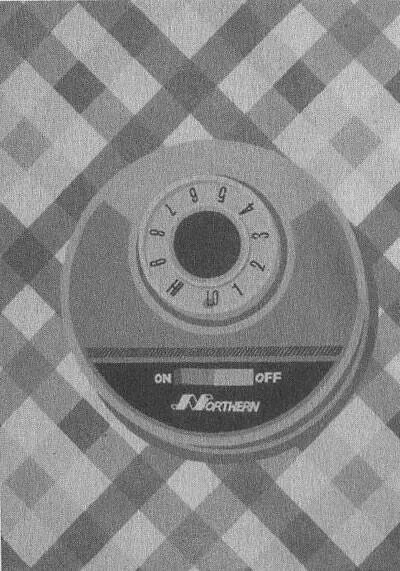
Electric blanket controls, in an untitled painting by Jessy
Jessy had reverted to the abstract patterns of her childhood. But now they were abstractions in the true sense — patterns perceived in, drawn from, abstracted from, the visible world. There was a window in a house near us; through it, by some architectural quirk, a chimney could be seen, right up against the glass. Fascinated by the pattern of the bricks, Jessy painted it four times: first just the chimney; then the chimney and the window; then chimney, window, and roof; finally chimney, window, roof, and the night sky with stars.
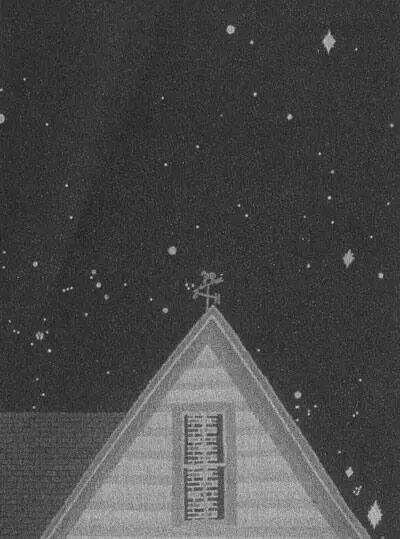
Jessy Park: Dagmar's House with Chimney in the Window, 1984
People liked the dials and heaters; if we’d lived in New York they’d have gone over big as pop art. But art, for an autistic person, can be a vehicle of social learning. Jessy had already learned, reluctantly, that people won’t buy just anything, that she had to put time into her work; now she learned that though people like dials and heaters, most of them prefer houses, trees, and stars. She had begun to spend hours poring over the Field Guide to the Stars; astronomy was a new obsession. Jessy wanted to paint a starry sky, but she didn’t know how she could paint the house and the chimney when everything was dark. She needed the support of tactful suggestion — tactful, for she had become very sensitive to what she perceived as criticism. Honoring surrealism and strangeness, her father showed her Magritte’s painting of an evening street scene against a bright sunny sky; reversing Magritte, she could keep the house in the daylight yellow of her earlier versions and still have stars above. So she painted the sky «purple-black», and Orion with Betelgeuse and Rigel in their correct colors and magnitudes, and Venus. A friend saw it and wanted one like it. Of course Jessy could have made another chimney in the window; she never minded repetition. But we suggested she tailor it to her client, an astronomer specializing in the Southern Hemisphere. So Jessy painted the professor’s house with the Magellanic Cloud and the Southern Cross, and from then on her path was clear.
That was almost twenty years ago, and art has continued to make its contribution to Jessy’s social education. Back then she was indifferent to praise of her paintings; now she smiles in pleasure. She likes it when people come to see her work. She can tolerate the interruption; she can even tolerate making one of the mistakes she calls a «painto», a word she invented on the analogy of «typo» (to be joined immediately by «cooko», «bake-o», and «speako»). Paintos used to elicit the banshee wail, even when they could be fixed easily with a stroke of the brush. It’s not the ease of repair that counts if you’re autistic, it’s the simple fact of error, in a world that seems controllable only when things go exactly according to plan.
Exactly; that’s the word. There is no vagueness in her painting, no dashing brushwork, no atmospheric washes. It’s hard-edge stuff; it always has been. No impressionism for Jessy, and no expressionism either. Even in nursery school she never overlapped one color on another, never scrubbed them together into lovely, messy mud. There were no free splashes, no drips, no finger paints. Her very first paintings were as autistic as these today.
Her art is autistic in other ways too. Autistic literalism has its visual equivalent; Jessy’s eye acts like a camera. Should we be surprised? Jessy is the seventh autistic person to come to my attention who drew in perspective before the age of eight. Perspective drawing seems to us a mark of artistic sophistication; we know that European artists did not master it until the Renaissance. Yet if we consider art historian E. H. Gombrich’s insight that the normal child draws not what it sees but what it knows — not its perception of the thing but the idea of the thing — we need not wonder at the ability of some autistic people to draw in perspective, even when severely retarded. Cameras do not ponder, they record.
And there is the lack of shading. Only in the last ten years has Jessy learned to gradually alter an expanse of color to make it seem to recede or appear round. Even so, most of her colors remain flat. Indeed, that unsettling tension between the prevailing flatness and the few bits of round is part of what makes her realism surreal. No shading. No nuance. Like her speech. Like her simplified comprehension of what people say, of their expressions, their emotions and needs. I recall the autistic man who when asked of six test photos of faces, «How do they feel?» replied, «Soft». There is no shading in the way Jessy apprehends the world. Nuance means shading. Call it a metaphor of her autism, or more than a metaphor.
But if Jessy’s painting bespeaks her handicap, it is a handicap not surmounted but transmuted into something rich and strange. Here is autism in its core characteristics, literal, repetitive, obsessively exact — yet beautiful. In her paintings, reality has been transfigured. Who wouldn’t want a painting of their house, recognizable to the last detail, but shimmering in colors no householder could conceive? Especially when they can get their favorite constellation thrown in?
Читать дальшеИнтервал:
Закладка:
Похожие книги на «Exiting Nirvana»
Представляем Вашему вниманию похожие книги на «Exiting Nirvana» списком для выбора. Мы отобрали схожую по названию и смыслу литературу в надежде предоставить читателям больше вариантов отыскать новые, интересные, ещё непрочитанные произведения.

![Майкл Азеррад - Come as you are - история Nirvana, рассказанная Куртом Кобейном и записанная Майклом Азеррадом [litres]](/books/392533/majkl-azerrad-come-as-you-are-istoriya-nirvana-ra-thumb.webp)



![Эверетт Тру - Nirvana - Правдивая история [litres]](/books/399241/everett-tru-nirvana-pravdivaya-istoriya-litres-thumb.webp)




Обсуждение, отзывы о книге «Exiting Nirvana» и просто собственные мнения читателей. Оставьте ваши комментарии, напишите, что Вы думаете о произведении, его смысле или главных героях. Укажите что конкретно понравилось, а что нет, и почему Вы так считаете.