Clara Park - Exiting Nirvana
Здесь есть возможность читать онлайн «Clara Park - Exiting Nirvana» весь текст электронной книги совершенно бесплатно (целиком полную версию без сокращений). В некоторых случаях можно слушать аудио, скачать через торрент в формате fb2 и присутствует краткое содержание. ISBN: , Жанр: Психология, на английском языке. Описание произведения, (предисловие) а так же отзывы посетителей доступны на портале библиотеки ЛибКат.
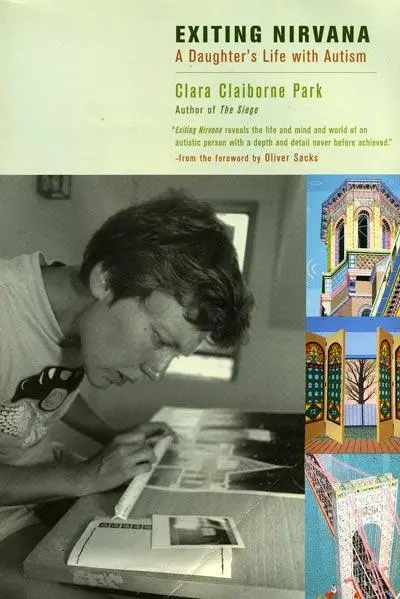
- Название:Exiting Nirvana
- Автор:
- Жанр:
- Год:неизвестен
- ISBN:0-316-69117-8
- Рейтинг книги:4 / 5. Голосов: 1
-
Избранное:Добавить в избранное
- Отзывы:
-
Ваша оценка:
Exiting Nirvana: краткое содержание, описание и аннотация
Предлагаем к чтению аннотацию, описание, краткое содержание или предисловие (зависит от того, что написал сам автор книги «Exiting Nirvana»). Если вы не нашли необходимую информацию о книге — напишите в комментариях, мы постараемся отыскать её.
All illustrations are by Jessy Park.
Exiting Nirvana — читать онлайн бесплатно полную книгу (весь текст) целиком
Ниже представлен текст книги, разбитый по страницам. Система сохранения места последней прочитанной страницы, позволяет с удобством читать онлайн бесплатно книгу «Exiting Nirvana», без необходимости каждый раз заново искать на чём Вы остановились. Поставьте закладку, и сможете в любой момент перейти на страницу, на которой закончили чтение.
Интервал:
Закладка:
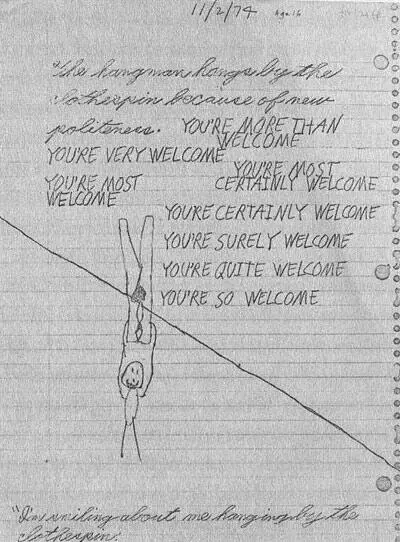
«Every time there is a late politeness hangman will hang on the tree and every time a mistaken politeness» — I still don’t know what that might be — «hangman will skip around. How about latest politeness ever? Hangman will hang on the largest tree. How about late mistaken? First skip around and then hang! How about high politeness?» (I.e., spoken in a high voice.) «Hangman will jump way up high».
In short, a system; her drawing shows eight levels of late and/or mistaken politenesses in which eight color-coordinated hangmen jump higher and higher on successively bigger trees. A late «you’re welcome» has its own picture. «The hangman hangs by the clothespin because of new politeness». Jessy, who had understood so few words, was now verbally alert — in her way. On the drawing she lettered YOU’RE SO WELCOME, YOU’RE QUITE WELCOME, YOU’RE VERY WELCOME, YOU’RE MOST WELCOME, YOU’RE SURELY WELCOME, YOU’RE CERTAINLY WELCOME, YOU’RE MOST CERTAINLY WELCOME, and YOU’RE MORE THAN WELCOME. Eventually she told us why she didn’t like politenesses, why she had to shut her eyes. It was so she wouldn’t see the hangman, there in my eyes, in anybody’s eyes, hanging on a pole.
Obsessive-compulsive disorder is a diagnosis; it is not usually thought of as a kind of thinking. In Jessy, however, obsessions and compulsions supplied both the material and the method of thought. Her systems, her numbers, her elaborate correlations, were integral to the activity of her mind. I don’t know how neatly Jessy’s array of strangenesses fit into the obsessive-compulsive box. Sometimes they seem too strange for any box but her own. Yet it seems a good enough label, though we’ve managed to get by without the drugs that are prescribed for it and that might indeed have made those hard times easier. Categories bleed; diagnoses in a given individual may never quite fit. Hypersensitivities, Obsessions, Compulsions — let the label, then, be a convenient shorthand for the oddities of thought, and feeling, and behavior that Jessy and we lived with.
Can an obsession make you happy? «I had a good time in school today because there was construction in a picture». At seventeen, the very thought made her smile — and draw her own picture of «layers of road which has three different layers of tar». Obsessions can certainly make you sad — along with everybody around you. Colds in the family make Jessy sad, for a very practical reason; she’s afraid she’ll catch one. We’ve learned to hide our symptoms as long as we can, for though she hates colds, she loves to talk about them. She’ll rehearse the dates and circumstances of each of our colds years after they should have been forgotten — tedious talk, obsessive talk, talk that can have the effect of the Chinese water torture, especially when you’ve got a cold.
Most of her obsessions showed this doubleness. Pleasure might turn to pain; «too good» meant you couldn’t stand it. Bad remembered might bring pleasure, as she laughed about the very thing that had set her crying. What more satisfying than to recall past distress? By the time she was in her twenties she made no more books, but she spent hours on listing her «discouragements» — five pages, twenty-two items with numbered subdivisions in proper outline form. «5. Run away if the refrigerator turns on after or while the door is opened, both bother me». «6. Discouragements at work»: «Making errors while working», «Writing down wrong price and pressing wrong keys on the calculator», «Putting a piece of mail in the wrong box, wrong names in the right box, and repeating boxes after somebody already fill them». She’s bothered by «being helped while working»; a coworker is all too likely to «mix hundreds, like 2471 mixed with 2500s and 3071 mixed with 3100s». These are the kinds of things that can (but today seldom do) cause her to «cry silently» at her desk, only to erupt as soon as she is on her way home for lunch. Today this rarely happens. Still troublesome, however, is number 7, «Questions that bother me».
A. What questions. What? What are you making? What are you doing?
B. Who questions. Who is somebody. I try to prevent them by identify people’s names.
C. Questions of happiness. Why are you smiling? I don’t like them, because they are too good to answer.
A couple of years later Jessy annotated her list, with characteristic precision. Her aversion to being helped was «outworked by fall 1986», number mix-ups «reduced a bit by 1987». Last year, rereading this list, Jessy made a philosophical comment. «This is what my life like. Like anything can be worn away and replaced by new things. Bad or good things. Like good things and discouragements both worn away». Jessy no longer makes a fuss if I forget to take one of the pills she so carefully counts out for me each morning; she can make sure I take it at lunch. She’s more anxious if it rolls under the fridge; she’s anxious if anything is missing, and if she hasn’t noticed, we don’t tell her. Because if we do, she’ll go on and on and on about it, reminding us yet again that her brain is simply not good at switching from one channel to another. Lucky that a helper gave her the phrase «Drop it like a hot potato!» She thinks it’s funny, and if we say it loud and sudden and with a laugh, it can break the connection so she too can laugh and move on.
But only a very few of these discouragements are completely «outworked». Jessy comes back from checking the boiler in the cellar. (Compulsiveness can be a valuable characteristic when tasks must be done regularly, and we need never fear that Jessy will forget to change the batteries in the smoke alarm.) In winter checking the boiler is routine, but today is different. Her face is radiant. She’s made such strides in self-control that I feel I can take a risk. I don’t ask «Why are you smiling?» but I approximate it. «What a happy face!» I say, hugging her. She accepts it, still smiling; she even answers the question she hears beneath my paraphrase. «The dryer going». «You like that?» «Yes — because of things going round and round!» But we’re not home free. «I did get annoyed about that. I smiled about the dryer going» — and she begins to whimper, almost cry. But that’s all this time — it’s over, it’s OK. That what our life like, tears and sunshine mixed. Yet Jessy insists on accentuating the positive. When a friend asked her what was her favorite obsession, he was told in no uncertain terms, «All obsessions are good!»
We read often that autistic children are deficient in imagination, in «pretend play». «Current diagnostic schemes pay particular attention to the abnormal lack of imaginative activity». «The lack of creative play [is] as unique and universal a feature… as [is] communication and socialization failure». [26] Uta Frith, Autism: Explaining the Enigma (Oxford: Basil Blackwell, 1989), p. 12; Frith, in Autism and Asperger Syndrome, p. 17.
Few who have watched a child repeat the same sterile lineup over and over will disagree. Grown older, autistic people who read tend not to read novels, with their confusing representations of a social world that is confusing already. Secure in the stability of fact, they navigate poorly among fictions.
Yet what about Jessy’s little imitation people? About her house plans with tiny steps so they can reach the china cupboard that is their «hotel»? «They rent different rooms in the hotel, just about a dollar a month. Sometimes they have slumber parties. A long time ago they used to live in the summer house but they moved during fall in 1972». What about the «make-believe forest where the Piper Cleaner family went during the party»?
Читать дальшеИнтервал:
Закладка:
Похожие книги на «Exiting Nirvana»
Представляем Вашему вниманию похожие книги на «Exiting Nirvana» списком для выбора. Мы отобрали схожую по названию и смыслу литературу в надежде предоставить читателям больше вариантов отыскать новые, интересные, ещё непрочитанные произведения.

![Майкл Азеррад - Come as you are - история Nirvana, рассказанная Куртом Кобейном и записанная Майклом Азеррадом [litres]](/books/392533/majkl-azerrad-come-as-you-are-istoriya-nirvana-ra-thumb.webp)



![Эверетт Тру - Nirvana - Правдивая история [litres]](/books/399241/everett-tru-nirvana-pravdivaya-istoriya-litres-thumb.webp)





Обсуждение, отзывы о книге «Exiting Nirvana» и просто собственные мнения читателей. Оставьте ваши комментарии, напишите, что Вы думаете о произведении, его смысле или главных героях. Укажите что конкретно понравилось, а что нет, и почему Вы так считаете.