Anthony Bogaert - Understanding Asexuality
Здесь есть возможность читать онлайн «Anthony Bogaert - Understanding Asexuality» весь текст электронной книги совершенно бесплатно (целиком полную версию без сокращений). В некоторых случаях можно слушать аудио, скачать через торрент в формате fb2 и присутствует краткое содержание. Город: New York, Год выпуска: 2012, ISBN: 2012, Издательство: Rowman & Littlefield, Жанр: Психология, Медицина, на английском языке. Описание произведения, (предисловие) а так же отзывы посетителей доступны на портале библиотеки ЛибКат.
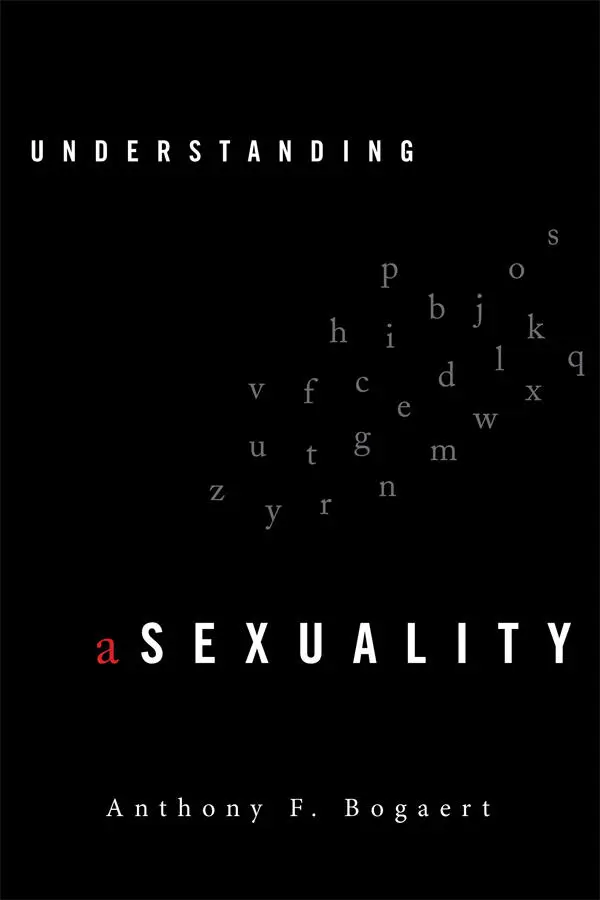
- Название:Understanding Asexuality
- Автор:
- Издательство:Rowman & Littlefield
- Жанр:
- Год:2012
- Город:New York
- ISBN:978-1-4422-0099-9
- Рейтинг книги:5 / 5. Голосов: 1
-
Избранное:Добавить в избранное
- Отзывы:
-
Ваша оценка:
Understanding Asexuality: краткое содержание, описание и аннотация
Предлагаем к чтению аннотацию, описание, краткое содержание или предисловие (зависит от того, что написал сам автор книги «Understanding Asexuality»). Если вы не нашли необходимую информацию о книге — напишите в комментариях, мы постараемся отыскать её.
More and more, those who identify as asexual are “coming out,” joining up, and forging a common identity. The time is right for a better understanding of this sexual orientation, written by an expert in the field who has conducted studies on asexuality and who has provided important contributions to understanding asexuality. This timely resource will be one of the first books written on the topic for general readers, and the first to look at the historical, biological, and social aspects of asexuality. It includes first-hand accounts throughout from people who identify as asexual. The study of asexuality, as it contrasts so clearly with sexuality, also holds up a lens and reveals clues to the mystery of sexuality.
Understanding Asexuality — читать онлайн бесплатно полную книгу (весь текст) целиком
Ниже представлен текст книги, разбитый по страницам. Система сохранения места последней прочитанной страницы, позволяет с удобством читать онлайн бесплатно книгу «Understanding Asexuality», без необходимости каждый раз заново искать на чём Вы остановились. Поставьте закладку, и сможете в любой момент перейти на страницу, на которой закончили чтение.
Интервал:
Закладка:
11
This is true especially if you consider the various names people use to describe their identity if they have same-sex attractions: gay, lesbian, queer, butch, femme, queen, and so forth.
12
Of course, some of these people may have never masturbated, if one wants to define sexuality broadly, beyond sexual activities with a partner.
13
A case in point: in the 1960s, I doubt viewers would likely have identified Gilligan as an “asexual.”
14
This code is subversive at least in part because it turns the heterosexual world’s discrimination against gays and lesbians on its ear. It is empowering (for some) because it often “steals” back the negative words (e.g., queer) that others have used against gays and lesbians for many years, and thus reclaims for gays and lesbians the right to use their own language in their own way.
15
As we noted in chapter 3, Kinsey placed a heavy (but not sole) emphasis on behavior in defining sexual orientation, so the caveats we raised about primarily “behavioral” definitions of sexual orientations should be kept in mind. And, of course, remember that Kinsey’s sample was not representative of the broader U.S. population.
16
Although they should be viewed with a high degree of caution, there have also been a number of relatively modern nonrepresentative surveys that provide some information on the prevalence of asexuality. In late 2004, when the popular press surrounding the issue of asexuality became heightened, CNN conducted an Internet poll on sexual identity. They asked people to report their sexual orientation using four categories (straight/heterosexual, gay/homosexual, bisexual, or asexual). Approximately 110,000 people responded, of whom 6 percent reported that they identify themselves as “asexual” (CNN.com, 2004, October 14). Furthermore, using a U.S.-based convenience sample of adults, one researcher reported that about 10 percent of women and 5 percent of men indicated that they lacked sexual attraction to either men or women (Nurius, 1983).
17
It should be pointed out that interest in these figures for political purposes is partly based on faulty logic. Statistical rarity, at least by itself, is not a good criterion for demonstrating pathology or the lack of it—consider, for example, extreme musical talent (see more on this in chapter 9). It is also illogical (and insensitive) to treat a group of individuals unfairly and inhumanely based solely on their prevalence rate in society.
18
Even though we all have this bias to some degree, one of the more intriguing experiences in life is, arguably, being faced with the incontrovertible evidence of human diversity. It often makes our lives richer, although perhaps a lot less predictable. So, while we may want to believe (and hope) that everyone is like us, when faced with evidence to the contrary, it may be initially threatening but, ultimately, often life affirming.
19
In the last two paragraphs, I expect I offended both men and women. In my defense, although lots of variability exists within each sex, there is also strong evidence that men, on average, have a higher sex drive than women do, and that women are more flexible in their sex drives/attractions (see also chapter 6) (Baumeister, 2000; Baumeister, Catanese, & Vohs, 2001).
20
However, note that a lack of a partner is not a good proxy for high frequency of masturbation, as sexual behaviors tend to correlate with one another, so those who have frequent sex with a partner also, on average, masturbate more. But the main point here is that masturbation can, at least for some, serve as a substitute for an unavailable partner.
21
Masturbation, then, is like all “play” activity in that it is more frequent in younger versus older people, but the seeming insignificance of the act belies the fact that it partially prepares one for later, adult-oriented challenges. Thus, it is not surprising that our fantasies often match or closely resemble what might be best for us from an evolutionary perspective, even if this fantasy world never exists in real life.
22
Even though our fantasies often resemble what might be “best” for us, at least from an evolutionary perspective, modern society also has the capacity to make our fantasies maladaptive. The modern media, with their high-tech sophistication and super-realistic images, may make our fantasies more real and powerful than our brains could ever conjure. Thus, along with ingraining sexual scripts, modern media probably raise our expectations and, at times, make us too unrealistic about what to expect in real-life sexual encounters. Thus, these fantasies may be somewhat maladaptive in modern society, even if they would have been adaptive in in our evolutionary past. After all, realistically, we can’t all mate with Brad Pitt!
23
This is not to imply that when (sexual) adolescents engage in masturbation with fantasies, they do so with the conscious intent of building sexual scripts into their psyches. Rather, this is done unconsciously; it just happens, especially after the fantasy/script is paired with (often repeatedly!) rewarding sexual pleasure and orgasm. If unconscious, one could argue that asexual people still retain the ancient mechanisms of masturbation (even an incentive to masturbate), which would have served this rehearsal function in our evolutionary past, but which is a somewhat useless byproduct for them now. However, as we will see later in this chapter, asexual people may be less likely to build sexual scripts into their psyches, because (perhaps not surprisingly) their masturbation is often without fantasy.
24
People often make a “causal inference” between a person’s exposure to pornography and his or her sexual attractions. So people may assume that exposure to pornography causes attraction to this material. For example, it is often assumed that an adolescent boy or a young man’s exposure to child pornography causes a sexual interest in children. Theoretically, this is possible, but most sex researchers are cautious about making such causal inferences, as they know that when two events co-occur—a correlation—this is not evidence of causation. When a correlation of this kind occurs, especially repeatedly (e.g., a man with a large stash of child porn collected over many different years), this may merely be good evidence that an attraction to this material occurs, and that we need to be alerted to that fact.
25
Note that biological and environmental/social explanations are not necessarily incompatible. As suggested in chapter 13, these two kinds of explanations can coexist because they offer different levels of analysis: micro (biological) versus macro (environment/social). Thus, they may represent different points along a causal stream or pathway. For example, a specific biological predisposition may make someone particularly sensitive to a certain environment, which ultimately has a large impact on this person, whereas a different biological predisposition may make another person especially sensitive to a completely different environment, which may also have a large (but different) impact on him or her.
26
We are currently collecting data on the coming-out process in lesbians and bisexual women, and it will be interesting to see if we can replicate these findings in women. In our first study (Bogaert and Hafer, 2009), there was not a sufficiently large sample to test this issue in women.
Читать дальшеИнтервал:
Закладка:
Похожие книги на «Understanding Asexuality»
Представляем Вашему вниманию похожие книги на «Understanding Asexuality» списком для выбора. Мы отобрали схожую по названию и смыслу литературу в надежде предоставить читателям больше вариантов отыскать новые, интересные, ещё непрочитанные произведения.








Обсуждение, отзывы о книге «Understanding Asexuality» и просто собственные мнения читателей. Оставьте ваши комментарии, напишите, что Вы думаете о произведении, его смысле или главных героях. Укажите что конкретно понравилось, а что нет, и почему Вы так считаете.