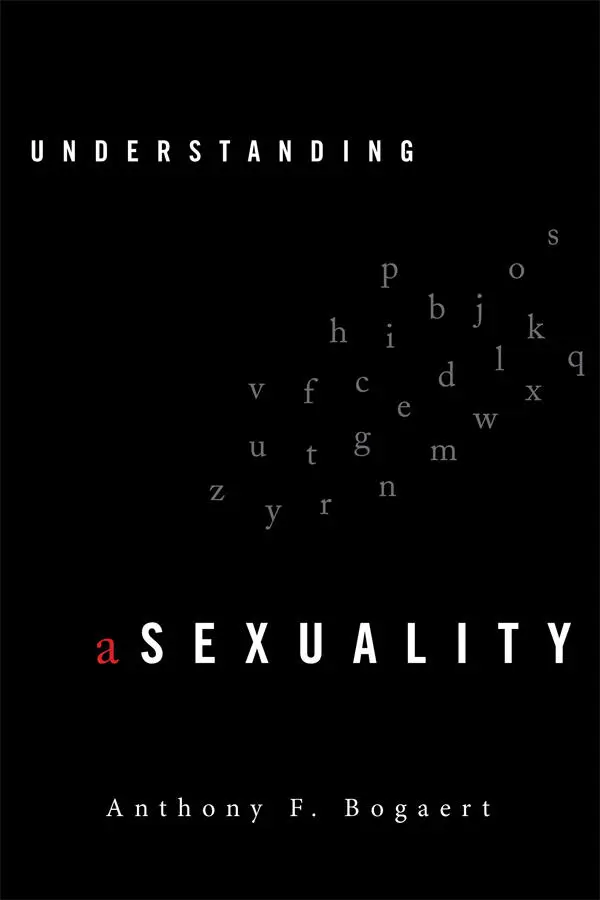
Anthony Bogaert - Understanding Asexuality
Здесь есть возможность читать онлайн «Anthony Bogaert - Understanding Asexuality» весь текст электронной книги совершенно бесплатно (целиком полную версию без сокращений). В некоторых случаях можно слушать аудио, скачать через торрент в формате fb2 и присутствует краткое содержание. Город: New York, Год выпуска: 2012, ISBN: 2012, Издательство: Rowman & Littlefield, Жанр: Психология, Медицина, на английском языке. Описание произведения, (предисловие) а так же отзывы посетителей доступны на портале библиотеки ЛибКат.
- Название:Understanding Asexuality
- Автор:
- Издательство:Rowman & Littlefield
- Жанр:
- Год:2012
- Город:New York
- ISBN:978-1-4422-0099-9
- Рейтинг книги:5 / 5. Голосов: 1
-
Избранное:Добавить в избранное
- Отзывы:
-
Ваша оценка:
Understanding Asexuality: краткое содержание, описание и аннотация
Предлагаем к чтению аннотацию, описание, краткое содержание или предисловие (зависит от того, что написал сам автор книги «Understanding Asexuality»). Если вы не нашли необходимую информацию о книге — напишите в комментариях, мы постараемся отыскать её.
More and more, those who identify as asexual are “coming out,” joining up, and forging a common identity. The time is right for a better understanding of this sexual orientation, written by an expert in the field who has conducted studies on asexuality and who has provided important contributions to understanding asexuality. This timely resource will be one of the first books written on the topic for general readers, and the first to look at the historical, biological, and social aspects of asexuality. It includes first-hand accounts throughout from people who identify as asexual. The study of asexuality, as it contrasts so clearly with sexuality, also holds up a lens and reveals clues to the mystery of sexuality.
Understanding Asexuality — читать онлайн бесплатно полную книгу (весь текст) целиком
Ниже представлен текст книги, разбитый по страницам. Система сохранения места последней прочитанной страницы, позволяет с удобством читать онлайн бесплатно книгу «Understanding Asexuality», без необходимости каждый раз заново искать на чём Вы остановились. Поставьте закладку, и сможете в любой момент перейти на страницу, на которой закончили чтение.
Интервал:
Закладка:
One might argue that this wanton behavior has less to do with the maddening effects of sex, and more to do with a sense of entitlement and disregard for others that seems to go hand in hand with power, status, and narcissism. Partly true, I expect, but this is likely not the whole story. For example, it does not explain the often careful and thoughtful behavior these men routinely display in other areas of their lives. If behavior in these other domains were chosen carelessly, it could be almost as damaging to their careers as an awkwardly planned sexual liaison. In addition, if one prefers a “power explanation” over a “sex explanation” to account for this wanton behavior of men of celebrity and status, one would still have to account for the tricky interplay of power and sex, particularly in men. For example, there is a surge of testosterone (potentially affecting both sex drive and feelings of power) in men after they win at competitions (Carré, Putnam, & McCormick, 2009). In short, it is very difficult to disentangle power from many men’s sexual motives (and vice versa). It is also hard to argue that sex is not at least partly the culprit underlying the seeming irrationality of the behavior leading to these scandals.
There is an antidrug ad showing an egg sizzling in a frying pan. The caption reads, “This is your brain on drugs.” Perhaps an equivalent one should be reserved for sex (“This is your brain on sex”), since brains on sex, including the brains of celebrities, politicians, and sports figures, do irrational things.
Three months after his bizarre car crash and a myriad of rumors, Tiger Woods [29] This section on Tiger Woods reopened a wound for me and was a bit difficult to write. Ever since I turned forty, I have been obsessed with golf, a game I played in my childhood, let slide in my twenties and thirties, and then recently returned to. So, since midlife, I have played a lot of golf and watched a ton of it on TV. My obsession reflects, perhaps, a bit of the energy of a midlife crisis channeled into this (harmless?) indulgence. Thus, I think I have used golf as an escape from my regular work life as a sexologist, which, of course, was filled with sex. Basically, I needed an escape, and golf was a good one, as it was totally removed from sex. Is there anything less sexy than golf? (Maybe a few things, but not many.) However, after the Tiger Woods sex scandal, my two worlds—sex and golf—collided, and now I can’t play golf, or watch it on TV, in the same way. Alas.
emerged on February 19, 2010, from his public hibernation to offer a mea culpa for his extramarital affairs and their impact on his family, friends, fellow players, fans, and sponsors. One of the more interesting elements of all this was the astonishing degree of interest in this story, relative to all the other issues of the day. One newspaper headline asserted boldly, “The world stops for 13 minutes” (Broad, 2010, February 28). Not literally true, of course, but almost: the New York Stock Exchange did stop trading for the thirteen minutes to watch the spectacle of Woods’s carefully crafted news conference. “Tiger Woods News Conference” was also the highest-rated Google search term by midday. The level of interest in this story, as with the scandals before and after it, was driven by sexual curiosity. This is not to say that there weren’t other angles that made people curious to watch or to hear or to read about it (e.g., the business/sponsorship impact), but the only angle that drove it to this level of fury was clearly the sexual one.
Also, consider this: the fact that a relatively conservative, business-oriented newspaper—Canada’s The Globe and Mail —would say that the “world stopped” (Broad, 2010, February 28) illustrates a main point of this book, that one’s view of the world—including the perception of whether it seems to stop or seems to run at a breakneck pace—is filtered through the different lenses that we have for seeing it. Most people see the world through sexual lenses, just as business-oriented people often see the world through business-oriented lenses; the lenses we wear—sexual or otherwise—are often no longer obvious to us, just as a long-worn set of spectacles over the years becomes imperceptible to the wearer and may even feel like part of his or her own face.
What much of the public and the media did not realize was that Woods’s apology was borne out of his need to complete a number of essential “steps” in his “sexual addiction” treatment, similar to the therapeutic steps required in Alcoholics Anonymous. These steps include an apology to all those whom his sexually addictive behavior (and its sequelae) has wronged in one way or another. It is perhaps fitting that it came in the form of a highly rated press conference, which was meant to reach not just family and friends but also fellow golfers, his fans, and sponsors, because the scandal and fallout probably affected—rightly or wrongly—many millions of people. [30] The paragraph above is not meant to imply that I believe such a public apology was necessary, either from a therapeutic perspective or because it was morally right to do so given his behavior. It is also not meant to imply that I believe that Tiger Woods has an “addiction,” which, by the way, many sexologists believe is not an appropriate name for sexual problems. I am also not necessarily implying he had a “sexual problem.” (Given his cover-up of his affairs to his wife and her reaction to them when they were revealed, however, it is clear to me that he had a relationship problem.) Rather, this story is merely meant to give a context for why this event occurred.
One of the interesting elements of this episode, however, was the fact that part of the public and much of the press wanted Woods to have a public shaming. They seemed to want him to admit that his sense of entitlement led to arguably excessive sexual behavior—including, evidently, threesomes with prostitutes. But why was this sexual shaming necessary, or at least interesting to us? Is it because sex is embedded, even pathologically so, in our culture and in the way we think?
But let’s push the point further by turning it on its head. Why is it that Tiger Woods’s sense of entitlement should not have spurred a public apology, a shaming, over his other excesses, ones that are arguably much more harmful to the planet and humanity than his sexual ones? Why isn’t he apologizing for his egregious and excessive consumption of the world’s resources and pollution of the planet? Why isn’t he apologizing for his private jet, his gas-guzzling vehicles, and the energy consumption in his houses, which could otherwise run a small country? (That is also an interesting “threesome,” by the way.) More importantly, why aren’t we more interested in that apology, rather than the one we got? Why wouldn’t the world stop for thirteen minutes for that? I think you know the answer: Because it is not about sex, and people are mad about sex. [31] I am picking on Tiger Woods about his excessive use of the world’s resources, but I could have chosen countless examples of excessive resource use in people, including myself, whose middle-class Western lifestyle (including my golf) is also open to criticism.
Summary
Sex is the great story of life (see chapter 1), but it is also truly and utterly mad. Some might argue that, yes, it is mad, but it does not have to be so. It is our culture that makes it mad, and if we were to strip away the neuroticism and hypocrisy from it and “raise the children right,” it would not be so. Whether this is true or not, it is an interesting argument to consider. What definitely is true is that the current state of sex should make us cautious about assuming that the absence of sex in one form or another—asexuality—is pathological. I discuss this subject—whether asexuality is indeed a disorder—more fully in my next chapter.
Читать дальшеИнтервал:
Закладка:
Похожие книги на «Understanding Asexuality»
Представляем Вашему вниманию похожие книги на «Understanding Asexuality» списком для выбора. Мы отобрали схожую по названию и смыслу литературу в надежде предоставить читателям больше вариантов отыскать новые, интересные, ещё непрочитанные произведения.












Обсуждение, отзывы о книге «Understanding Asexuality» и просто собственные мнения читателей. Оставьте ваши комментарии, напишите, что Вы думаете о произведении, его смысле или главных героях. Укажите что конкретно понравилось, а что нет, и почему Вы так считаете.