Aleksandr Solzhenitsyn - The GULag Archipelago Volume 1 - An Experiment in Literary Investigation
Здесь есть возможность читать онлайн «Aleksandr Solzhenitsyn - The GULag Archipelago Volume 1 - An Experiment in Literary Investigation» весь текст электронной книги совершенно бесплатно (целиком полную версию без сокращений). В некоторых случаях можно слушать аудио, скачать через торрент в формате fb2 и присутствует краткое содержание. Город: New York, Год выпуска: 2007, ISBN: 2007, Издательство: Harper Perennial Modern Classics, Жанр: История, Биографии и Мемуары, dissident, на английском языке. Описание произведения, (предисловие) а так же отзывы посетителей доступны на портале библиотеки ЛибКат.
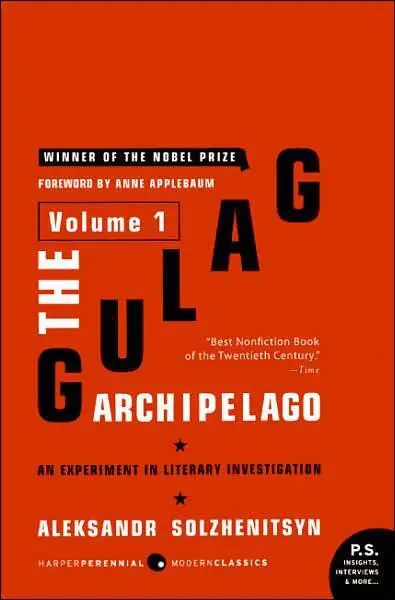
- Название:The GULag Archipelago Volume 1: An Experiment in Literary Investigation
- Автор:
- Издательство:Harper Perennial Modern Classics
- Жанр:
- Год:2007
- Город:New York
- ISBN:9780061253713
- Рейтинг книги:3 / 5. Голосов: 1
-
Избранное:Добавить в избранное
- Отзывы:
-
Ваша оценка:
The GULag Archipelago Volume 1: An Experiment in Literary Investigation: краткое содержание, описание и аннотация
Предлагаем к чтению аннотацию, описание, краткое содержание или предисловие (зависит от того, что написал сам автор книги «The GULag Archipelago Volume 1: An Experiment in Literary Investigation»). Если вы не нашли необходимую информацию о книге — напишите в комментариях, мы постараемся отыскать её.
“Best Nonfiction Book of the Twentieth Century” (Time magazine ) Review
The GULag Archipelago Volume 1: An Experiment in Literary Investigation — читать онлайн бесплатно полную книгу (весь текст) целиком
Ниже представлен текст книги, разбитый по страницам. Система сохранения места последней прочитанной страницы, позволяет с удобством читать онлайн бесплатно книгу «The GULag Archipelago Volume 1: An Experiment in Literary Investigation», без необходимости каждый раз заново искать на чём Вы остановились. Поставьте закладку, и сможете в любой момент перейти на страницу, на которой закончили чтение.
Интервал:
Закладка:
I was stupefied. The line-up dispersed and the trusties in the camp compound surrounded me. Some of them said: “They are going to hang a new stretch on you.” And others said: “To be released.” But everyone agreed on one thing—that there was no escaping Minister of Internal Affairs Kruglov. And I, too, swayed between a new term and being released. I had quite forgotten that half a year before, some character had come to our camp and distributed Gulag registration cards. (After the war they had begun this registration in all the nearby camps, but it seems unlikely that it was ever completed.) The most important question on it was: “Trade or Profession.” And the zeks would fill in the most precious Gulag trades to enhance their own value: “barber,” “tailor,” “storekeeper,” “baker.” As for me, I had frowned and filled in “nuclear physicist.” I had never been a nuclear physicist in my life, and what I knew of the field I had heard in the university before the war—just a little bit, the names of the atomic particles and their parameters. And I had decided to write down “nuclear physicist.” This was in 1946. The atom bomb was desperately needed. But I didn’t assign any importance to that Gulag registration card and, in fact, forgot about it.
There was a vague, unverified legend, unconfirmed by anybody, that you might nevertheless hear in camp: that somewhere in this Archipelago were tiny paradise islands. No one had seen them. No one had been there. Whoever had, kept silent about them and never let on. On those islands, they said, flowed rivers of milk and honey, and eggs and sour cream were the least of what they fed you; tilings were neat and clean, they said, and it was always warm, and the only work was mental work—and all of it super-supersecret.
And so it was that I got to those paradise islands myself (in convict lingo they are called “sharashkas”) and spent half my sentence on them. It’s to them I owe my survival, for I would never have lived out my whole term in the camps. And it’s to them I owe the fact that I am writing this investigation, even though I have not allowed them any place in this book. (I have already written a novel about them.) And it was from one to another of those islands, from the first to the second, and from the second to the third, that I was transported on a special-convoy basis: two jailers and I.
If the souls of those who have died sometimes hover among us, see us, easily read in us our trivial concerns, and we fail to see them or guess at their incorporeal presence, then that is what a special-convoy trip is like.
You are submerged in the mass of freedom, and you push and shove with the others in the station waiting room. You absent-mindedly examine announcements posted there, even though they can hardly have any relevance for you. You sit on the ancient passenger benches, and you hear strange and insignificant conversations: about some husband who beats up his wife or has left her; and some mother-in-law who, for some reason, does not get along with her daughter-in-law; how neighbors in communal apartments make personal use of the electric outlets in the corridor and don’t wipe their feet; and how someone is in someone else’s way at the office; and how someone has been offered a good job but can’t make up his mind to move—how can he move bag and baggage, is that so easy? You listen to all this, and the goose pimples of rejection run up and down your spine: to you the true measure of things in the Universe is so clear! The measure of all weaknesses and all passions! And these sinners aren’t fated to perceive it. The only one there who is alive, truly alive, is incorporeal you, and all these others are simply mistaken in thinking themselves alive.
And an unbridgeable chasm divides you! You cannot cry out to them, nor weep over them, nor shake them by the shoulder: after all, you are a disembodied spirit, you are a ghost, and they are material bodies.
And how can you bring it home to them? By an inspiration? By a vision? A dream? Brothers! People! Why has life been given you? In the deep, deaf stillness of midnight, the doors of the death cells are being swung open—and great-souled people are being dragged out to be shot. On all the railroads of the country this very minute, right now, people who have just been fed salt herring are licking their dry lips with bitter tongues. They dream of the happiness of stretching out one’s legs and of the relief one feels after going to the toilet. In Orotukan the earth thaws only in summer and only to the depth of three feet—and only then can they bury the bones of those who died during the winter. And you have the right to arrange your own life under the blue sky and the hot sun, to get a drink of water, to stretch, to travel wherever you like without a convoy. So what’s this about unwiped feet? And what’s this about a mother-in-law? What about the main thing in life, all its riddles? If you want, I’ll spell it out for you right now. Do not pursue what is illusory—property and position: all that is gained at the expense of your nerves decade after decade, and is confiscated in one fell night. Live with a steady superiority over life—don’t be afraid of misfortune, and do not yearn after happiness; it is, after all, all the same: the bitter doesn’t last forever, and the sweet never fills the cup to overflowing. It is enough if you don’t freeze in the cold and if thirst and hunger don’t claw at your insides. If your back isn’t broken, if your feet can walk, if both arms can bend, if both eyes see, and if both ears hear, then whom should you envy? And why? Our envy of others devours us most of all. Rub your eyes and purify your heart—and prize above all else in the world those who love you and who wish you well. Do not hurt them or scold them, and never part from any of them in anger; after all, you simply do not know: it might be your last act before your arrest, and that will be how you are imprinted in their memory!
But the convoy guards stroke the black handles of the pistols in their pockets. And we sit there, three in a row, sober fellows, quiet friends.
I wipe my brow. I shut my eyes, and then I open them. And once again I see this dream: a crowd of people unaccompanied by guards. I remember clearly that I spent last night in a cell and will be in a cell again tomorrow. But here comes some kind of conductor to punch my ticket: “Your ticket!” “My friend there has it!”
The cars are full. (Well, “full” in free people’s terms—no one is lying under the benches, and no one is sitting on the floor in the aisles.) I was told to behave naturally, and I have been behaving very naturally indeed: I noticed a seat beside a window in the next compartment, and got up and took it. And there were no empty seats for my guards in that compartment. They sat where they were and kept their loving eyes on me from there. In Perebory, the seat across the table from me was vacated, but before my guard could get to it and sit down, a moon-faced fellow in a sheepskin coat and a fur cap, with a plain but strong wooden suitcase, sat down there. I recognized his suitcase: it was camp work, “made in the Archipelago.”
“Whew!” he puffs. There was very little light, but I could see he was red in the face and that he had had a hassle to get on the train. And he got out a bottle: “How about a beer, comrade?” I knew that my guards were close to a nervous breakdown in the next compartment: I was not allowed anything alcoholic. But still… I was supposed to conduct myself as naturally as possible. And so I said carelessly: “All right, why not?” (Beer! It’s a whole poem! For three years I hadn’t had even one swallow. And tomorrow in my cell I would brag: “I got beer!”) The fellow poured it, and I drank it down with a shiver of pleasure. It was already dark. There was no electricity in the car. This was post-war dislocation. One tiny candle end was burning in an ancient lantern at the door, one for four compartments: two in front and two behind. I talked amiably with the fellow even though we could hardly see each other. No matter how far forward my guard leaned, he couldn’t hear a thing because of the clickety-clack of the wheels. In my pocket I had a postcard addressed to my home. And I was about to explain who I was to my simple friend across the table and ask him to drop the card in a mailbox. Judging by his suitcase he had been in stir himself. But he beat me to it: “You know, I just barely managed to get some leave. They haven’t given me any time off for two years; it’s a dog’s branch of the service.” “What kind?” “Don’t you know? I’m an MVD man, an asmodeus, blue shoulder boards, haven’t you ever seen them?” Hell! Why hadn’t I guessed right off? Perebory was the center for Volgolag, and he had gotten his suitcase out of the zeks, they had made it for him for free. How all this had permeated our life! Two MVD men, two asmodei, weren’t enough in two compartments. There had to be a third. And perhaps there was also a fourth concealed somewhere? And maybe they were in every compartment? And maybe someone else there was traveling by special convoy like me.
Читать дальшеИнтервал:
Закладка:
Похожие книги на «The GULag Archipelago Volume 1: An Experiment in Literary Investigation»
Представляем Вашему вниманию похожие книги на «The GULag Archipelago Volume 1: An Experiment in Literary Investigation» списком для выбора. Мы отобрали схожую по названию и смыслу литературу в надежде предоставить читателям больше вариантов отыскать новые, интересные, ещё непрочитанные произведения.












Обсуждение, отзывы о книге «The GULag Archipelago Volume 1: An Experiment in Literary Investigation» и просто собственные мнения читателей. Оставьте ваши комментарии, напишите, что Вы думаете о произведении, его смысле или главных героях. Укажите что конкретно понравилось, а что нет, и почему Вы так считаете.