Lev Rosen - Depth
Здесь есть возможность читать онлайн «Lev Rosen - Depth» весь текст электронной книги совершенно бесплатно (целиком полную версию без сокращений). В некоторых случаях можно слушать аудио, скачать через торрент в формате fb2 и присутствует краткое содержание. Город: New York, Год выпуска: 2015, ISBN: 2015, Издательство: Regan Arts., Жанр: sf_postapocalyptic, Детективная фантастика, на английском языке. Описание произведения, (предисловие) а так же отзывы посетителей доступны на портале библиотеки ЛибКат.
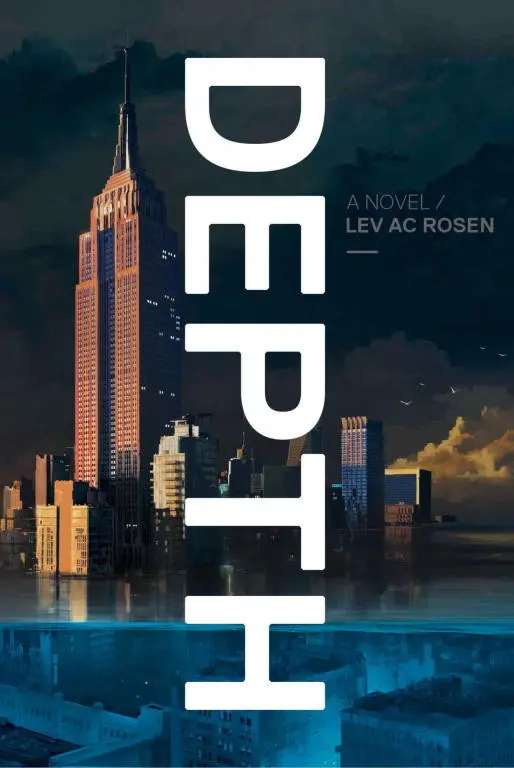
- Название:Depth
- Автор:
- Издательство:Regan Arts.
- Жанр:
- Год:2015
- Город:New York
- ISBN:978-1-941393-07-9
- Рейтинг книги:3 / 5. Голосов: 1
-
Избранное:Добавить в избранное
- Отзывы:
-
Ваша оценка:
Depth: краткое содержание, описание и аннотация
Предлагаем к чтению аннотацию, описание, краткое содержание или предисловие (зависит от того, что написал сам автор книги «Depth»). Если вы не нашли необходимую информацию о книге — напишите в комментариях, мы постараемся отыскать её.
(Tor, 2011), which was an
, on over a dozen best of the year lists, and has been nominated for multiple awards.
described it as “mixing genres with fearless panache.” His work has been featured in Esopus Magazine and on various blogs including Tor.com. He lives in Manhattan. Review
About the Author “Heinlein meets Hammett in this whip-smart whodunnit set amid the billowing fog and rising waters of a future New York.”
(Chuck Greaves, award-winning author of
) “I have long admired Lev Rosen's strange, genre-bending work—his riff on the detective story is elegant, surprising, and, yes, deep.”
(Dan Chaon, National Book Award finalist, author of
)
Depth — читать онлайн бесплатно полную книгу (весь текст) целиком
Ниже представлен текст книги, разбитый по страницам. Система сохранения места последней прочитанной страницы, позволяет с удобством читать онлайн бесплатно книгу «Depth», без необходимости каждый раз заново искать на чём Вы остановились. Поставьте закладку, и сможете в любой момент перейти на страницу, на которой закончили чтение.
Интервал:
Закладка:
“Come on, baby,” her mom said. When she grinned, her nose wrinkled up, and her freckles danced on her face. “Just jump in. I’ll catch you.” Simone hooked a finger into her mouth, sucking on it, and looked at the water her feet were dangling in. It wasn’t like ocean water. It was clear, and the pool was painted blue. Her feet looked bone white. This water wasn’t safe, she knew. No water was safe. Here it seemed like an old dog that couldn’t bite anymore, but it was still water.
Her mom came to the edge of the pool and, in one swoop, lifted Simone up and put her in the water before she could protest. She bobbed there a moment, the floaties keeping her up, the water lukewarm.
“See? See how easy that is?” her mom asked, crouching down so she was eye-level with Simone. Simone paddled her hands so she was up against her mother and clung to her, as best as the floaties would allow. “Nothin’ to be afraid of,” her mom said. “Just water.”
THE SOUND DIDN’T JUST wake her; it made her whole body convulse. Simone used the blanket to cover her ears, but it didn’t help. She knew she had been dreaming, and she remembered the smell of chlorine and feeling safe. That was gone now. Instead, there was the sound, the horrible sound that burrowed into her skull like a drill and wouldn’t go away. She opened her eyes. The room, thankfully, was dim, her blinds down, the lights off. She lay on the sofa, still fully clothed and smelling of stale smoke. And still the horrible sound persisted: her phone. It was on the floor, where it had fallen out of her ear. A weak holoprojection shone out of it, the name too blurry to make out. She hit it. Sensing no ear, it went into speaker mode.
“Hey soldier.”
“What do you want, Peter?” Simone rubbed her temples, and stayed on the sofa, eyes closed. It was an awful hangover, but a survivable one.
“Thought you’d want to know, a snitch fingered Linnea St. Michel sometime last night. I didn’t get the call, or else I would’ve told you.”
“Where was she?”
“Trying to score some Foam over on the West Side.” Simone furrowed her brow. Drugs again. Why would she need more?
“That doesn’t make sense,” she said.
“Snitch swears on his mother it was her. They sent some blues over, but she was long gone. Thing is, I know this snitch. We’re not the only ones he talks to.”
“And there are plenty of people looking for Linnea right now,” Simone said, thinking of Dash.
“Yep.”
“Fuck. Thanks for telling me.” Simone tried opening her eyes again but gasped as the light sliced her eyes, julienning them like soft grapes.
“You sailing smooth, there, soldier?”
“Just need a shower,” Simone said, rubbing her face.
Peter paused. “Guess you better take one, then,” he said.
“Yeah. Thanks again.” She hung up on Peter and made her way to the bathroom, where she shook out a handful of painkillers and took them without bothering to count. She tried Linnea’s number again but hung up when she heard the outgoing message. Then she took a shower. She’d screwed things up with Caroline; Linnea had briefly appeared, but was still missing; deCostas was meeting with Marina—The Blonde—and somehow this was all about drugs and art. Simone didn’t know anything about art.
She toweled herself off, feeling a little better, and drank several glasses of water. Then she got dressed and went to her touchdesk. When she turned it on, a screen was already up. Memories came back to her, hazy, sea-glass-stained from last night. She’d been searching the web for Reinel, the name of the artist Caroline had mentioned. Paul Reinel, born in 2063, died 2170. He went to art school in Chicago, then dabbled in painting for a while. But he was most known as a coral sculptor—one of the early ones. When the waters were rising, one of the bits of technology that was quickly born out of desperation was accelerated coral growing for making reefs to keep particularly nasty tides at bay, like breakers. They worked okay for a little while; New York probably still had some sort of reef somewhere around it, though no doubt dead from pollution by now, just a wall of bone. But the technology also led to a fad in the art world, where artists would grow coral, almost like bonsai, into the shapes of animals, plants, humans, or other, less definable forms. Reinel’s work was noted but not actively sought after or especially valuable.
She stared at some images of his art: eerie human forms bending backwards or laying down, arms stretched out as though they were reaching for something. Their outlines rippled because of the coral, so they seemed like they were underwater, drowning. Simone wasn’t an art collector, but she could tell they were good—just not good enough to kill for. And certainly not valuable enough to kill for, judging by recent recorded sales. He was just a sculptor who sold some work and taught college art classes. He wasn’t even dead that long. Simone shook her head. She had fucked up things with Caroline getting Reinel’s name, and still hadn’t learned anything new about the case.
She could try to fix it at least, she thought. She went online and found a place that sold straws—neon, bendy ones, Caroline’s favorite kind. Simone smiled thinking about Caroline and her straws. Simone had asked her once about it, and Caroline had said she thought it made life a little more fun. Simone shipped a carton of them—enough for a small restaurant—to Caroline’s address. No note. She didn’t know what to say.
The touchdesk beeped, and a reminder popped up. She had a meeting with Pastor Sorenson tonight. Simone leaned back and folded her hands together. That was for the deCostas case—except it wasn’t, really. Sorenson had told her to come alone. It was an excuse to meet with her privately, to talk to her about something else, which is why she decided to go. If it had just been about deCostas… Simone wasn’t sure what to do about that. She still hadn’t responded to the message from him. But he’d met with Marina. That meant everything he’d told her could have been a lie, that that little routine where she pointed a gun at him was staged. deCostas didn’t seem like the type to try to play her. Didn’t seem smart enough. Was he that good an actor?
Simone rolled her head. She’d meet with Sorenson, find out what she could about Marina, figure out where the fuck Linnea was, solve this case, and make good with Caroline somehow. After that, she was taking a nice long vacation—and only working cases involving missing pets.
She’d stop by the West Side to ask the junkies about Linnea on her way to the Hearst Building, where Sorenson would be waiting. But before that, she needed to walk, to breathe in the brine of the ocean, and think. She got up, made herself eat some toast, then threw on her trench and hat and headed out.
The day was a damp one, the sea beneath her particularly active, the sky gray, the fog thick. She lit a cigarette as she walked and took a long drag. So that art Trixie had mentioned—this Reinel—was somehow valuable, even though valuable Reinels didn’t exist. The package she had seen Henry pass Marina must have been payment for her services as a broker. And Marina was going around offering up the Reinel sculpture to various people who could afford it—the Khans, Anika, Sorenson. Was deCostas on that list? He was only a student, but he had some funding.
But what coral sculpture could catch the fancy of all of them? The sculpture couldn’t even be that old—no more than a century, which wasn’t much these days. And Reinel wasn’t much more than a footnote in an art history class.
Simone thought of heading to Undertow, but her head still felt soft from the drinking last night. Instead, she turned uptown and walked towards the ferry docks near City Hall. She used to go there when she was little, with her mom. Mom would talk about the mainland, where she’d grown up, and about going back some day. Simone never realized it would be without her. The docks were made of solid wood and stretched out for the mainland so far that if you stood on the end you might think you could see the shoreline. The ferry had already left that morning, so the platform was deserted. Simone sat down on a bench and looked at the water. White froth swirled around the dock legs, all white lines and bubbles, like excited children around a clown. They kept the water clean there, the bridges and buildings, too. When the tourists got off the ferry, they saw a dream of New York, not the real thing. If they were lucky, that’s all they ever saw. The air felt cool on her face as she leaned back, squinting into the sunlight. She took her hat off and put it on her lap, letting the wind blow out her hair. Salt singed her scalp, burning away the toxins from last night, boiling her bad choices out of her.
Читать дальшеИнтервал:
Закладка:
Похожие книги на «Depth»
Представляем Вашему вниманию похожие книги на «Depth» списком для выбора. Мы отобрали схожую по названию и смыслу литературу в надежде предоставить читателям больше вариантов отыскать новые, интересные, ещё непрочитанные произведения.











Обсуждение, отзывы о книге «Depth» и просто собственные мнения читателей. Оставьте ваши комментарии, напишите, что Вы думаете о произведении, его смысле или главных героях. Укажите что конкретно понравилось, а что нет, и почему Вы так считаете.