Lev Rosen - Depth
Здесь есть возможность читать онлайн «Lev Rosen - Depth» весь текст электронной книги совершенно бесплатно (целиком полную версию без сокращений). В некоторых случаях можно слушать аудио, скачать через торрент в формате fb2 и присутствует краткое содержание. Город: New York, Год выпуска: 2015, ISBN: 2015, Издательство: Regan Arts., Жанр: sf_postapocalyptic, Детективная фантастика, на английском языке. Описание произведения, (предисловие) а так же отзывы посетителей доступны на портале библиотеки ЛибКат.
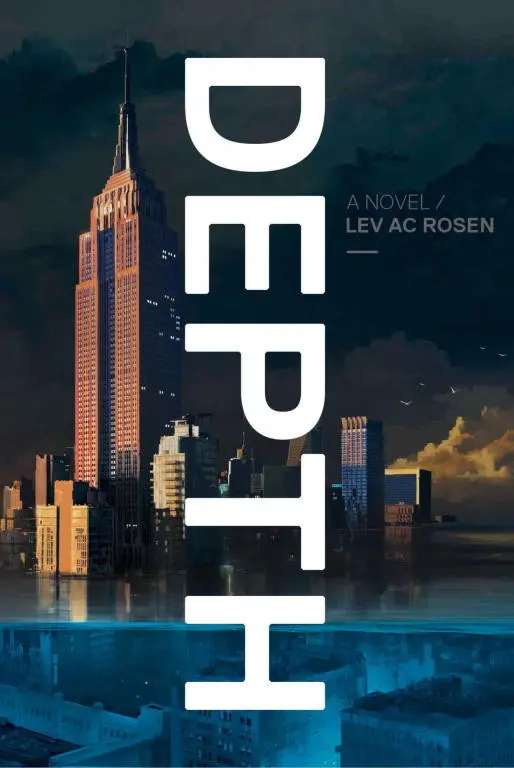
- Название:Depth
- Автор:
- Издательство:Regan Arts.
- Жанр:
- Год:2015
- Город:New York
- ISBN:978-1-941393-07-9
- Рейтинг книги:3 / 5. Голосов: 1
-
Избранное:Добавить в избранное
- Отзывы:
-
Ваша оценка:
Depth: краткое содержание, описание и аннотация
Предлагаем к чтению аннотацию, описание, краткое содержание или предисловие (зависит от того, что написал сам автор книги «Depth»). Если вы не нашли необходимую информацию о книге — напишите в комментариях, мы постараемся отыскать её.
(Tor, 2011), which was an
, on over a dozen best of the year lists, and has been nominated for multiple awards.
described it as “mixing genres with fearless panache.” His work has been featured in Esopus Magazine and on various blogs including Tor.com. He lives in Manhattan. Review
About the Author “Heinlein meets Hammett in this whip-smart whodunnit set amid the billowing fog and rising waters of a future New York.”
(Chuck Greaves, award-winning author of
) “I have long admired Lev Rosen's strange, genre-bending work—his riff on the detective story is elegant, surprising, and, yes, deep.”
(Dan Chaon, National Book Award finalist, author of
)
Depth — читать онлайн бесплатно полную книгу (весь текст) целиком
Ниже представлен текст книги, разбитый по страницам. Система сохранения места последней прочитанной страницы, позволяет с удобством читать онлайн бесплатно книгу «Depth», без необходимости каждый раз заново искать на чём Вы остановились. Поставьте закладку, и сможете в любой момент перейти на страницу, на которой закончили чтение.
Интервал:
Закладка:
“Why were you meeting with Henry St. Michel the other night?” Simone asked. She kept her gun lowered but walked a few steps closer to The Blonde, trying to block deCostas.
“That’s my business. But I do like having my picture taken. Makes me feel famous.”
“I tried to get your good side.”
The Blonde gave Simone a look like she’d tried to tell a joke and no one had laughed. “They’re all good sides.” She tilted her head, her perfect hair swaying with the motion. An earring sparkled.
“I don’t know why you were taking those photos, but whoever hired you, whatever you think you’re on to, you should stop.”
“Why’s that?”
“Because it’s not whatever you think it is. I’m not a prostitute or a mistress. Do I look like one?” Simone didn’t answer. “Oh, now you’re just being mean.”
“So why were you meeting St. Michel?”
“Like I said, that’s my business.”
“Did you shoot him last night?”
The Blonde raised an eyebrow at Simone.
“No. I didn’t realize he’d been shot.”
“Maybe,” Simone said. “Maybe he shot someone. Maybe he lived.”
The Blonde shrugged. “It doesn’t matter. The point is, you should leave me alone. I have things to do, and they don’t involve you. I don’t need a fangirl right now.”
“Are you threatening me?”
“Maybe.” The Blonde smiled, took out the small gun Simone had known she was holding, and pointed it at Simone. She felt the prickle of adrenaline down her spine, and her brain calculated the way she could handle this if it became a gunfight: Which cubicle was the closest to dive behind? Could The Blonde shoot twice before she could fire back? She felt her heart speed up slightly, and blood rushed to her fingertips, which twitched in anticipation. Then she realized the gun wasn’t aimed at her, it was aimed behind her and a little to her right. Fuck. “But it looks like I have lots of people to threaten today.” She half shrugged, half giggled, her hair and earrings shimmering again. “I like options.” Simone couldn’t tackle deCostas before the bullet hit him, and if she was implicated in the death of a foreign student, she wasn’t sure Caroline could clean that up for her.
The Blonde dropped the gun into her purse as though it were lipstick. “But I’ve made my point. Go away.” She flashed Simone a wide grin and then turned her back on her, walking into the setting sun. Simone turned on deCostas, furious. He was pushing hair out of his face but smiling, as though it had been fun.
“What the fuck were you thinking? I told you to stay.”
“I was curious,” he said, turning away slightly, as if unprepared for a scolding.
“You’re an idiot. You could have gotten shot.”
“I didn’t think you cared.” He smiled again, trying to be charming.
“You’re not disturbed by the fact that the little blonde woman just pointed a gun at you?”
He shrugged. “She didn’t shoot.” Simone took a deep breath. She put her gun back in its holster.
“You’re an idiot,” she repeated, walking past him out of the building.
“Can you take me home?” he asked softly. “Or at least to a main bridge?”
“Follow me. Don’t speak.” She led him back to the large bridge people called Broadway because it was supposedly built over the street of the same name. He stayed silent, which she appreciated.
“Here,” she said. “You can get home from here, right?”
“Yes,” he said, looking around. “I think I can. Should I send you more buildings, or are you done with me?”
Simone pursed her lips. It was her own fault for letting him come at all. And the money was good.
“You can send them,” she said. Then she walked away.
At home, the first thing she did was check the recycling site. Sure enough, posted about an hour earlier, blue and bloated from the water, was the face of Henry St. Michel. Simone frowned and put her coat back on. Time to stop by the recycling station.
FIVE
THE RECYCLING STATION WAS a large brown building that thrust out of the water like the fist of a bully. It was one of the most eastern buildings in the city, located in a relatively empty area of midtown, about a mile from City Hall. No one had moored boats nearby. It had one bridge leading to the entrance, and no other bridges wrapped around it. Instead, bobbing in the water, anchored all around the perimeter, were the bright red recycling boats, their long nets hanging off them like veils.
Before going in, Simone tried calling Linnea again. Still nothing. She didn’t leave a message. She’d stopped after the sixteenth call. She’d begun to consider the possibility that Linnea had decided to conclude the investigation on her own terms and had fled the city. In which case, Simone wouldn’t get paid. In which case, she had no reason to be here.
She pushed open the doors to the recycling station. Simone had been there enough times before to know the layout. There was a front desk and to its right a big bulletin board with photos of the found bodies. Under each photo was a room number. You went to the room, and if you recognized the body, you reported it at the desk, made arrangements, whatever. There were usually some peepers hanging around in the lobby—people who just went from room to room, looking at the dead bodies. Most dressed in black, trying to be respectful. Many were old women. Today, only a few of them stood in the corner, murmuring to one another. They looked up at her with interest and voyeuristic sympathy. She went right to the board and checked for Henry’s photo. Then she headed to the marked room. The hallways were narrow and tiled, the walls painted with that plastic-y antimold stuff that always smelled like new shoes.
She opened the door to Henry’s room quickly and walked straight up to the body to confirm it was him. The room was small, just a white cube with a slab in the middle. She pulled the sheet down off his face. The eyelids were gone, eaten away by sea creatures, and part of the lips, too, but it was definitely Henry. She recognized a birthmark on his neck.
“Please tell me you’re here by mistake,” came a voice from behind. Simone turned. Standing in the corner, where the door had hidden him when she came in, was Peter, in full uniform.
“Officer,” she said with a nod. “Why should this be a mistake?”
“Because he bobbed up with a hole in him that didn’t come from the fish, and Kluren wants me to bring in whoever stops by to check him out.”
“She thinks they’d come to admire their handiwork?”
“Something like that.”
“So pretend you didn’t see me.”
“Sorry, soldier, you know I can’t do that. Especially now that it’s pretty clear you’re not in here by mistake. Who was he to you?”
“Wife thought he was seeking outside company, paid me to tail him.”
“She pay you to rough him up a little?”
“You know I don’t do that.”
“Where is she now?” Peter took a step towards her.
“Can’t get her on the phone.”
“Think she decided he’d be a better sieve than husband?”
“Not sure. There are a few players.”
“What is your gun shooting these days?”
“40 S&Ws, same as yours.”
“Same as the holes in the guy.”
“Same as a lot of people.” What caliber was The Blonde’s gun? It wasn’t big, but it had been hard to see exactly, with her backlit.
“Still.”
“Yeah.”
“You want to head over to Teddy with me?”
“Thanks for making it sound like a question.” She smiled slightly and followed him out the door.
The NYPD was located in a decommissioned navy cruiser called the Theodore Roosevelt . Everyone called it Teddy. The whole force was stationed there and on the smaller police boats tied up around it. It was a large ship, moored on the Upper East Side, and it had been cleared out of anything deemed unnecessary when the NYPD had taken it over. On deck were some guards and a parked helicopter, but inside were all metal walls and desks. Each of the bureau chiefs had his or her own office, and the commissioner held what was once the captain’s room towards the top. But the current commissioner, John Boady, was seldom seen doing actual police work. Usually he operated as more of an advisor to the mayor. Simone knew that the police force itself paid him little heed. Kluren, chief of homicide and chief of departments, was the one in charge.
Читать дальшеИнтервал:
Закладка:
Похожие книги на «Depth»
Представляем Вашему вниманию похожие книги на «Depth» списком для выбора. Мы отобрали схожую по названию и смыслу литературу в надежде предоставить читателям больше вариантов отыскать новые, интересные, ещё непрочитанные произведения.











Обсуждение, отзывы о книге «Depth» и просто собственные мнения читателей. Оставьте ваши комментарии, напишите, что Вы думаете о произведении, его смысле или главных героях. Укажите что конкретно понравилось, а что нет, и почему Вы так считаете.