Alistair MacLean - The Complete Navarone
Здесь есть возможность читать онлайн «Alistair MacLean - The Complete Navarone» — ознакомительный отрывок электронной книги совершенно бесплатно, а после прочтения отрывка купить полную версию. В некоторых случаях можно слушать аудио, скачать через торрент в формате fb2 и присутствует краткое содержание. Год выпуска: 2008, ISBN: 2008, Издательство: HarperCollins, Жанр: sf_mystic, Триллер, prose_military, на английском языке. Описание произведения, (предисловие) а так же отзывы посетителей доступны на портале библиотеки ЛибКат.
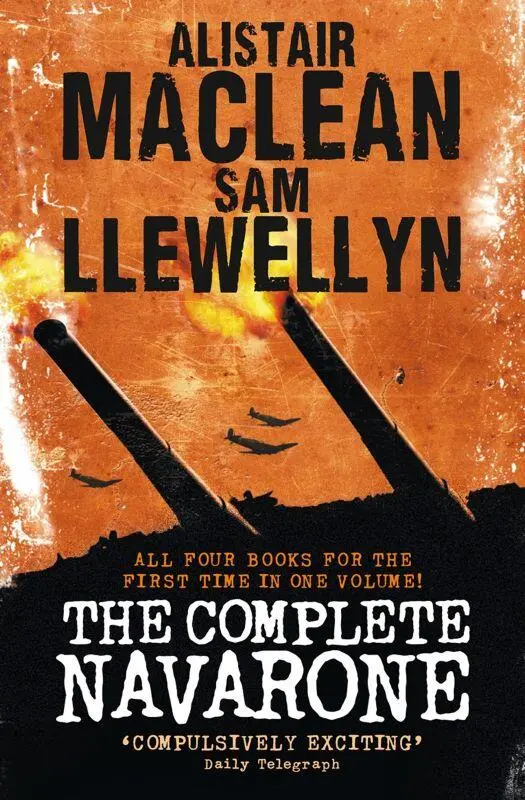
- Название:The Complete Navarone
- Автор:
- Издательство:HarperCollins
- Жанр:
- Год:2008
- ISBN:9780007438334
- Рейтинг книги:4 / 5. Голосов: 1
-
Избранное:Добавить в избранное
- Отзывы:
-
Ваша оценка:
The Complete Navarone: краткое содержание, описание и аннотация
Предлагаем к чтению аннотацию, описание, краткое содержание или предисловие (зависит от того, что написал сам автор книги «The Complete Navarone»). Если вы не нашли необходимую информацию о книге — напишите в комментариях, мы постараемся отыскать её.
THE GUNS OF NAVARONE
Mallory, Miller and Andrea are united into a lethally effective team. Their mission: to silence the impregnable guns set in the tall cliffs of Navarone. On their success or failure rests one of the most critical offensives of the Second World War.
FORCE 10 FROM NAVARONE
Almost before the last echoes of the famous guns have died away, the three Navarone heroes are parachuted into war-torn Yugoslavia to rescue a division of partisans and fulfil a secret mission, so deadly that it must be hidden even from their own allies.
STORM FORCE FROM NAVARONE
The surviving commandos are sent on a perilous journey through the Pyrenees to disable the greatest threat to the impending D-Day landings: the 'Werwolf' U-boats. But their Basque guides declare it mission impossible — D-Day is less than six days away.
THUNDERBOLT FROM NAVARONE
Summoned back to Naval HQ, Mallory, Miller and Andrea are given a final assignment: to reconnoitre the Greek island of Kynthos and destroy the German facilities developing the lethal V3 weapon. A rocket expert is to accompany them — but can he be trusted not to turn the operation into a suicide mission?
The Complete Navarone — читать онлайн ознакомительный отрывок
Ниже представлен текст книги, разбитый по страницам. Система сохранения места последней прочитанной страницы, позволяет с удобством читать онлайн бесплатно книгу «The Complete Navarone», без необходимости каждый раз заново искать на чём Вы остановились. Поставьте закладку, и сможете в любой момент перейти на страницу, на которой закончили чтение.
Интервал:
Закладка:
The concrete mixers were still grinding away below him. You did not stop concrete mixers. You kept them turning, or they went solid. From high above there descended on a cable an angel of mercy in the form of a great steel bucket.
There now began one of the longest minutes of Mallory’s life. He moved along the cable until he was standing on a concrete cornice directly above the concrete mixer. The cornice was eighteen inches wide. He lay along it, face averted from the yard.
Down below, men shouted and milled. The rain sheeted down, soaking Mallory to the skin. The bucket dropped, five feet from his right ear, clanked down into the enclosure in front of the mixer. He heard the flop of the concrete as the operator shot it down the pipe and into the bucket, the groan of the wire as it took the strain. Then the bucket was rising again.
Mallory got back on his feet. He saw the grease-black cable rise before him, no handhold there. He saw the battered steel rim of the big bucket. He knew it was now or not at all.
As the rim came up to eye level, he jumped.
His clawed fingers hit concrete-splattered steel, hung on. His toes found the flange at the top of the bucket.
Down below, someone started shouting. It was a new kind of shouting. It meant only one thing. Trouble.
He looked down. The reclaimed area was a mass of men, swarming around the wreck of the stone train like worker ants around a queen. Mallory scrambled on top of the bucket. His final glimpse stayed with him. Heads, helmeted or capped or just hairy, milling to and fro. And in the middle of all those heads, one face turned upwards into the rain, eyes wide, open-mouthed. Wehrmacht-grey shoulders. An expression of total shock.
Mallory sat on the handle of the bucket out of sight of the ground, and hoped that nobody would pay any attention to one man who had spotted something wrong with the concrete lifting gear. The cliff moved past fifteen feet away, sheer and black. Carstairs was up there somewhere; either that, or dead. Mallory would rather have been climbing. The bucket was a trap. There was no way off it –
The bucket stopped with a jerk, and hung swinging. Seven hundred and fifty feet below, little figures milled. Seven hundred and fifty feet is two hundred and fifty yards. At two hundred and fifty yards a human face is invisible, even if it is staring at you, or looking at you through binoculars, or aiming a rifle at you. Mallory drew his head back sharply. Then he looked up.
Some distance above — it was impossible to tell exactly how far, but it could have been a hundred feet — was a projection in the cliff face. A jetty or platform, crusted, by the look of it, with spilt concrete, and a crane jib. Not a crane, perhaps; a windlass. Call it what you liked, there were people up there. And the odds were that they had been warned by telephone that there was someone on the concrete bucket. So why would they halt the bucket in mid-ascent?
There were a lot of answers. The one that made the most sense to Mallory was that they were waiting for reinforcements.
Mallory looked at the cliff face. It had sloped gradually away from the bucket. Now it was a good twenty-five feet off through the rain, a wall of black basalt, but weathered up here, unsmoothed, pockmarked …
Only twenty-five feet. Too far to jump.
For a moment, Mallory watched that wall with the intensity of a falcon watching a pigeon. Then he unstrapped the lightweight rope from his pack, took a deep breath, and began.
He looped an end of the rope through the handle of the bucket, and hauled in until the two ends were equalized. He grasped the doubled rope, spat on his hands, and went over the side.
It was flimsy stuff, this silk rope, only one up from parachute cord. Harder to grip than the wire-cored Manila they had used on Navarone and in the Pyrenees; but lighter. Infinitely lighter. You could carry twice, three times the length for the same weight –
Comforting things, technicalities. They had brought him down hand over painful hand until he was hanging seventy-five feet below the bucket, like a spider on a thread, turning slowly.
He wound his left hand into the rope above his head, let go with his right. The horizon wheeled around him: clouds, the mountains on the far side of the valley, the sea, a ray of sunlight striking through the clouds making a sudden dazzling path; then the slopes and faces of the Acropolis, the cliff, twenty-five feet away, not far at all. His left hand was agony now, the rope biting like a cheese wire. His right fumbled with the rope, tying a double figure-of-eight as the world turned another forty-five degrees, ninety, to the lengthening shadows of the aeroplanes and the fuel dumps on the dim sward of the airfield. And directly below, spinning with wonderful slowness, the little corpse of the wrecked train.
The knot was finished. The two strands of the rope were tied together. Mallory jammed his right boot into the loop, and put his weight on it, and flexed his left hand to get the blood circulating again. He hung there and let the world turn another two hundred and seventy degrees. Nobody seemed to be shooting at him. When the spin had brought him face to the cliff again, he let his weight drop back.
Seven hundred feet above the wrecked train, seventy-five feet below the bucket, a hundred and seventy feet below the crane, he started to swing.
He swung like a child on a rope hung from a tree branch, except that he was a soldier an eighth of a mile from the ground. The arc grew. He could feel the air dividing in front of his face, smell, as he approached the cliff, that odd smell of hot wet rock, half clammy, half aromatic.
He started to analyse the place where he would land. His present arc would leave him somewhere too smooth. Over to the right, erosion had left a little hook, a semi-detached plate of rock with a tuft of sun-dried grass sprouting from the crevice above. It swept towards him. He reached out his hand, measuring. Just short. The next swing, he moved the axis, gave the rope a little extra pull, gained that extra ounce of speed; so that on the next swing he found himself at the top of the arc, weightless, standing for a split second on nothing, stationary at the apex of his swing. He put out his hand and grasped the little hook of rock, jamming his fingers into the crevice behind it. His weight came on to the flake. He heard his finger joints crack. His boot hit the rock. The nails found a hold. He stood for a second like a starfish, his right hand and right boot holding the cliff, his left arm and left boot engaged with the doubled rope. He shifted the foot. Now he had two boots on the face, his right hand on the flake, his left holding the rope. He would need the rope again –
The flake under his right hand gave way.
There was no warning. One second he was on the wall, getting balanced. The next he was out, falling, no holds anywhere except in his left hand, where the thin rope was sliding through his palm, and the ground far below was coming up to meet him.
He clamped his teeth and his fist at the same time. His fist slid to the knot he had tied in the end of the rope, the bulky double figure-of-eight. He stopped with a crack that tried to tear his arm out by the roots. Each swing tried to shake him off. He held on grimly. As the oscillations grew smaller, the centrifugal force was not so tormenting. He got his right hand on to the rope, then his foot. He manoeuvred himself into a standing position. He thought his knees into not shaking.
Then he started all over again.
This time, he left nothing to chance. He found a new handhold, and went for it. But this time, he committed himself only when he was quite sure. He found himself a place to stand, and he stood there, and methodically untied the figure-of-eight, and coiled the rope, and slung it, and started to climb up and to the left, into a sort of shallow gully or couloir, where he would be out of sight from below and above.
Читать дальшеИнтервал:
Закладка:
Похожие книги на «The Complete Navarone»
Представляем Вашему вниманию похожие книги на «The Complete Navarone» списком для выбора. Мы отобрали схожую по названию и смыслу литературу в надежде предоставить читателям больше вариантов отыскать новые, интересные, ещё непрочитанные произведения.



Обсуждение, отзывы о книге «The Complete Navarone» и просто собственные мнения читателей. Оставьте ваши комментарии, напишите, что Вы думаете о произведении, его смысле или главных героях. Укажите что конкретно понравилось, а что нет, и почему Вы так считаете.