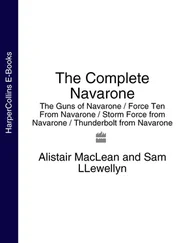
Alistair MacLean - The Complete Navarone
Здесь есть возможность читать онлайн «Alistair MacLean - The Complete Navarone» — ознакомительный отрывок электронной книги совершенно бесплатно, а после прочтения отрывка купить полную версию. В некоторых случаях можно слушать аудио, скачать через торрент в формате fb2 и присутствует краткое содержание. Год выпуска: 2008, ISBN: 2008, Издательство: HarperCollins, Жанр: sf_mystic, Триллер, prose_military, на английском языке. Описание произведения, (предисловие) а так же отзывы посетителей доступны на портале библиотеки ЛибКат.
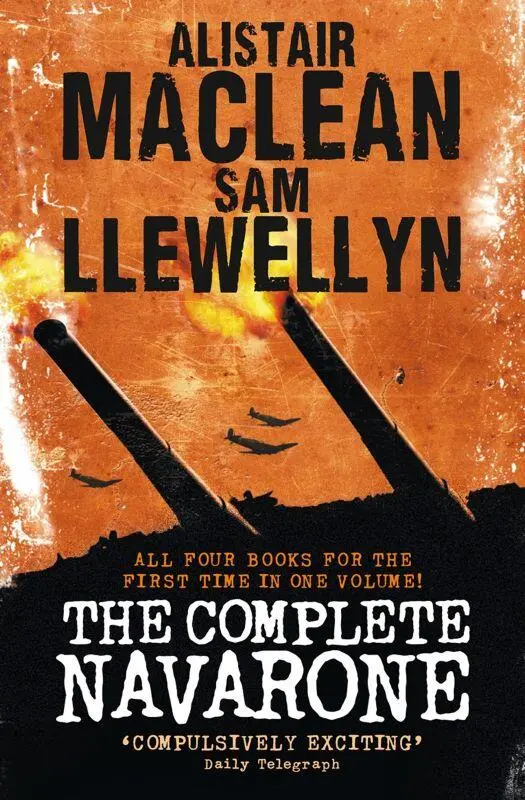
- Название:The Complete Navarone
- Автор:
- Издательство:HarperCollins
- Жанр:
- Год:2008
- ISBN:9780007438334
- Рейтинг книги:4 / 5. Голосов: 1
-
Избранное:Добавить в избранное
- Отзывы:
-
Ваша оценка:
The Complete Navarone: краткое содержание, описание и аннотация
Предлагаем к чтению аннотацию, описание, краткое содержание или предисловие (зависит от того, что написал сам автор книги «The Complete Navarone»). Если вы не нашли необходимую информацию о книге — напишите в комментариях, мы постараемся отыскать её.
THE GUNS OF NAVARONE
Mallory, Miller and Andrea are united into a lethally effective team. Their mission: to silence the impregnable guns set in the tall cliffs of Navarone. On their success or failure rests one of the most critical offensives of the Second World War.
FORCE 10 FROM NAVARONE
Almost before the last echoes of the famous guns have died away, the three Navarone heroes are parachuted into war-torn Yugoslavia to rescue a division of partisans and fulfil a secret mission, so deadly that it must be hidden even from their own allies.
STORM FORCE FROM NAVARONE
The surviving commandos are sent on a perilous journey through the Pyrenees to disable the greatest threat to the impending D-Day landings: the 'Werwolf' U-boats. But their Basque guides declare it mission impossible — D-Day is less than six days away.
THUNDERBOLT FROM NAVARONE
Summoned back to Naval HQ, Mallory, Miller and Andrea are given a final assignment: to reconnoitre the Greek island of Kynthos and destroy the German facilities developing the lethal V3 weapon. A rocket expert is to accompany them — but can he be trusted not to turn the operation into a suicide mission?
The Complete Navarone — читать онлайн ознакомительный отрывок
Ниже представлен текст книги, разбитый по страницам. Система сохранения места последней прочитанной страницы, позволяет с удобством читать онлайн бесплатно книгу «The Complete Navarone», без необходимости каждый раз заново искать на чём Вы остановились. Поставьте закладку, и сможете в любой момент перейти на страницу, на которой закончили чтение.
Интервал:
Закладка:
Mallory caught hold of the rifle barrel and pushed it sharply aside, stepping aside himself as he did so. Something very big and very fast came past him. The Feldwebel made a loud whooshing sigh, and crumpled forward over Andrea’s fist. Andrea heaved him upright. He whipped out the knife he had driven up and under the man’s ribs and into his heart, and in the same movement pushed the body back into the shadows under the crusher. The air was thick and still. A couple of big raindrops made dark blots in the dust.
Mallory lit a cigarette. Nobody said anything. Mallory blew smoke and said, ‘Listen.’
They listened. Thunder rumbled. The rails were humming. Three minutes later, the train came in.
In the cab, the driver yawned. He was German, and so was his fireman. Give a Greek this job, and nothing would get done. The soldiers were as bad. They were meant to sign each load in and out as the train went through the gate in the fence by the guard-house. But they were Wehrmacht , not railwaymen. They had made him do all the signing at the beginning of his shift, so he could come and go as he liked –
The hopper roared. He pulled forward to the second red post, applied the brakes, turned to tell the fireman to chuck a bit more coal on. The fireman was blond, with blue eyes in a sooty face. The engine driver’s mouth fell open.
This was not him. This was a man with a lean brown face and the coldest grey eyes the driver had ever seen.
The engine driver was about to shout when he felt something press against his leather jerkin. Something sharp. He felt the sting of cold steel in the fat on his belly. He closed his mouth. Fill up,’ said the man. ‘Then drive.’
The engine driver did not ask what had happened to his fireman. He said, ‘The pressure is down.’
There were two men in the cab with him now: the lean-faced man and another with an eyebrow moustache. The man with the eyebrow moustache opened the firebox, and shovelled in coal. ‘All right,’ he said. ‘Off we go, what?’
The driver blew out his oil-stained moustache. ‘No,’ he said. The thing in his belly moved a couple of inches. Skin broke. Blood rolled. It was raining now, hot, steamy rain, but the driver was suddenly bathed in cold sweat. ‘Sorry,’ he said. ‘Yes. Of course. Very well.’ His hand went to the regulator.
The leg of the hopper started to move. The train gathered speed. The quarry face faded into a grey curtain of rain. The gate loomed, guard post beside it. Mallory crouched on the footplate, and Carstairs bent, shovelling. The driver stared straight ahead, not acknowledging the wave of the crop-headed sentry drinking coffee in the wooden hut. And the train was travelling on an embankment over green fields. To the right was young corn and rain-grey sea. To the left was more young corn, terminated abruptly by a tall fence of mesh and barbed wire, with sheds and what looked like a fuel dump. Tailplanes stood like blunt sharks’ fins beyond the sheds. Ahead, down the cylinder of the ancient locomotive, the fields fell away. The train rattled through a belt of reeds. Then there were rain-pocked pools of water on either side, dead-looking, dotted with clumps of sickly vegetation. The margins of the pools were crusted with white deposits. The place had a flat, washing-soda stink. When Mallory licked his lips, his tongue was dry with lime.
Over to the left was another causeway, carrying a road. At its landward side it passed between high fences, with red-and-white-striped barriers, huts for a platoon of soldiers, and a machine-gun post on either side, one to cover the approach, the other to cover the causeway itself. Mallory was glad he had decided to come by train.
The far shore was upon them: first a glacis of new stone, then a flat area that looked as if it had been reclaimed from the marsh. Beyond the flat area, the basalt colossus of the Acropolis rose like a wall. On the far side of the reclaimed area, behind a chainlink fence, was a vehicle park. As Mallory watched, an ambulance rolled in. The doors opened. A pair of orderlies lifted out a stretcher and ran with it through the rain and into a steel door set in the face of the cliff.
Mallory glanced at Carstairs. Carstairs was watching the ambulance too.
The tracks ran across the reclaimed area on a trestled viaduct ending in a set of buffers. Below the viaduct was a pile of crushed stone. Two huge concrete mixers churned alongside the rock piles.
The train slowed to a crawl. The driver raised his hand to another lever and pulled it. The train shuddered. Looking back over the tender, Mallory saw the hopper of the first wagon tilt sideways, and dump its cargo over the side of the trestle with a roar. An explosion of dust mingled with the rain and spread over the cab.
‘Out,’ said Mallory into the fog.
When the dust settled, Carstairs was gone.
The driver reversed the engine and opened the throttle. The train shuttled back across the marshes and the fields, past the bored sentry and into the quarry. Men were still moving on the escarpment, searching. They were lower down, now.
It was only a matter of time, thought Mallory. The clock had been ticking. And now it was about to strike.
The train slowed. The locomotive came to a halt by the first red post. The driver pointed. On the steel staging beside the cab was a lever. Mallory stepped off the footplate and hauled. The hopper opened with a roar. The truck filled. Miller and Andrea appeared out of the shadows. ‘In,’ said Mallory.
Up ahead in the sentry box, there was turbulent movement. The sweaty guard came out of the door into the rain, cramming a steel helmet on to his cropped head with one hand, waving a rifle in the other. He was shouting, his words drowned by the roar of the diggers and the huge metallic pant and grind of the crusher.
It was time to leave.
The sentry had slung his rifle and was dragging the gates shut across the railway line, boots slipping in the big puddles. The train picked up speed. Mallory saw his face, red-eyed. Then the locomotive hit the gates with a crash, and there was a squeal of tortured metal, and the train was through. When Mallory looked back, he saw a wisp of smoke coming from the guardhouse window. His eyes fell on Miller. ‘I guess he sat in his ashtray,’ said Miller, returning his gaze with great innocence.
The wisp of smoke became billows, turning orange at the roots as the Thermite bomb Miller had tossed through the window burned its way through the desk and into the floor, consuming paper and timber and the sentry’s lunch, and most importantly the Bakelite of the telephone system.
‘Now listen to me,’ said Mallory.
They all listened. Even the train driver listened. He did not understand, but he trained his ears with maximum concentration on the string of incomprehensible syllables that came from the New Zealander’s lips. All of them knew that what was about to happen in the next five minutes was a matter of life and death. The train driver thought it would probably be death.
As it turned out, the train driver did not need to understand. The train thundered through dense curtains of rain into the marshes. As he stood trembling with terror, he felt himself seized by strong arms and flung like a human cannonball at the swamp. He landed in a pool of foul-smelling water that stung his eyes like caustic. When he could breathe again, he struggled on to a mud bank and lay there coughing. After a while, he heard a terrible noise.
The engine driver was a railwayman, not a soldier. He decided that discretion was the better part of valour. He still was not seeing too well. But he could locate the noise, all right. He began to crawl, swim and flounder as fast as he could in the opposite direction.
Andrea threw the engine driver out of the right-hand side of the cab, away from the greatest number of prying eyes. Then Mallory hit the throttle and jammed it right forward. Even with a full quota of trucks, the locomotive was over powered for the job. Now it was only half-loaded. As steam blasted into its cylinders it leaped forward, belching smoke, and shot across the last of the embankment. By the time it hit the trestled dumping section, it was travelling at forty miles an hour, all thirty-five tons of it.
Читать дальшеИнтервал:
Закладка:
Похожие книги на «The Complete Navarone»
Представляем Вашему вниманию похожие книги на «The Complete Navarone» списком для выбора. Мы отобрали схожую по названию и смыслу литературу в надежде предоставить читателям больше вариантов отыскать новые, интересные, ещё непрочитанные произведения.



Обсуждение, отзывы о книге «The Complete Navarone» и просто собственные мнения читателей. Оставьте ваши комментарии, напишите, что Вы думаете о произведении, его смысле или главных героях. Укажите что конкретно понравилось, а что нет, и почему Вы так считаете.