Alistair MacLean - The Complete Navarone
Здесь есть возможность читать онлайн «Alistair MacLean - The Complete Navarone» — ознакомительный отрывок электронной книги совершенно бесплатно, а после прочтения отрывка купить полную версию. В некоторых случаях можно слушать аудио, скачать через торрент в формате fb2 и присутствует краткое содержание. Год выпуска: 2008, ISBN: 2008, Издательство: HarperCollins, Жанр: sf_mystic, Триллер, prose_military, на английском языке. Описание произведения, (предисловие) а так же отзывы посетителей доступны на портале библиотеки ЛибКат.
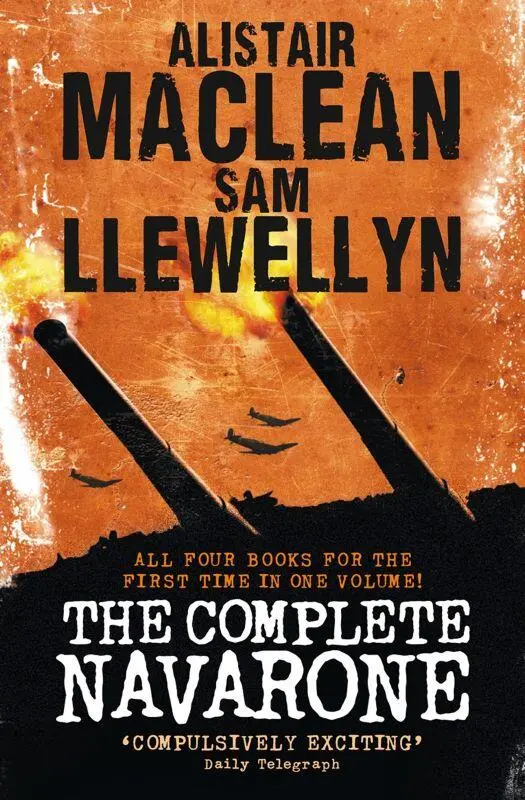
- Название:The Complete Navarone
- Автор:
- Издательство:HarperCollins
- Жанр:
- Год:2008
- ISBN:9780007438334
- Рейтинг книги:4 / 5. Голосов: 1
-
Избранное:Добавить в избранное
- Отзывы:
-
Ваша оценка:
The Complete Navarone: краткое содержание, описание и аннотация
Предлагаем к чтению аннотацию, описание, краткое содержание или предисловие (зависит от того, что написал сам автор книги «The Complete Navarone»). Если вы не нашли необходимую информацию о книге — напишите в комментариях, мы постараемся отыскать её.
THE GUNS OF NAVARONE
Mallory, Miller and Andrea are united into a lethally effective team. Their mission: to silence the impregnable guns set in the tall cliffs of Navarone. On their success or failure rests one of the most critical offensives of the Second World War.
FORCE 10 FROM NAVARONE
Almost before the last echoes of the famous guns have died away, the three Navarone heroes are parachuted into war-torn Yugoslavia to rescue a division of partisans and fulfil a secret mission, so deadly that it must be hidden even from their own allies.
STORM FORCE FROM NAVARONE
The surviving commandos are sent on a perilous journey through the Pyrenees to disable the greatest threat to the impending D-Day landings: the 'Werwolf' U-boats. But their Basque guides declare it mission impossible — D-Day is less than six days away.
THUNDERBOLT FROM NAVARONE
Summoned back to Naval HQ, Mallory, Miller and Andrea are given a final assignment: to reconnoitre the Greek island of Kynthos and destroy the German facilities developing the lethal V3 weapon. A rocket expert is to accompany them — but can he be trusted not to turn the operation into a suicide mission?
The Complete Navarone — читать онлайн ознакомительный отрывок
Ниже представлен текст книги, разбитый по страницам. Система сохранения места последней прочитанной страницы, позволяет с удобством читать онлайн бесплатно книгу «The Complete Navarone», без необходимости каждый раз заново искать на чём Вы остановились. Поставьте закладку, и сможете в любой момент перейти на страницу, на которой закончили чтение.
Интервал:
Закладка:
‘Go,’ said Mallory.
As Miller jumped, he could see a steam-shovel working, hazy and grey in the rain, but he was not thinking about witnesses, because he had fifty pounds of high explosive in his pack, and besides, Mallory and Andrea were beside him in mid-air. Then they were hitting the side of a pile of crushed stone a terrible whack, rolling over and over in a soup of falling water and wet stone dust.
The train thundered through the buffers, corkscrewed into midair, drive-wheels spinning. It lost momentum, crashed on to the rubble bed of the reclaimed ground, and tobogganed forward into the cliff. The basalt face crumpled its nose like a cardboard mailing tube and drove its boiler back into its firebox. There was a mighty roar and a thunderclap detonation. The reclaimed ground was suddenly obliterated by a scalding fog of escaping steam and rain and stone dust.
In that fog, a voice close to Miller’s ear said, ‘Go now.’ Mallory’s voice. In the background was shouting, and the churn of the concrete mixers, and a klaxon.
Miller got up, and ran behind Andrea in what he assumed was the right direction. Somewhere, the klaxon was still screaming.
Andrea was bleeding. Miller imagined he was probably bleeding himself. There was an entrance ahead, a hole in the cliff. The klaxon noise was coming out of the horn above the hole. Andrea said, in German, ‘Herein.’ In. Somewhere a sergeant was shouting, a Feldwebel telling people to take cover. Wait a minute, thought the rational part of Miller, that is a German secret weapon factory, you can’t go in there. Besides, where’s Mallory?
But by that time he was inside the mountain, and with a steady hum of hydraulics the steel door was easing to …
Was shut.
In the cellar of the ruined house above the ledge, Clytemnestra woke suddenly from a fitful sleep. Next to her she could hear the breathing of Wills: regular breathing, shallow. He was improving, she thought. Men do improve after a few days, unless they die … Her thoughts strayed towards Achilles: her own dear brother Achilles, tall and strong and quick to laugh, his falcon’s beak of a nose above the moustache, his eyes glittering with kindness and amusement. The whacking of rifle-butts on the door. The dragging away of Achilles, and her next — her last — sight of him, on the cart in the square, the Nazi swine yanking the noose taut over his head; the look in his poor eyes, that said this is really happening, to me …
Clytemnestra dragged her thoughts back from that thing too dreadful to contemplate. It had filled her mind with a turbulence that broke against the edge of her consciousness in waves of rage. She reached out her hand for her gun. She closed her fingers on the cool metal. It had a grounding effect, drew her back to the here and now.
To what it was that had woken her up.
When she remembered what that had been, she drew in her breath and did not let it out. And in the silence, that thing came again: half-way between a howl and a yelp, the distant sound of a dog. Not the sheepdogs they used in the mountains: a more purposeful sound. The sound of a dog hunting. One of the black-and-tan dogs the Sonderkommando used for hunting people.
She reached out and squeezed Wills’ hand. The feel of his warm flesh gave her encouragement. ‘What is it?’ he said.
She told him.
‘Well,’ he said. ‘We’d better do something about it, eh?’ As he said it, he felt a sense of wonder: his head was clear, his thoughts sharp. He remembered very little about the past twenty-four hours, except a blurred procession of images, feet walking over rock, Nelson, terrible dreams …
But that was all over now. He groped for his Schmeisser and snapped in a new magazine. Clytemnestra had her eye to the spy-hole in the wall. ‘How many?’ he said.
‘Four. And the dog.’
‘One feels they may be in for a bit of a shock.’
Clytemnestra said, ‘A very big shock.’ She did not go in for his English understatement. After all, there was no shock like dying.
‘Good dog, Mutzi,’ said Tietmeyer, the handler.
Marsdorff did not agree. This damned animal had dragged him and Schmidt and Kohl up a cliff in the noonday sun. It had relieved itself on a handhold, which he had then put his hand on, and of course everyone had found that very amusing. Marsdorff was a pudgy, maggot-coloured man, who owed his place in the Sonderkommando more to a lack of scruple than to any positive military talent. Basically, Marsdorff was very good at hanging people, an accomplished hand with a red-hot iron and a pair of pliers, and no beginner when it came to the process of gang rape — a business that in Marsdorff’s view was often approached crudely and without thought. A really well-handled woman could keep a squad amused for some days –
‘Good dog,’ said the handler. The Doberman on the choke lead growled and slavered, claws scritching on the bare rock as it hauled Tietmeyer up the path towards the ruined house. It had needed some persuasion to come out of the rocks by the tomb, into which it had fled after the death of its previous handler. Now it was back at work, though, it seemed enthusiastic to make amends. ‘There’s been someone in there, all right. Gone now.’
‘Oh, good,’ said Marsdorff, with sarcasm. ‘Eagles, are they? Or mountain goats?’
‘Let’s hope they’re goats,’ said Kohl, who disliked Marsdorff. ‘I don’t mind shagging a goat, but eagles are right out.’
‘You have to draw the line somewhere,’ said Marsdorff, sagely. He was not joking. ‘On a bit.’
Negligently, the four men approached the next group of ruins. They did not believe anyone was on this island who was not supposed to be. Apparently there had been shooting. Well, they would believe it when they saw it.
The path had come to a narrow place, a defile dug out between a blade of rock and the cliff. The defile ended in a sort of groove, shoulder-deep in bare rock, leading to another group of ruined houses, the first of them a massive stone building, with loopholes staring blankly at the defile and the groove. They entered the groove, Tietmeyer in the lead. In one of the loopholes, something moved; a short, slender pipe. The barrel of a machine pistol. Tietmeyer said, nervously, ‘I don’t —’ There was a large and dreadful noise, and the groove filled up with bullets. All of them jumped. None of them hit the ground alive.
Wills walked up to the bodies. He was pale again. ‘Christ,’ he said.
Clytemnestra squatted by Tietmeyer’s body and liberated his Schmeisser, half-a-dozen magazines and a bunch of stick grenades. Then she spat in the dead face, and moved on to the next corpse. Wills watched the place where the path came round the bend in the rocks. ‘They’ll be back,’ he said. ‘Unless they’re deaf.’
Clytemnestra raised a scornful eyebrow. ‘So let them come,’ she said. She pointed upwards, to where the cliff bulged out in an overhang like the brow of a stone genius. ‘If they come there, we swat them like spiders.’ She pointed over the lip of the path. ‘There, they will not come unless they are birds. From this way’ — she pointed to where the path ended among the houses — ‘also, you will need to be a bird. And up the path, all must pass between the narrow rocks. It is like the path at Thermopylae. But you have never heard of Thermopylae, I expect.’
‘Battle in ancient Greece,’ said Wills. ‘Played in a mountain pass. Three hundred Spartans v. a hundred thousand Persians. Home team triumphant. Leonidas played centre forward.’
‘So now help me with these bodies, and we should get back to the houses.’
‘Quite,’ said Wills. It would have been bad taste to point out that the heroes of Thermopylae had died while achieving their victory. He helped Clytemnestra topple the bodies over the cliff. Then he gathered up an armful of guns and bombs and scrambled after Clytemnestra back to the Swallow’s Nest.
Читать дальшеИнтервал:
Закладка:
Похожие книги на «The Complete Navarone»
Представляем Вашему вниманию похожие книги на «The Complete Navarone» списком для выбора. Мы отобрали схожую по названию и смыслу литературу в надежде предоставить читателям больше вариантов отыскать новые, интересные, ещё непрочитанные произведения.







Обсуждение, отзывы о книге «The Complete Navarone» и просто собственные мнения читателей. Оставьте ваши комментарии, напишите, что Вы думаете о произведении, его смысле или главных героях. Укажите что конкретно понравилось, а что нет, и почему Вы так считаете.