Jeffrey Lewis - The 2020 Commission Report on the North Korean Nuclear Attacks Against the United States
Здесь есть возможность читать онлайн «Jeffrey Lewis - The 2020 Commission Report on the North Korean Nuclear Attacks Against the United States» весь текст электронной книги совершенно бесплатно (целиком полную версию без сокращений). В некоторых случаях можно слушать аудио, скачать через торрент в формате fb2 и присутствует краткое содержание. Город: New York, Год выпуска: 2018, ISBN: 2018, Издательство: Mariner Books, Жанр: Фантастика и фэнтези, Триллер, на английском языке. Описание произведения, (предисловие) а так же отзывы посетителей доступны на портале библиотеки ЛибКат.
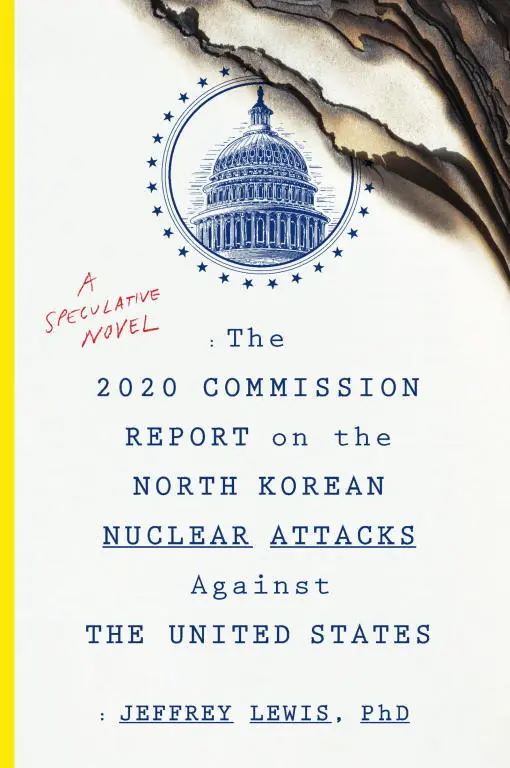
- Название:The 2020 Commission Report on the North Korean Nuclear Attacks Against the United States
- Автор:
- Издательство:Mariner Books
- Жанр:
- Год:2018
- Город:New York
- ISBN:9-781-328-57391-9
- Рейтинг книги:4 / 5. Голосов: 1
-
Избранное:Добавить в избранное
- Отзывы:
-
Ваша оценка:
The 2020 Commission Report on the North Korean Nuclear Attacks Against the United States: краткое содержание, описание и аннотация
Предлагаем к чтению аннотацию, описание, краткое содержание или предисловие (зависит от того, что написал сам автор книги «The 2020 Commission Report on the North Korean Nuclear Attacks Against the United States»). Если вы не нашли необходимую информацию о книге — напишите в комментариях, мы постараемся отыскать её.
The 2020 Commission Report on the North Korean Nuclear Attacks Against the United States — читать онлайн бесплатно полную книгу (весь текст) целиком
Ниже представлен текст книги, разбитый по страницам. Система сохранения места последней прочитанной страницы, позволяет с удобством читать онлайн бесплатно книгу «The 2020 Commission Report on the North Korean Nuclear Attacks Against the United States», без необходимости каждый раз заново искать на чём Вы остановились. Поставьте закладку, и сможете в любой момент перейти на страницу, на которой закончили чтение.
Интервал:
Закладка:
The flesh-and-blood Kim vastly preferred being outside Pyongyang, either at the beach in Wonsan or in the mountains near Kusong. And because its leader was a dictator, the entire country bent to accommodate these and all of his other whims as well. North Korea’s Strategic Rocket Force even mothballed its main missile testing site in the country’s far, freezing north in order to shift test launches of long-range missiles—always big events under Kim Jong Un—to friendlier terrain where Kim might view them in comfort. Kim had watched one missile launch from atop a ski resort near Wonsan. Another launch was conducted from a lakeshore shared with his retreat in Kusong.
Of course, discomfort could not be entirely eliminated for the supreme leader. At the moment he was informed of the explosions around Pyongyang, for example, Kim was standing in an unheated warehouse near Kusong, watching a crew prepare a long-range missile for a test the next day.
The United States was completing an annual war game hosted with South Korea, and an enormous number of forces were massed in South Korea for the exercises. From a North Korean point of view, the presence of so many enemy forces was indistinguishable from preparations for an invasion, and so North Korea always placed its own armed forces on alert for the duration of the exercises. Indeed, in recent years North Korea had begun staging missile launches to show that two could play at war. “Every year, you practiced invading us,” Jo Yong Won, a close aide to Kim, explained to his interrogators. “So every year, we practiced repelling your invasion with our nukes. It was balanced, like the Taeguk,” he added, referring to the national Korean icon that resembled the yin and yang. This ancient symbol represented interdependence and complementarity—principles that, in retrospect, were vital to the tenuous peace that had been maintained on the Korean Peninsula until this fateful moment.
The missile test whose preparations Kim Jong Un was observing on the night of March 21 was to be part of North Korea’s response to the annual American war games. A long-range missile launch, it was intended to simulate a nuclear attack against Guam. During the war game, American bombers had taken off from Guam, flown to a South Korean bombing range, and simulated a strike on the North. It was now North Korea’s turn to simulate striking Guam, demonstrating the ability to destroy those bombers with nuclear weapons before they could even take off.
In the warehouse near Kusong, Kim was watching a group of soldiers bolting a dummy warhead to a long-range missile when Choe Ryong Hae, his most important aide, whispered in his ear that there were reports of explosions in Pyongyang. Choe suggested that they immediately seek shelter. Kim agreed.
A small party was traveling with Kim—Choe, a handful of important missile engineers, and Kim’s sister, Kim Yo Jong. They immediately walked out of the warehouse and then into the basement of a nearby building. A table and chairs were brought in so that Kim could sit down while his aides tried to figure out what was happening in Pyongyang.
In the basement, Kim and his aides discovered that their cell phones were not working. They were largely cut off from any communication with Pyongyang.
Despite the common impression of North Korea before the war as a “hermit kingdom” cut off from the outside world, there were in fact more than three million cell-phone users in North Korea by 2015, largely located in and around Pyongyang. These users relied on a single state telecommunications network that was provided by a North Korean joint venture with an Egyptian firm called Orascom. The North Korean cellular network was called Koryolink.
Koryolink was a single cell-phone network that offered three separate services—one service for local North Koreans, a second service for foreigners, and a third service for government officials that was encrypted. This “third channel” was in fact the primary method used by senior leaders to communicate with one another because it was the only encrypted communications channel that North Korean leaders believed was secure from American and South Korean eavesdropping. According to Ahmed El-Noamany, an Egyptian national who served as technical director of the network from 2011 to 2013, only high-ranking officials had SIM cards that could access the third channel. North Korea relied on this channel, El-Noamany explained, because sanctions had prevented North Korea from building its own secure military communications system.
The “third channel” was not immune to disruption, however. As soon as people in and around Pyongyang saw and heard the explosions at the Kim family compound there, rumors began to spread. Cell-phone users in Pyongyang began calling and texting one another, quickly generating a mass call event that overloaded the telecommunications system. Because all three channels—domestic, foreign, and governmental—relied on the same physical network, as the calls flooded Koryolink the third channel became largely unavailable to North Korea’s leaders. Apart from sporadic text messages and calls, cell communication all but ground to a halt.
Kim Jong Un appears to have become extremely unsettled while sitting in the basement in Kusong with little or no cell-phone service. He was not accustomed to the spartan accommodations of the makeshift shelter. He was in the dark, literally and figuratively. “The supreme leader was very uneasy. He really did not like being underground or uncomfortable,” explained Kim’s aide Jo Yong Won. “The easiest way to see if he was unhappy was to watch how much he smoked. It was hard to breathe in that little room, with him smoking so much. But of course no one dared ask him to stop.”
For Kim Jong Un and his aides, the sudden inability to communicate with Pyongyang appeared to be no coincidence. “We assumed it was an American cyber-attack,” Jo said, then added, “wouldn’t you?”
With the spotty cell-phone service in the Kusong shelter, Kim Jong Un had only intermittent and unreliable updates about the situation in Pyongyang. The absence of a steady stream of reliable information led Kim Jong Un to jump to a number of conclusions based on his strongly held beliefs about the United States and South Korea. Understanding these views is essential to understanding the decisions that Kim now made.
During the extensive military operation to stabilize the shattered, post-conflict Korean Peninsula, US and United Nations forces captured thousands of hours of secret recordings of meetings, phone calls, and conferences that detailed the decision-making process of the North Korean leadership in March 2020. It is unclear whether the participants knew they were being recorded, although surviving regime functionaries said that eavesdropping and surveillance were so pervasive that they expected monitoring to be the norm. Others said that the recording reflected a culture of documentation. Although aides were always photographed taking notes, apparently many recordings also were made by personnel who wanted a record of Kim’s decisions so that they could track the implementation of his edicts. Until this material became available, the United States had only a few minutes of clandestinely taped conversations of Kim Il Sung and Kim Jong Il—and nothing from the era of Kim Jong Un—on which to base its assessment of North Korea’s decision-making.
The image of Kim Jong Un that emerges in these transcripts is that of a leader who, much like Saddam Hussein, was highly intelligent but also frequently ill-informed about the United States and the outside world. Kim was, to borrow a phrase used to describe Saddam, a “curious mix of shrewdness and nonsense.” It was this mix of shrewdness and nonsense that, in the basement at Kusong, filled in the gaps and connected the dribs and drabs of information that were trickling in.
Читать дальшеИнтервал:
Закладка:
Похожие книги на «The 2020 Commission Report on the North Korean Nuclear Attacks Against the United States»
Представляем Вашему вниманию похожие книги на «The 2020 Commission Report on the North Korean Nuclear Attacks Against the United States» списком для выбора. Мы отобрали схожую по названию и смыслу литературу в надежде предоставить читателям больше вариантов отыскать новые, интересные, ещё непрочитанные произведения.




Обсуждение, отзывы о книге «The 2020 Commission Report on the North Korean Nuclear Attacks Against the United States» и просто собственные мнения читателей. Оставьте ваши комментарии, напишите, что Вы думаете о произведении, его смысле или главных героях. Укажите что конкретно понравилось, а что нет, и почему Вы так считаете.