Jeffrey Lewis - The 2020 Commission Report on the North Korean Nuclear Attacks Against the United States
Здесь есть возможность читать онлайн «Jeffrey Lewis - The 2020 Commission Report on the North Korean Nuclear Attacks Against the United States» весь текст электронной книги совершенно бесплатно (целиком полную версию без сокращений). В некоторых случаях можно слушать аудио, скачать через торрент в формате fb2 и присутствует краткое содержание. Город: New York, Год выпуска: 2018, ISBN: 2018, Издательство: Mariner Books, Жанр: Фантастика и фэнтези, Триллер, на английском языке. Описание произведения, (предисловие) а так же отзывы посетителей доступны на портале библиотеки ЛибКат.
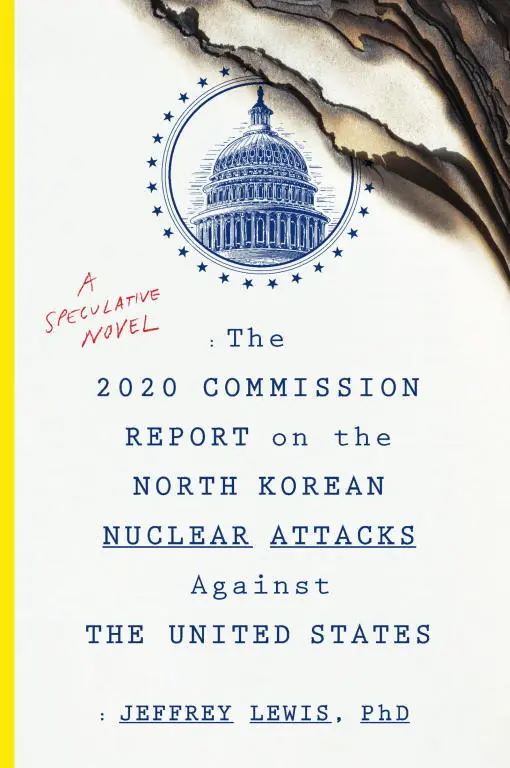
- Название:The 2020 Commission Report on the North Korean Nuclear Attacks Against the United States
- Автор:
- Издательство:Mariner Books
- Жанр:
- Год:2018
- Город:New York
- ISBN:9-781-328-57391-9
- Рейтинг книги:4 / 5. Голосов: 1
-
Избранное:Добавить в избранное
- Отзывы:
-
Ваша оценка:
The 2020 Commission Report on the North Korean Nuclear Attacks Against the United States: краткое содержание, описание и аннотация
Предлагаем к чтению аннотацию, описание, краткое содержание или предисловие (зависит от того, что написал сам автор книги «The 2020 Commission Report on the North Korean Nuclear Attacks Against the United States»). Если вы не нашли необходимую информацию о книге — напишите в комментариях, мы постараемся отыскать её.
The 2020 Commission Report on the North Korean Nuclear Attacks Against the United States — читать онлайн бесплатно полную книгу (весь текст) целиком
Ниже представлен текст книги, разбитый по страницам. Система сохранения места последней прочитанной страницы, позволяет с удобством читать онлайн бесплатно книгу «The 2020 Commission Report on the North Korean Nuclear Attacks Against the United States», без необходимости каждый раз заново искать на чём Вы остановились. Поставьте закладку, и сможете в любой момент перейти на страницу, на которой закончили чтение.
Интервал:
Закладка:
North Korea’s military leaders were rational and competent. They understood that just as the American military had defeated Iraq and just as NATO airpower had toppled Libyan dictator Muammar Gaddafi, the United States could beat North Korea in a conventional war. American military forces were, they knew, far superior to anything that North Korea could field. There was no level of ideological fervor that could blind the North Koreans to this obvious gap between their military and those of their enemies.
The goal of North Korea’s nuclear weapons program was to close that gap. Nuclear weapons, the North Koreans believed, would deter any attempt at regime change by the United States. And in the event that deterrence failed, North Korea’s military was counting on nuclear weapons to seriously damage the American invasion force and give North Korea the best shot at victory—or at least survival.
Kim Jong Un’s grandfather Kim Il Sung had believed that North Korea might be able to use nuclear weapons to destroy American forces in South Korea and Japan, thus preventing an invasion. The United States had, after all, refused to use nuclear weapons against North Korea in the 1950s, in no small part because American military officials believed that the US forces were far more vulnerable to Soviet nuclear weapons if fighting escalated. “Right now we present ideal targets for atomic weapons in Pusan and Inchon,” General Joseph “Lightning Joe” Collins had argued in a 1953 meeting. “An atomic weapon in Pusan harbor could do serious damage to our military position in Korea. We would again present an ideal target if we should undertake a major amphibious operation. An amphibious landing fleet would be a perfect target for an atomic weapon at the time when it was putting the troops ashore.”
Kim Il Sung and his generals keenly understood that American forces had an Achilles’ heel. They would be most vulnerable when they were concentrated, whether in ports or beachheads. As early as the 1960s, Kim Il Sung had told anyone who would listen that North Korea needed atomic weapons to defend itself, for the same reasons that Lightning Joe outlined.
Kim also believed that the horrific casualties arising from the use of nuclear weapons would cause the United States to stop an invasion. “As early as 1965, Kim Il-sung had said that North Korea should develop rockets and missiles to hit US forces inside Japan,” according to Ko Young-hwan, a former North Korean diplomat who defected to the United States. Such a strike would produce “casualties of somewhere between 10,000 to 20,000… in order to have anti-war sentiments rise inside the United States and cause the withdrawal of US forces in the time of war.” According to Ko, Kim Jong Il believed the same thing: “Kim Jong Il believes that if North Korea creates more than 20,000 American casualties in the region, the US will roll back and North Korea will win the war.” Like Saddam, members of the Kim family believed that the United States was casualty-averse and unable to sustain public support for military operations that involved substantial loss of American lives.
Unlike Saddam, however, North Korean military officials would never allow the United States to build up a massive invasion force immediately outside their borders. After carefully analyzing US military operations against Saddam in Iraq and Gaddafi in Libya, North Korean military officials reached the same conclusion as General Norman Schwarzkopf, who commanded US forces during the first Gulf War and who famously admitted that he would have struggled to liberate Kuwait had Saddam continued his offensive into Saudi Arabia. As one commentary that appeared in North Korean state media explained, North Korea was “well aware of [the] foolishness of Saddam Hussein who allowed the deployment of the world’s most powerful war forces just at its doorstep.” And the commentary made clear that, unlike Saddam, North Korea “would not miss an opportunity but mount an attack by mobilizing all possible forces under its possession in case there is a sign of deployment of armed forces.”
Saddam had watched the United States build up a massive invasion force in 1991 and again in 2003. The North Koreans had concluded that was suicide. Saddam’s mistake—and Gaddafi’s too—was not possessing nuclear weapons that could stop the invasion before it started. “The Saddam Hussein regime in Iraq and the Gaddafi regime in Libya could not escape the fate of destruction after being deprived of their foundations for nuclear development,” was how one North Korean statement put it.
This was precisely why North Korea’s generals hated the annual American military exercises. Each war game included a large buildup of troops, ships, and aircraft—an agglomeration of military might that could easily be an invasion force hiding in plain sight. North Korea’s generals had to watch the exercises extremely carefully for the slightest indication that this was no game. Pyongyang was constantly on guard for the day when the US military exercises turned out to be the real thing. On that day, the North Korean plan was to strike the invaders with nuclear weapons.
All North Korea missile units were trained to execute this plan. They practiced striking US forces with nuclear weapons in port and in their barracks, and they practiced destroying US airbases where airplanes were kept. And to make sure that the United States clearly understood that Kim Jong Un would not sit idly by while the United States assembled his executioners, he posed with maps showing that the DPRK planned to strike US forces throughout the region. Invariably there would be a map, held down by weights and an ashtray, showing the point where the missile had landed in the ocean. And just as invariably, some North Korean military official had drawn an arc from the splash point down to the intended target—the port in Busan, South Korea, in one case, or the US airbase near Iwakuni in Japan in another. And just to make sure the United States understood all this, North Korea released statement after statement making clear that Kim Jong Un would not hesitate to use nuclear weapons against US forces in South Korea and Japan to stop any invasion by the United States.
Now, trapped in a basement, Kim was certain that an American invasion was gathering steam. And he knew that he must act quickly if North Korean forces were to have any hope of stopping that invasion.
Still, it is one thing to have a plan on paper. It is quite another thing to go through with that plan, particularly when everything hangs in the balance. It would have been understandable if Kim had hesitated. No one, not even Kim Jong Un, would have started a nuclear war with the United States of America unless he was certain that there was no other option, no other way out. Above all, Kim wanted to live—he wanted “regime survival,” in the peculiar language of intelligence assessments. But everything he knew about surviving told him that he had to act decisively when the moment came. He could wait—but he could not wait too long. He still had intermittent cell-phone service. How long would that last? Once his cell phone stopped working, it would be too late.
In the end, Kim’s cell phone provided the final confirmation he needed. An aide showed him a tweet sent by the American president, time-stamped early in the evening at 7:03 PM Seoul time—nearly an hour before the missiles had been launched. The message was in the president’s own distinctive voice. It read:
Donald J. Trump@tehDonaldJTrump
LITTLE ROCKET MAN WON’T BE BOTHERING US MUCH LONGER!
Kim’s English, picked up in boarding school, was passable—certainly passable enough to understand what Trump meant. It was clear evidence, at least to Kim, that Trump knew about the strike in advance. Still, he showed the phone to his sister, who showed it to Choe. Everyone agreed that the tweet’s meaning was plain.
Читать дальшеИнтервал:
Закладка:
Похожие книги на «The 2020 Commission Report on the North Korean Nuclear Attacks Against the United States»
Представляем Вашему вниманию похожие книги на «The 2020 Commission Report on the North Korean Nuclear Attacks Against the United States» списком для выбора. Мы отобрали схожую по названию и смыслу литературу в надежде предоставить читателям больше вариантов отыскать новые, интересные, ещё непрочитанные произведения.





Обсуждение, отзывы о книге «The 2020 Commission Report on the North Korean Nuclear Attacks Against the United States» и просто собственные мнения читателей. Оставьте ваши комментарии, напишите, что Вы думаете о произведении, его смысле или главных героях. Укажите что конкретно понравилось, а что нет, и почему Вы так считаете.