Jeffrey Lewis - The 2020 Commission Report on the North Korean Nuclear Attacks Against the United States
Здесь есть возможность читать онлайн «Jeffrey Lewis - The 2020 Commission Report on the North Korean Nuclear Attacks Against the United States» весь текст электронной книги совершенно бесплатно (целиком полную версию без сокращений). В некоторых случаях можно слушать аудио, скачать через торрент в формате fb2 и присутствует краткое содержание. Город: New York, Год выпуска: 2018, ISBN: 2018, Издательство: Mariner Books, Жанр: Фантастика и фэнтези, Триллер, на английском языке. Описание произведения, (предисловие) а так же отзывы посетителей доступны на портале библиотеки ЛибКат.
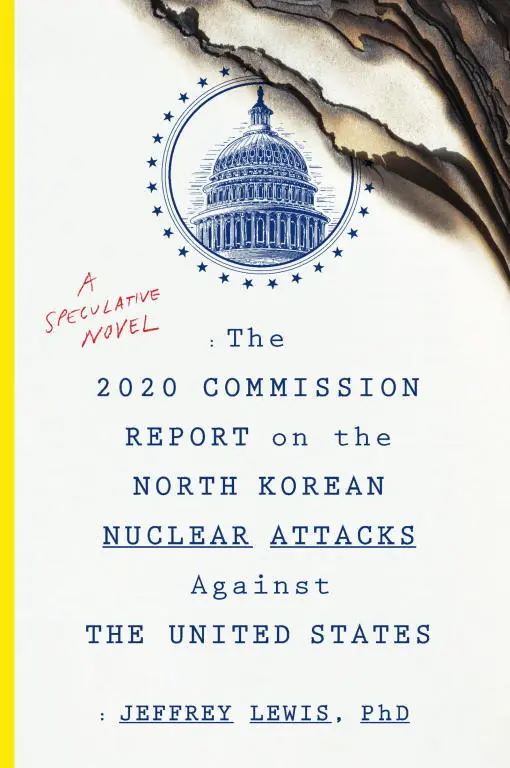
- Название:The 2020 Commission Report on the North Korean Nuclear Attacks Against the United States
- Автор:
- Издательство:Mariner Books
- Жанр:
- Год:2018
- Город:New York
- ISBN:9-781-328-57391-9
- Рейтинг книги:4 / 5. Голосов: 1
-
Избранное:Добавить в избранное
- Отзывы:
-
Ваша оценка:
The 2020 Commission Report on the North Korean Nuclear Attacks Against the United States: краткое содержание, описание и аннотация
Предлагаем к чтению аннотацию, описание, краткое содержание или предисловие (зависит от того, что написал сам автор книги «The 2020 Commission Report on the North Korean Nuclear Attacks Against the United States»). Если вы не нашли необходимую информацию о книге — напишите в комментариях, мы постараемся отыскать её.
The 2020 Commission Report on the North Korean Nuclear Attacks Against the United States — читать онлайн бесплатно полную книгу (весь текст) целиком
Ниже представлен текст книги, разбитый по страницам. Система сохранения места последней прочитанной страницы, позволяет с удобством читать онлайн бесплатно книгу «The 2020 Commission Report on the North Korean Nuclear Attacks Against the United States», без необходимости каждый раз заново искать на чём Вы остановились. Поставьте закладку, и сможете в любой момент перейти на страницу, на которой закончили чтение.
Интервал:
Закладка:
Third, why was the cell-phone network not working? For many years, the United States and North Korea had engaged in a battle to hack into and disrupt each other’s computer networks. In December 2014, North Korea suffered a massive distributed denial-of-service attack that knocked down its internet after President Barack Obama promised a “proportionate response” to allegations that North Korea had hacked the company Sony Entertainment in retaliation for an unflattering portrayal of Kim in the film The Interview . And in late 2017, the United States accused North Korea of conducting another large-scale cyber-attack called Wanna Cry. US officials declined to specify what steps the United States took in response. But it is clear that, as a result of the ongoing campaign of hacking and counter-hacking, North Korean military officials had long concluded that any American attack on North Korea was likely to begin with a cyber-attack against North Korea’s critical infrastructure, particularly the communications channel used by North Korea’s senior leaders.
It is conceivable that aides might have presented Kim with reasons for doubt. Perhaps the aircraft had suffered some kind of electrical problem that disabled the transponder? Maybe the larger war games were nothing more than a reflection of the unusually tense atmosphere? And wouldn’t explosions in Pyongyang be expected to result in a huge volume of calls and text messages that might overload the network? But there is no evidence in any of the transcripts that his aides attempted to contradict Kim. This should not be surprising, given that he was already convinced that a plot on his life was afoot. After all, an attempt to deny the existence of a plot would have only led Kim to suspect that the denier was one of the conspirators.
In fact, the small number of Kim’s surviving aides remain convinced to this day that the aircraft was in fact a bomber and that the United States staged the provocation as a pretext for an invasion under the cover of the annual FOAL EAGLE/KEY RESOLVE exercise. “History is written by victors,” Kim’s aide Jo told his interrogators. “And even if this was all a coincidence, how do you explain the missiles?”
Neither Kim nor his aides seriously considered the possibility that the missiles were South Korean or that they had been launched without the approval of the United States. The immediate assumption around Kim was that the missiles were either American or fired on orders from the United States. “We actually did discuss the fact that Moon claimed that he ordered the strike,” Jo told his interrogators. “Kim just laughed when Choe said that.”
Kim’s sister Kim Jo Yong was one of the few North Koreans other than Kim to have spoken with Moon or to have met the South Korean president in person. She played an important role in shaping Kim’s thinking at this point. According to Jo, “She smiled and said, very sweetly, ‘Don’t forget that I too spoke privately with [Moon] Jae-in during the Olympics. He doesn’t take a shit without permission from the Americans.’ I had never heard her swear before. I was very shocked.”
Kim was also receiving inaccurate information from beyond the basement. South Korea had launched only six missiles against two targets, but in the rumors racing through a panicked Pyongyang, the attack had grown to involve dozens of missiles against a much larger number of targets. It is quite common for rumors in a crisis to provide a distorted picture of events, all the more so in a closed society like North Korea, where the most important news usually arrives in the form of a rumor. Even the supreme leader had to pay attention to informal information networks. In the first thirty minutes after the attacks, with sporadic cell-phone service, Kim received conflicting information about the size of the attack and the intended targets, in some cases in reports that were dramatically exaggerated. “I think at one point Choe got a text saying that the zoo had been destroyed and one of the lions had gotten loose,” Jo recalled. “We talked for a long time about why the Americans would target a zoo and whether the lion would kill anyone.”
Eventually, Choe received a text message informing the party gathered in the basement that the Air Force headquarters had been destroyed. That explained why the Air Force was not in contact with air defense units around the country and was unable to say whether a general attack was under way or not. “The cyber-attack on our communications, the destruction of our air defenses—isn’t that how Americans always start wars?” Jo said to his interrogators.
Then, a few minutes later, word reached Kim’s sister that the family residence had been hit by another strike. This time Kim’s staff in Pyongyang had succeeded in placing a call to Kim Yo Jong in the bunker. She informed her brother that the residence had been targeted and that a small number of staff had been killed or injured. This news marked an important turning point for Kim. “In Kim’s mind, there wasn’t really any difference between an attack on his house and an attack on him,” explained one of Kim’s aides in a postwar debriefing.“You have to remember, back then, in North Korea, it was treason to even deface a poster with his picture on it. And you went and blew up his house with a missile!”
South Korea’s strike on the Kim residence created one final impression that was a most unfortunate coincidence. North Korean strategists had closely examined Operation Iraqi Freedom, the US military invasion of Iraq in 2003, to understand what a military operation against North Korea might look like. In doing so, they seized on what is generally thought of as a minor footnote in the war. The day before the invasion was set to begin, the United States received intelligence indicating that Saddam Hussein would be at a location known as Dora Farm. The Bush administration raced to design a small strike using cruise missiles in a dawn raid, hoping to kill Saddam as he slept and end the war before it could begin. After reports indicated that Dora Farm had a hardened bunker, two aircraft with four guided bombs were added to the strike package. However, while daring, the strike was a spectacular failure. Like so much of the Iraq War, it was based on flawed intelligence. Saddam had not visited Dora Farm in years. There wasn’t even a bunker at the site.
Within the United States, the strike on Dora Farm is largely forgotten—dismissed as a fool’s errand, an inconsequential, last-minute improvisation. It received little attention in after-action reports or books about the Iraq War. But in North Korea, military strategists saw something different. They saw a page in the American playbook. They believed that any invasion of North Korea would begin with an effort to isolate Kim Jong Un from his nuclear forces and, in all probability, to kill him. “How did you start your invasion of Iraq? You tried to kill Saddam in his bed and end the war before it started!” Jo reminded his interrogators. “We studied your approach very closely!”
From Kim Jong Un’s point of view, the strike on his residence outside Pyongyang was the opening gambit of an invasion. The air defenses that protected him from American bombers were under attack, and he had only intermittent communications by cell phone with what remained of his military. There was every reason to believe that American forces would follow. If Kim Jong Un was going to avoid the grisly end that had met Saddam Hussein, he concluded, he must act decisively to blunt the coming American attack.
North Korea had a single, well-developed war plan. It was based on the realistic understanding that North Korea could not hold out for long against the combined military power of South Korea and the United States.
Читать дальшеИнтервал:
Закладка:
Похожие книги на «The 2020 Commission Report on the North Korean Nuclear Attacks Against the United States»
Представляем Вашему вниманию похожие книги на «The 2020 Commission Report on the North Korean Nuclear Attacks Against the United States» списком для выбора. Мы отобрали схожую по названию и смыслу литературу в надежде предоставить читателям больше вариантов отыскать новые, интересные, ещё непрочитанные произведения.


Обсуждение, отзывы о книге «The 2020 Commission Report on the North Korean Nuclear Attacks Against the United States» и просто собственные мнения читателей. Оставьте ваши комментарии, напишите, что Вы думаете о произведении, его смысле или главных героях. Укажите что конкретно понравилось, а что нет, и почему Вы так считаете.