Ким Робинсон - Red Moon
Здесь есть возможность читать онлайн «Ким Робинсон - Red Moon» весь текст электронной книги совершенно бесплатно (целиком полную версию без сокращений). В некоторых случаях можно слушать аудио, скачать через торрент в формате fb2 и присутствует краткое содержание. Город: New York, Год выпуска: 2018, ISBN: 2018, Издательство: Orbit, Жанр: Фантастика и фэнтези, на английском языке. Описание произведения, (предисловие) а так же отзывы посетителей доступны на портале библиотеки ЛибКат.
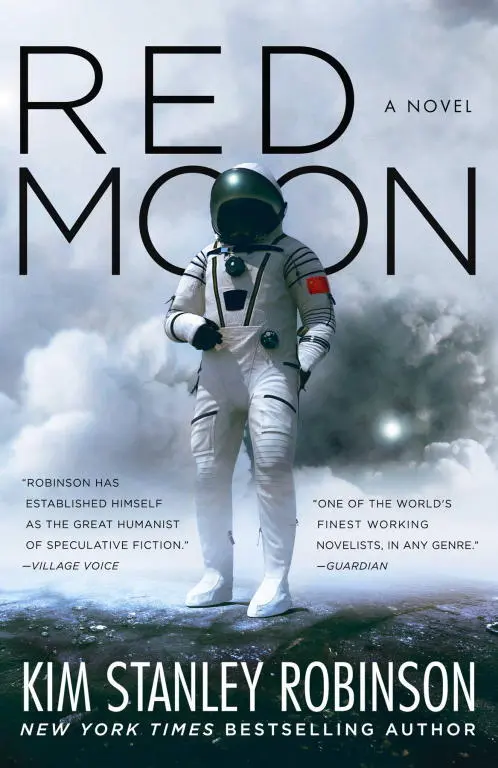
- Название:Red Moon
- Автор:
- Издательство:Orbit
- Жанр:
- Год:2018
- Город:New York
- ISBN:978-0-316-26237-8
- Рейтинг книги:3 / 5. Голосов: 1
-
Избранное:Добавить в избранное
- Отзывы:
-
Ваша оценка:
Red Moon: краткое содержание, описание и аннотация
Предлагаем к чтению аннотацию, описание, краткое содержание или предисловие (зависит от того, что написал сам автор книги «Red Moon»). Если вы не нашли необходимую информацию о книге — напишите в комментариях, мы постараемся отыскать её.
American Fred Fredericks is making his first trip, his purpose to install a communications system for China's Lunar Science Foundation. But hours after his arrival he witnesses a murder and is forced into hiding.
It is also the first visit for celebrity travel reporter Ta Shu. He has contacts and influence, but he too will find that the moon can be a perilous place for any traveler.
Finally, there is Chan Qi. She is the daughter of the Minister of Finance, and without doubt a person of interest to those in power. She is on the moon for reasons of her own, but when she attempts to return to China, in secret, the events that unfold will change everything - on the moon, and on Earth.
Red Moon is a magnificent novel of space exploration and political revolution from New York Times bestselling author Kim Stanley Robinson.
For more from Kim Stanley Robinson, check out:
New York 2140
2312
Aurora
Shaman
Red Moon — читать онлайн бесплатно полную книгу (весь текст) целиком
Ниже представлен текст книги, разбитый по страницам. Система сохранения места последней прочитанной страницы, позволяет с удобством читать онлайн бесплатно книгу «Red Moon», без необходимости каждый раз заново искать на чём Вы остановились. Поставьте закладку, и сможете в любой момент перейти на страницу, на которой закончили чтение.
Интервал:
Закладка:
But appearances could be deceiving, even this most amazing appearance. Beijing was jammed, shut down, in crisis; but elsewhere around the country, life was mostly going on as usual. News from Beijing was spread by some social media, and by phone conversations, pigeons, word of mouth; but not by the media controlled by the Party and its immense censorship complex. The Great Firewall would try to stop even this great flood. So in the end it was hard to tell what was going on. Even looking down at the real city, it was hard to tell what was real.
On the way to the airport, he changed his mind and asked Peng Ling to arrange two stops. First on the roof of a Second Ring Road crematorium, where he picked up his mother’s ashes, contained in a rectangular gold box inside a velvet bag, with a rope tie that he could close and hold. He held it as the drone lofted them to the Buddhist shrine near the North Gate, where on certain memorial days his mom had sometimes visited to burn incense. She had not been particularly devout in that way, but there was a columbarium there willing to take her ashes and place them in a wall behind a nameplate. He got out of the drone with the box, and as a monk helped him secure the box in its slot in the wall, he was reminded of his weird trip to the landfill with her junk. He hefted the box one last time, curious as to the weight of its contents, and muttered so that the monk couldn’t hear, “Ma, you have been compacted.”
But these were just her mortal remains. Her spirit was somewhere else. If it was anywhere at all, it seemed to him, it was in his brain. Her soul was now a pattern of neurons in his brain, making a certain set of memories, certain habits of mind. He himself was what remained of her in this world. He made a quick vow to her to take on the burden of keeping her going, and gave a final turn to the little wrench that the monk handed him, tightening shut the door on her remains, feeling that she would approve of his filial resolve. She had been resolute, he would be resolute. She had done her best, he would do his best. This felt almost like serenity. In any case it was resolve. He would persevere.
Then it was off to the airport.
At the Party airport he said goodbye to Peng Ling and got in a little jet with two other passengers. None of them greeted the others or said anything after they were in the air. Ta Shu sat in a right-side window seat and fell asleep for a while, overwhelmed by his long week home. If he could call it home anymore.
When he woke it was early morning. The plane flew over bare brown hills, shorn to dirt after centuries of deforestation, although here it had the look of recent work. In some places the Great Greening had proceeded, in other places it had been ignored or contradicted. Here below, the slash marks still scored the hillsides, and raw dirt roads wound down in widening spirals to the flatlands. The feng shui was simply awful. Kill the body and the spirit will go away. Then it will not be an issue. This country had been chopped up, murdered, desecrated. But what if the people who had cut down the forest on these hills were desperate to cook that night’s food? But no, it didn’t have that look. It hadn’t been cut down by hand, tree by tree, ax by ax. This had all the marks of an industrial process. Forest genocide. Thirty thousand square kilometers of China were poisoned beyond use. This patch below had just been added to that dismal total. Already there was no groundwater to speak of in the entire north.
Strangely, the plane crossed a ridge and suddenly the next watershed below them was dark green, hills glowing with a forest that looked primeval, eternal, untouched through all the dynasties. Could it be? Or had it been restored in the last few decades? It was more likely to have been restored than to have escaped history like some hidden Shambhala, but from this height it looked ancient. A very heartening sight, given what they had just been flying over. He wondered if that watershed ridge marked the Hu Line. Ninety-five percent of the Chinese population lived on the third of China that lay to the southeast of the Hu Line, five percent lived on the two-thirds of the country to the northwest of the line. That was strange, though perhaps it only marked how much people needed to live by water and fertile soil. This too was feng shui; wind and water made all the difference.
He watched the world sliding below from a consciousness that did not feel like his own. He was history; he was time; he was a buddha; he was his mother, looking back and down. Five thousand years of struggle, and where had it brought them? They were pressed against that day’s crisis, their options as small as a wedge in a crack—no way forward, no way back. What was China now? What had it been, what would it become?
As the plane descended, Ta Shu caught sight of what had to be the Three Gorges Dam. He stared down, startled at the sight. When the dam was nearing completion he had publicly grieved, recalling trips through the gorge made in his childhood. One of the great dragon arteries of China drowned, an ecological debacle: he had said this many times on his cloud show, and ever since then he had avoided visiting it.
Now he saw that he had been right to avoid it. He almost pulled down the window shade. But there was a fascination too, as when witnessing some immense catastrophe. From the perspective of the plane as it descended, the dam appeared to cross the entire visible world. It was hard to believe humans had made it; the Great Wall was a mere thread on the land in comparison. The reservoir of water extended as far to the west as he could see. Seven hundred kilometers upstream, he seemed to recall. An entire watershed drowned, two million people moved, a thousand archeological sites lost, including everything that had remained of the proto-Chinese culture that had lived there in the time before history. Earthquakes had been caused by the weight of the water, landslides, sedimentation, pollution: an ecological disaster, just as he had predicted. Not that this fulfilled prophecy gave him any satisfaction. It was the kind of devastation that should have been reserved for the moon, the land of death. To turn Earth into that kind of thing…
Well, this was what was happening. And since nothing lived on the moon, nothing died there either. So the moon was not the land of death but rather the land of nothingness, which was not the same. Earth was the land of life and death; the moon was a blank white ball in the sky. Now they were making the moon into something more than that, but what that new thing was he could not make clear to himself; nor he suspected could anyone else. They were doing it first, and later they would understand it. Or not. Just like with this dam.
When the little plane landed, the door opened and the other passengers got off. But as Ta Shu was following them, two men came up the stairs and introduced themselves: Bo Chuanli and Dhu Dai. Bo was tall and bulky, Dhu short and slight. Associates of Peng’s, they said they were, instructed to join Ta Shu on his trip. Dhu held out his wristpad and tapped it, and a small image of Peng Ling appeared on the screen and said, “Ta Shu, please let these men Bo and Dhu accompany you to the moon, it will be safest that way for all.”
“Ah,” Ta Shu said.
“Really no reason to get off the plane, if you don’t mind,” Bo said, standing in Ta Shu’s way.
“No?” Ta Shu said.
“It seems as if we should hurry a little,” Bo said calmly. Dhu stared past Bo’s elbow at Ta Shu, inspecting him to see how he would react. Suddenly this made Ta Shu wary.
“We’re from the Central Commission for Discipline Inspection,” Bo added. “Dhu is with the agency, which is run by Peng Ling, and I am the Party cadre who has been helping him.”
Читать дальшеИнтервал:
Закладка:
Похожие книги на «Red Moon»
Представляем Вашему вниманию похожие книги на «Red Moon» списком для выбора. Мы отобрали схожую по названию и смыслу литературу в надежде предоставить читателям больше вариантов отыскать новые, интересные, ещё непрочитанные произведения.

![Ким Робинсон - Годы риса и соли [litres]](/books/394367/kim-robinson-gody-risa-i-soli-litres-thumb.webp)

Обсуждение, отзывы о книге «Red Moon» и просто собственные мнения читателей. Оставьте ваши комментарии, напишите, что Вы думаете о произведении, его смысле или главных героях. Укажите что конкретно понравилось, а что нет, и почему Вы так считаете.