Ким Робинсон - Red Moon
Здесь есть возможность читать онлайн «Ким Робинсон - Red Moon» весь текст электронной книги совершенно бесплатно (целиком полную версию без сокращений). В некоторых случаях можно слушать аудио, скачать через торрент в формате fb2 и присутствует краткое содержание. Город: New York, Год выпуска: 2018, ISBN: 2018, Издательство: Orbit, Жанр: Фантастика и фэнтези, на английском языке. Описание произведения, (предисловие) а так же отзывы посетителей доступны на портале библиотеки ЛибКат.
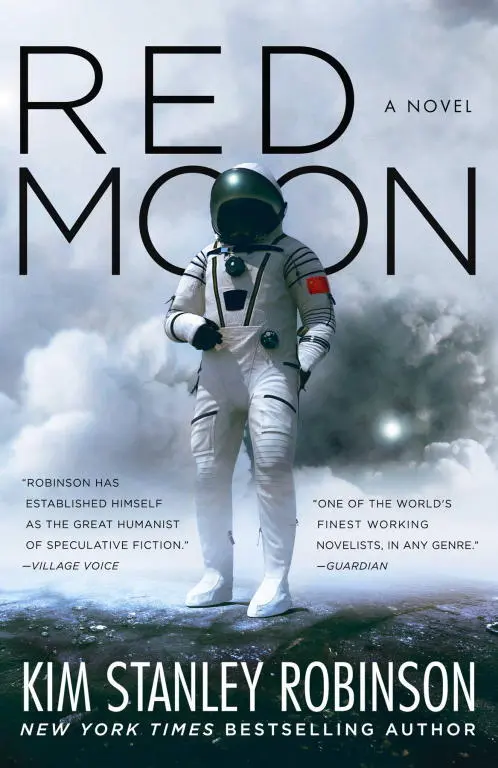
- Название:Red Moon
- Автор:
- Издательство:Orbit
- Жанр:
- Год:2018
- Город:New York
- ISBN:978-0-316-26237-8
- Рейтинг книги:3 / 5. Голосов: 1
-
Избранное:Добавить в избранное
- Отзывы:
-
Ваша оценка:
Red Moon: краткое содержание, описание и аннотация
Предлагаем к чтению аннотацию, описание, краткое содержание или предисловие (зависит от того, что написал сам автор книги «Red Moon»). Если вы не нашли необходимую информацию о книге — напишите в комментариях, мы постараемся отыскать её.
American Fred Fredericks is making his first trip, his purpose to install a communications system for China's Lunar Science Foundation. But hours after his arrival he witnesses a murder and is forced into hiding.
It is also the first visit for celebrity travel reporter Ta Shu. He has contacts and influence, but he too will find that the moon can be a perilous place for any traveler.
Finally, there is Chan Qi. She is the daughter of the Minister of Finance, and without doubt a person of interest to those in power. She is on the moon for reasons of her own, but when she attempts to return to China, in secret, the events that unfold will change everything - on the moon, and on Earth.
Red Moon is a magnificent novel of space exploration and political revolution from New York Times bestselling author Kim Stanley Robinson.
For more from Kim Stanley Robinson, check out:
New York 2140
2312
Aurora
Shaman
Red Moon — читать онлайн бесплатно полную книгу (весь текст) целиком
Ниже представлен текст книги, разбитый по страницам. Система сохранения места последней прочитанной страницы, позволяет с удобством читать онлайн бесплатно книгу «Red Moon», без необходимости каждый раз заново искать на чём Вы остановились. Поставьте закладку, и сможете в любой момент перейти на страницу, на которой закончили чтение.
Интервал:
Закладка:
“I see,” Ta Shu said. “And how will you help in this situation?”
“We think that these people you are hoping to meet on the moon are involved with the recent unrest in Beijing. You think so as well, correct?”
“I don’t know,” Ta Shu prevaricated. “How they could be involved with these events on Earth when they’re on the moon?”
They regarded him skeptically, unconvinced he could be so stupid.
“There are ways,” Dhu said. “Talking on private radios. Sending coded signals. We don’t know if any of those ways explain this, but we have been told to help you get there, and to help you in every way while you are there.”
Ta Shu looked at their faces. Security operatives. Peng Ling must have decided he needed protecting. A disturbing thought. “All right,” he said. “Let’s go.”
When they were seated, with the attached agents up near the front of the plane, Ta Shu tapped a message to Peng Ling on their private WeChat line. When several minutes passed without a response, Ta Shu began to worry. Usually she got back to him immediately. Possibly she was busy. He had no other way of contacting her, and there were no third parties who knew both of them.
As the plane took off, Ta Shu looked down again on the concrete evidence, so to speak, of the power of the Chinese Communist Party: the big dam. If he recalled correctly, it was about two hundred meters high and a few kilometers long. It seemed much bigger than that from this angle: massive, crushing, universal.
Now it seemed he might be in the grip of another part of that great power. Bo’s presence made it tangible and personal. Ta Shu knew this feeling was simply seeing the whole in a part: he had never been out of the grip of the Party, not just since being joined by these men, but for the entire length of his life. Seeing it personified by these two men changed nothing.
And now he was part of a little team organized by Peng. It was difficult to feel too resentful about this, as she had reason to want security people of her own along. Still it was worrying. He couldn’t be sure what this team’s purpose was, he was simply its front man. Maybe even its bait.
Well, bait could bite, as his father used to say. He needed to find out what Peng really wanted from him on this trip. If she was in the running to become the next president, as she had more or less confirmed in the waffle shop, then the jockeying must be intense now, an all-absorbing dogfight even in the midst of the general crisis. And what a crisis—the whole world caught up in something, it seemed, even though no one was sure what it was. Maybe they were living through a transition to some new world order, unnamed and inchoate. Maybe this was a wrestling match between elements among the elite; but maybe it was a wrestling match in which the many were trying yet again to seize power from the few. For the bait could bite.
The little plane got to altitude, and again the hills of South China filled the world. Then they flew higher, south and west, over the steep-sided mountains of Sichuan, dark green forests flanking the lower slopes of black rock ridges, with snow on the north faces of the highest peaks.
They landed on the northeast edge of the Tibetan plateau, Ta Shu thought. It wasn’t where they had taken off from the previous time Fang Fei’s organization had flown them to the moon. It looked like Fang Fei kept a personal estate up here, extending to the horizon as far as one could see. Leader Xi’s plan to make all of Tibet into a national park, which would have dwarfed any other such park on Earth, and incidentally turned the Tibetan people into something like protected wildlife, had never been implemented. But the proposal had over time changed Beijing’s treatment of the region, and the absence of a new incarnation of the Dalai Lama had left Tibetans and everyone else in a state of confusion as to what Tibet really was. Of course the Party liked it that way. And at certain times vast tracts of state-owned land had been offered for sale to individuals. As apparently here.
They got off the plane and walked into a low building with a central courtyard. All here was cool and quiet. A separate world. Bo and Dhu had disappeared with some of Fang’s people, and Ta Shu was left in the hands of a young woman named Shuling.
“How long before we take off?” he asked her.
“If you have no objections, the plan is to launch in two hours.”
“Two hours! It’s like making a connecting flight at an airport!”
She smiled nervously. “We hope you don’t mind?”
“No, it’s fine.”
He spent the interval napping. After he woke up he went outside to say goodbye to the world. He walked around in the crisp cool air, feeling the altitude in his lungs and seeing it in the sharp outlines of the low mountains to the east and south. The horizon was huge, the gravity heavy. He was tired and confused. The feng shui of this place was awesome, but he was having trouble focusing on things, and feeling them. In his mind he was still stuck in that amazing crowd, or in his mom’s apartment. At the same time, there in the distance across the sere high plain a herd of some kind of deer or antelope grazed, round-sided in the sun. Under the cobalt sky, autumn grass gleamed like gold. Life. The contrast to the little dead ball they were headed for could not have been greater. There it was above him, visible in the sky even by day—a half-moon, making the color of the sky darker by contrast—its shadowed half quite visible. It was hard to believe they were headed there.
He was rejoined by Bo and Dhu, which reminded him: still no response from Peng Ling. This was unlike her. The three of them were led through hallways and up in an elevator to a launch deck, where they stepped into another tall slender spaceship and settled onto thick seats. His seat tilted back, flight assistants connected up his seatbelts, and shortly after that the rockets rumbled distantly under them, their chairs vibrated, and off they went. Crushing pressure for a while, then no pressure at all. It was interesting to see it all become routine. Oh yes, going back to the moon—one did it all the time. He kept quiet, fell asleep.
In the hypnagogic state of drifting off, he thought he heard Bo say to Dhu, “We will follow the old man to the source of the peach blossom stream.”
Somewhere a tiger roared. He floated on a pond like a black swan.
AI 12
houhui
Regret
The analyst sat on the concrete floor of a cell. A standard prison cell, plastic bucket for a toilet, nothing else. No windows. Door solid. Air vent above. Neither comfortable nor horrid.
In his head he talked to Little Eyeball. I hope you are following the protocol for this situation, he said to the program. I hope you can help the situation even in my absence.
From here it was impossible to say, and it seemed very unlikely he would ever find out. Well, maybe. Much depended on how his friends on the outside reacted, and on many other forces outside any one person’s control. He would either be released or not. If not, he would either be questioned, which might involve torture, or shot; or left alive but incarcerated in isolation forever; or allowed to join some prison population, for some period of time or for the rest of his days. Possibly there were other options, but he didn’t want to think too much about them. It was hard not to think of the varieties of interrogation he might be subjected to, but there was no use in that, so he kept directing his mind elsewhere. The painful possibilities were known to all people at all times, everything from simple deprivations and impositions to luridly ingenious Ming mutilations. Of course the basic methods were as effective as anything fancier, old things like the ankle press (he had bad ankles), or fingernail pulling (he had arthritis in his hands). Even to think of it was painful. He had always known this possibility had existed, but it was easy to ignore when you were in your own life and felt safe. Clever, protected, shielded. In fact he wasn’t sure how they had found him. Probably he would never know. There was so much he would never know.
Читать дальшеИнтервал:
Закладка:
Похожие книги на «Red Moon»
Представляем Вашему вниманию похожие книги на «Red Moon» списком для выбора. Мы отобрали схожую по названию и смыслу литературу в надежде предоставить читателям больше вариантов отыскать новые, интересные, ещё непрочитанные произведения.

![Ким Робинсон - Годы риса и соли [litres]](/books/394367/kim-robinson-gody-risa-i-soli-litres-thumb.webp)



Обсуждение, отзывы о книге «Red Moon» и просто собственные мнения читателей. Оставьте ваши комментарии, напишите, что Вы думаете о произведении, его смысле или главных героях. Укажите что конкретно понравилось, а что нет, и почему Вы так считаете.