Ким Робинсон - Red Moon
Здесь есть возможность читать онлайн «Ким Робинсон - Red Moon» весь текст электронной книги совершенно бесплатно (целиком полную версию без сокращений). В некоторых случаях можно слушать аудио, скачать через торрент в формате fb2 и присутствует краткое содержание. Город: New York, Год выпуска: 2018, ISBN: 2018, Издательство: Orbit, Жанр: Фантастика и фэнтези, на английском языке. Описание произведения, (предисловие) а так же отзывы посетителей доступны на портале библиотеки ЛибКат.
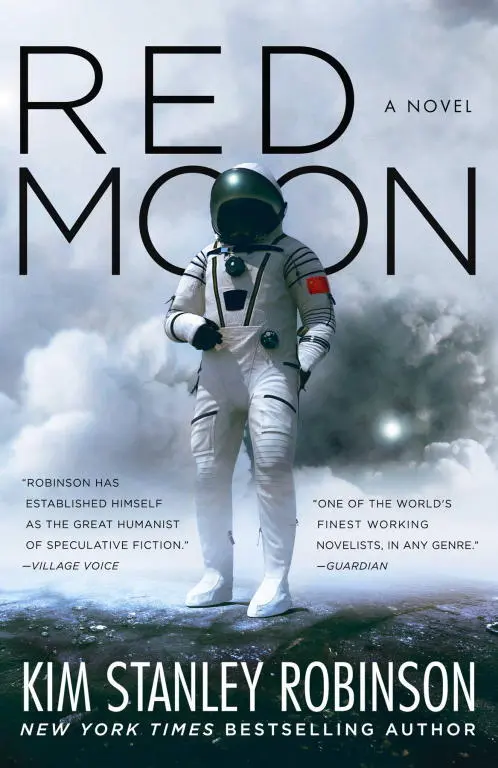
- Название:Red Moon
- Автор:
- Издательство:Orbit
- Жанр:
- Год:2018
- Город:New York
- ISBN:978-0-316-26237-8
- Рейтинг книги:3 / 5. Голосов: 1
-
Избранное:Добавить в избранное
- Отзывы:
-
Ваша оценка:
Red Moon: краткое содержание, описание и аннотация
Предлагаем к чтению аннотацию, описание, краткое содержание или предисловие (зависит от того, что написал сам автор книги «Red Moon»). Если вы не нашли необходимую информацию о книге — напишите в комментариях, мы постараемся отыскать её.
American Fred Fredericks is making his first trip, his purpose to install a communications system for China's Lunar Science Foundation. But hours after his arrival he witnesses a murder and is forced into hiding.
It is also the first visit for celebrity travel reporter Ta Shu. He has contacts and influence, but he too will find that the moon can be a perilous place for any traveler.
Finally, there is Chan Qi. She is the daughter of the Minister of Finance, and without doubt a person of interest to those in power. She is on the moon for reasons of her own, but when she attempts to return to China, in secret, the events that unfold will change everything - on the moon, and on Earth.
Red Moon is a magnificent novel of space exploration and political revolution from New York Times bestselling author Kim Stanley Robinson.
For more from Kim Stanley Robinson, check out:
New York 2140
2312
Aurora
Shaman
Red Moon — читать онлайн бесплатно полную книгу (весь текст) целиком
Ниже представлен текст книги, разбитый по страницам. Система сохранения места последней прочитанной страницы, позволяет с удобством читать онлайн бесплатно книгу «Red Moon», без необходимости каждый раз заново искать на чём Вы остановились. Поставьте закладку, и сможете в любой момент перейти на страницу, на которой закончили чтение.
Интервал:
Закладка:
His wristpad vibrated his forearm with its little electrocution, reminding him that he was still shackled to this moment of the world. He had been thinking that the cloud had probably shut down. But his wrist was vibrating insistently, and he checked it. Peng Ling wanted to talk to him.
“Hello, Ling!” he said into his wristpad. “I’m glad you called!”
“I need to see you,” she said peremptorily. The tiny image of her face on his wristpad looked unusually serious. “Can you come to me?”
“I’m caught in traffic on the south side of town,” Ta Shu told her. “Something’s going on down here.”
“It’s going on everywhere!” Peng exclaimed. “Your friend Chan Qi has triggered a march on Beijing.”
“Oh no.”
“Oh yes.”
“Why don’t you tell her to stop it?” Ta Shu asked.
“She’s disappeared. She and her American friend slipped out of Fang Fei’s place on the moon.”
“How did it happen? When?”
“Fang likes to be friendly. I don’t blame him. The whole idea of house arrest is weak to begin with. There were some visitors there who probably smuggled them out. I’ve just heard from Zhou Bao that their rover may have been spotted near Petrov Crater. Chan Qi has to have reached the near side if she’s sending laser messages home, isn’t that right?”
“I don’t know.”
“Can you get over here to talk?”
“I’m not sure. Is Tiananmen Square really closed?”
“Yes.”
“It could be hard to get to the north side.”
“That’s true. How about meeting at that waffle shop?”
“That would be easier. I can try.”
“Meet me there in two hours. That should give us both time to get there.”
“I’ll try.”
Ta Shu walked his bike east, which proved to be somewhat easier than pushing north, as he could skirt the back side of every crush. Geomancy of crowds, feeling the dragon arteries and the tangled knots. Now that this one was confirmed to be some kind of demonstration, Ta Shu could not help but think of May Thirty-fifth, also known as April Sixty-fifth, or any of the other dates that the Great Firewall had created by its ban on any mention of June Fourth, infamous for the deaths that had occurred in Tiananmen Square on that day in 1989. In that crisis some kind of pro-democracy, pro-reformist demonstration had been finally suppressed and dispersed, on Deng’s orders. They had done it by way of an influx into the city of a huge number of soldiers from all over China, moving them by train into the capital, after which some of them had fired on the crowd of students and their supporters filling the great national square. A disaster in China’s history—nothing much in terms of deaths, compared to the Cultural Revolution or any other of the earlier disasters, but undeniably it had been a moment when Chinese authorities had killed Chinese, with no involvement or incitement from outsiders. In this case it had not even been a civil war against reactionaries, but a case of civil unrest that could have been resolved without violence. The idea could not be avoided that the situation had had better solutions than to order the Chinese army to kill Chinese people. Such an act had no ren , Confucius’s central notion of ruler benevolence. Very little intelligence either. In retrospect it didn’t seem that desperate of a moment for China, or even for the Party. The leadership had probably overreacted to events elsewhere in the world, in particular the ongoing collapse of the Soviet empire. Seeing the trouble in Moscow they had panicked in Beijing, and so a number of idealistic protesters had died.
Now he was caught in a crowd of such people. Workers and urban precariat, the three withouts and the two maybe withouts, some exploited by their hukou status, some by the gig economy, some simply unemployed. The so-called billion, converging on Beijing to support the rule of law, but also, Ta Shu thought, just a decent living. The return of the iron rice bowl, or maybe even the whole work unit system, which had given several generations some stability in China’s constantly shifting economy.
Around Ta Shu people were energetically shouting. There was no way to be sure what had caused all these people to come out. They looked ready and willing to charge at tanks should those appear. But this time it wouldn’t be tanks, he thought. This time it would be drones from the sky, and what would they do then? Fear of this made him lean hard on his bike’s handlebars. But the people around him were not afraid. They had a project, a collective project, and maybe that’s what had caused this to happen, because people craved a project. Chinese history was full of them, and now one had sprung up again. Out of nothing, out of material conditions, out of the cloud—it might be very hard to find out how this had started. Although Peng Ling had all the resources of the government to look into it. But as he jammed his bike into the narrow gaps between people, Ta Shu knew for sure that this was not just one person’s doing. This was mass action, this was what mass action looked like, felt like. Despite his age, he himself had never seen it.
He followed a line of people snaking east toward Tiantan and Longtan, then turned up an alley too narrow to allow a crowd like this one to move in it, so that it was only crowded in the usual way, or a little more so. The alley snaked through its neighborhood like the lines of moving people snaked through the crush on the big streets. Though he still couldn’t ride his bike, he could walk it at a decent speed. Even so, it took more than two hours to make his way to the waffle shop, and near the end of it he felt like he was shoving the bike up a steep hill. He wished he was still wearing a body bra. What if a time came when wearing such a thing was always preferable, or even necessary? Then he would be truly old.
When he got to the waffle shop he found it was closed, but as he stood there, exhausted and stupid, a tap came on the window and one of the owners opened up the door for him and quickly locked it behind him. “She’s not here yet. She’ll be here soon.”
He groaned and handed over his bike to the woman, then hauled himself up by the banister to the upper floor of the shop. He flopped into an armchair, stared up into the constellations of antique chandeliers filling the space. The surreal sight hypnotized him into sleep.
When he woke Peng Ling was sitting on a couch across from him, sipping tea and reading her wrist.
“Sorry,” he said. “I fell asleep.”
“I just got here. You look tired.”
“Yes,” he said. “Sorry. I must smell like the garbage place and the highway both.” He shifted, groaned.
“My sympathies about your mother. I was sorry to hear.”
“She had a good life.”
“Yes. Still, when your mother goes, it changes something inside you.”
“It does. No more umbrella.”
“No more umbrella.”
Peng sipped her tea, watching him. “Maybe it would be a good thing for you to have something to do now. And I need you. This girl on the moon is causing big problems.”
“What do you mean?”
“She’s wrecking my plan!”
Ta Shu shifted in his chair. “Pour me some tea and tell me about this plan.”
Peng gestured at one of her staff to get more hot water brought to them. When it came she poured Ta Shu’s tea and stirred the cup nine times. Ta Shu sipped it and sighed happily at the taste of an oolong, possibly the one called Iron Goddess of Mercy. That would be right for his tiger friend.
“This is a big moment,” Peng Ling said. “The Party congress is in session, and a lot of the Politburo and the standing committee are aged out, including President Shanzhai. He’s trying to stack the new standing committee and get Huyou into the presidency, and then stay in charge from behind. A lot of us don’t want that. At the same time Hong Kong has returned fully to us, and people there are anxious. So as I told you before, I’m trying to slip some reforms in with all this.”
Читать дальшеИнтервал:
Закладка:
Похожие книги на «Red Moon»
Представляем Вашему вниманию похожие книги на «Red Moon» списком для выбора. Мы отобрали схожую по названию и смыслу литературу в надежде предоставить читателям больше вариантов отыскать новые, интересные, ещё непрочитанные произведения.


![Ким Робинсон - Годы риса и соли [litres]](/books/394367/kim-robinson-gody-risa-i-soli-litres-thumb.webp)


Обсуждение, отзывы о книге «Red Moon» и просто собственные мнения читателей. Оставьте ваши комментарии, напишите, что Вы думаете о произведении, его смысле или главных героях. Укажите что конкретно понравилось, а что нет, и почему Вы так считаете.