Ким Робинсон - Red Moon
Здесь есть возможность читать онлайн «Ким Робинсон - Red Moon» весь текст электронной книги совершенно бесплатно (целиком полную версию без сокращений). В некоторых случаях можно слушать аудио, скачать через торрент в формате fb2 и присутствует краткое содержание. Город: New York, Год выпуска: 2018, ISBN: 2018, Издательство: Orbit, Жанр: Фантастика и фэнтези, на английском языке. Описание произведения, (предисловие) а так же отзывы посетителей доступны на портале библиотеки ЛибКат.
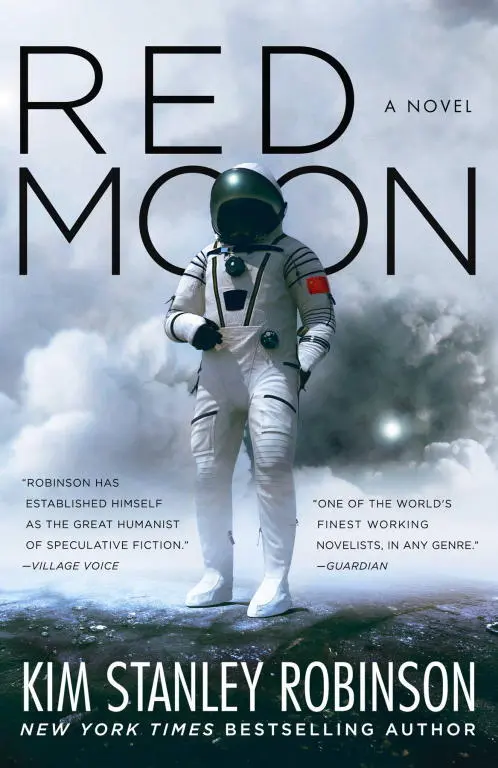
- Название:Red Moon
- Автор:
- Издательство:Orbit
- Жанр:
- Год:2018
- Город:New York
- ISBN:978-0-316-26237-8
- Рейтинг книги:3 / 5. Голосов: 1
-
Избранное:Добавить в избранное
- Отзывы:
-
Ваша оценка:
Red Moon: краткое содержание, описание и аннотация
Предлагаем к чтению аннотацию, описание, краткое содержание или предисловие (зависит от того, что написал сам автор книги «Red Moon»). Если вы не нашли необходимую информацию о книге — напишите в комментариях, мы постараемся отыскать её.
American Fred Fredericks is making his first trip, his purpose to install a communications system for China's Lunar Science Foundation. But hours after his arrival he witnesses a murder and is forced into hiding.
It is also the first visit for celebrity travel reporter Ta Shu. He has contacts and influence, but he too will find that the moon can be a perilous place for any traveler.
Finally, there is Chan Qi. She is the daughter of the Minister of Finance, and without doubt a person of interest to those in power. She is on the moon for reasons of her own, but when she attempts to return to China, in secret, the events that unfold will change everything - on the moon, and on Earth.
Red Moon is a magnificent novel of space exploration and political revolution from New York Times bestselling author Kim Stanley Robinson.
For more from Kim Stanley Robinson, check out:
New York 2140
2312
Aurora
Shaman
Red Moon — читать онлайн бесплатно полную книгу (весь текст) целиком
Ниже представлен текст книги, разбитый по страницам. Система сохранения места последней прочитанной страницы, позволяет с удобством читать онлайн бесплатно книгу «Red Moon», без необходимости каждый раз заново искать на чём Вы остановились. Поставьте закладку, и сможете в любой момент перейти на страницу, на которой закончили чтение.
Интервал:
Закладка:
Xuanzang quoted something: “‘The amount of gas left in the tank wouldn’t have filled a cigarette lighter.’”
“What does that mean?”
“About ten kilometers.”
From inside the station, someone behind a control window pointed them to one of the hookups. Once they were settled in place before it, the various arms of the refueling station extended from the wall and attached to the rover with no sign that anyone was operating them. As probably they weren’t.
When their car was hooked up and the juice had started to flow, there came an audio request asking to enter the rover, and when Xuanzang granted it and opened the door’s locks, four Chinese men came through, one after the next.
“Come with us,” one of them said to Qi.
“No,” Qi said.
“You’re under arrest,” the man explained.
“No!”
“Just come with us.” The man looked at Fred and the two miners. “All of you.”
CHAPTER SIXTEEN
tianxia
All Under Heaven
Ta Shu made two more trips on the rented bike, taking trailer loads of his mom’s detritus out to the garbage station. On his final trip, as he headed back into the city center, he found the streets growing more and more crowded. Eventually things clogged entirely. Gridlock. Something had happened up ahead. Cars and trucks stopped, motors were turned off, drivers and passengers got out and stood beside their vehicles, talking things over, even sitting on the street to heat up tea over camping stoves. Only bikes and motor scooters were still moving, weaving slowly through the maze of cars as they dodged not just vehicles but people. That made for slow going, and yet it was almost as fraught with peril as when the trucks and cars were moving, because a fair number of the people standing around were annoyed, and inclined to take that out on people still trundling through.
Near the Third Ring Road the mass of vehicles and people thickened to the point that he had to get off his bike and walk it. Even that was difficult. There was no space to move forward. He stood there holding his bike handles, puzzled. Everyone he could see looked equally mystified. Most of them wanted to be somewhere else, that was clear. So it was still a traffic jam, but for some reason it had locked up completely. And it felt different too. People stood around talking to each other or to their wrists, either agitated or resigned. The crush was so unusual that more and more faces were looking worried. What could have caused the city to seize up like this? It was always very crowded, always just a few people per block from jamming, but why today?
Ta Shu stopped by a man standing by his truck: broad flat face, red cheeks, maybe Tibetan, friendly look. Ta Shu asked what was happening and the man pointed north. Word was that something was going on. Maybe some kind of demonstration. Of course there were demonstrations every day in China, but they were always elsewhere, out in the west or down south. Here in Beijing, and this big? It was strange, even spooky. It was too big to be a demonstration.
Ta Shu stood next to his bike, resting his weight on its handlebars. He interrogated his wristpad like so many others. Traffic maps were very slow to load, they were all stalling out. Finally he got one that showed the city red everywhere, farther to the south than the north. Then an alert appeared on the map, announcing that Tiananmen Square and the area around it was closed. Ta Shu felt a stab of dread. To empty the center of the capital, the heart of China in feng shui terms, scene of so many national moments, from the glory of the declaration of national independence to the horror of July 339th—that was a clear sign that city officials, or more probably the national leadership, thought that something was very wrong. The crowd around him did not seem anything like a terrorist threat, or even a protest—too many people were involved. Although many of them, now that he looked around, did seem headed north. It was true on both sides of the street. To the extent this mass of people was moving at all, it was moving north, toward the city center.
Ta Shu found seams in the crowd and nosed his bike along. Other bicyclists were trying this, and the people stuck with their cars were getting more and more annoyed with them. The empty boxes on his bike’s trailer made it wider than it needed to be, so he untied them and left them on the ground. On he pushed, following lines of walking people he could follow north or east. Slowly the logjam was resolving into eddies of movement in various directions, as some people gave up and turned around, while others pressed on, or headed to the side. Sometimes moving lanes of people crossed each other, taking turns one by one. Everything went slowly, as if they were caught in syrup. People were more and more distant with each other, their harmony impersonal and brittle. Some still shared rumors or sympathy, but mostly they ignored the people around them, withdrawing into themselves. The whole situation was just too disconcerting. There were many, many thousands of people on the streets.
Now Ta Shu was beginning to see groups that seemed to have formed before the gridlock began. These were mostly lines of young people snaking through the crowd, holding banners and following multiperson dragons, as during New Year’s parades, some speaking through megaphones, others chanting or singing. These tuanpai , if they were youth league groups, were singing slogans like The united masses will always be victorious , or The rule of law is the rule of the land . Also: Law yes, corruption no . Also: Law over Party, law over Party .
So maybe it was a protest after all. And the content of these slogans was startling to Ta Shu, as he had been under the impression that young urban people were almost entirely molded by their social media. These netizens usually parroted the Party line, exuding an intense nationalism and rejecting any talk of the rule of law as nothing but baizuo , white left nonsense. The rule of law was self-interested pseudo universalism, they often said, promulgated by the West in its usual imperialist attempt to take over the world. A very convenient opinion from the Party’s point of view, and vigorously reiterated by many supposedly independent voices who were actually in the Party’s pay. But it had also gotten into many people’s heads who did not think of themselves as Party hacks. Even in Hong Kong a youthful attack on “leftards” was common, and to Ta Shu’s way of thinking, a discouraging sign of the mind-wiping conformism of cloudpolitics. Not that Ta Shu was a New Leftist; he was an old leftist. Laozi was his favorite political theorist.
In any case now here they were, long lines of young people snaking through the crowds singing joyfully, intensely, looking eerily like the young faces seen in photos from the time of the Cultural Revolution, or the Communist revolution, or the 1911 national revolution. No doubt if there had been cameras on hand during the White Lotus revolt they would have captured the same look, because it was always the same feeling bursting into the world: the return of the repressed. Or even dynastic succession. Perhaps the wheel had come around again.
Ta Shu hoped not with all his heart. He could not imagine China without the Party in charge. It would surely collapse into the most horrible chaos. If democracy came to China they would end up electing idiots, as in America. Best of a bad situation to let professionals work on these matters, meaning engineers, technicians, bureaucrats. Maybe.
Or maybe not. Now he began to see that many or even most of these lines of young people snaking through the crowd were not urban youth, not the netizen precariat with their wristpads and part-time service jobs. These marchers were workers, looking weather-beaten even though young. They were the hardened and hungry internal migrants, the three withouts, the billion. Many of them had to have come to Beijing from far away, although quite a few looked as if they had arrived directly from work sites. Quite a few looked like they owned little more than the clothes they stood in. Usually one saw such people in one’s peripheral vision, on work sites or through factory windows, or in the subway intent on their own lives. Now that Ta Shu had noticed them, he saw they were a big part of the mix here. They had come to Beijing to do this. A line of young women, slight and stylish, busy as sparrows, slipped forward chanting something. Factory girls, shoving people out of the way in trios or quartets of cheerful minor mayhem, moving in time to their chant, ready to gang up on obstructions. Who would oppose these dangerous young people?
Читать дальшеИнтервал:
Закладка:
Похожие книги на «Red Moon»
Представляем Вашему вниманию похожие книги на «Red Moon» списком для выбора. Мы отобрали схожую по названию и смыслу литературу в надежде предоставить читателям больше вариантов отыскать новые, интересные, ещё непрочитанные произведения.

![Ким Робинсон - Годы риса и соли [litres]](/books/394367/kim-robinson-gody-risa-i-soli-litres-thumb.webp)

Обсуждение, отзывы о книге «Red Moon» и просто собственные мнения читателей. Оставьте ваши комментарии, напишите, что Вы думаете о произведении, его смысле или главных героях. Укажите что конкретно понравилось, а что нет, и почему Вы так считаете.