Tham Cheng-E - Surrogate Protocol
Здесь есть возможность читать онлайн «Tham Cheng-E - Surrogate Protocol» весь текст электронной книги совершенно бесплатно (целиком полную версию без сокращений). В некоторых случаях можно слушать аудио, скачать через торрент в формате fb2 и присутствует краткое содержание. Город: Singapore, Год выпуска: 2017, ISBN: 2017, Издательство: Epigram Books, Жанр: Фантастика и фэнтези, Триллер, Современная проза, на английском языке. Описание произведения, (предисловие) а так же отзывы посетителей доступны на портале библиотеки ЛибКат.
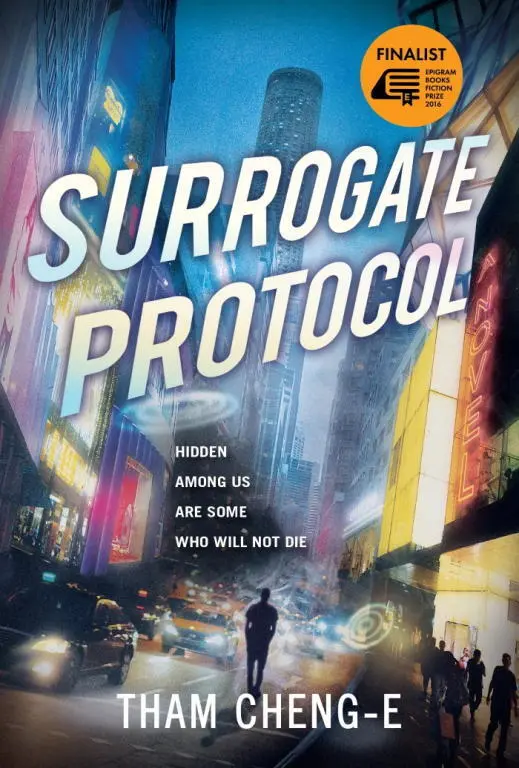
- Название:Surrogate Protocol
- Автор:
- Издательство:Epigram Books
- Жанр:
- Год:2017
- Город:Singapore
- ISBN:978-981-17-0091-0
- Рейтинг книги:5 / 5. Голосов: 1
-
Избранное:Добавить в избранное
- Отзывы:
-
Ваша оценка:
Surrogate Protocol: краткое содержание, описание и аннотация
Предлагаем к чтению аннотацию, описание, краткое содержание или предисловие (зависит от того, что написал сам автор книги «Surrogate Protocol»). Если вы не нашли необходимую информацию о книге — напишите в комментариях, мы постараемся отыскать её.
Landon Locke is no ordinary barista. A man of many names and identities, he has lived though many lifetimes, but his memory spans only days.
Danger brews as Landon struggles to piece together reality through his fog of amnesia. A mysterious organisation called CODEX bent on hunting him down, a man named John who claims to be a friend, and women from Landon’s past who have come back to haunt him.
As CODEX closes in, he finds himself increasingly backed into a corner. Battling an unreliable memory, Landon is forced to make a choice: who can he trust?
Surrogate Protocol — читать онлайн бесплатно полную книгу (весь текст) целиком
Ниже представлен текст книги, разбитый по страницам. Система сохранения места последней прочитанной страницы, позволяет с удобством читать онлайн бесплатно книгу «Surrogate Protocol», без необходимости каждый раз заново искать на чём Вы остановились. Поставьте закладку, и сможете в любой момент перейти на страницу, на которой закончили чтение.
Интервал:
Закладка:
“If I had the choice I’d gladly give this strength to others,” said John.
“It is a profound subject, Bowen,” said the Reverend. “People think they rule fate by making choices; they think they must always be allowed to choose even though they don’t have a clue how their life will turn out or how it must end. But you can do something about it while you’re at it. In that way you can’t blame everything on a predestined life. It’s like being assured of your salvation and not being complacent about it.
“Instead you work at it because you know it has to be that way, because you know about gratitude. When it comes to predestination you either condemn yourself right from the beginning or work the best out of uncertainties.”
“Working out your salvation.” John surprised himself with his ability to conjure a vague memory of it. “Philippians.”
“With fear and trembling,” the Reverend added approvingly. “Philippians two-twelve. It’s about being certain of what you’ve been assured of.”
“With my family and the job I have I don’t know what I’m assured of anymore.”
The Reverend regarded John with a tilt of his head and an air of paternal fondness. “I see tons of courage and strength in you, Bowen. You keep going despite the odds; a day, a minute, a second at a time, never expecting too much and hoping for nothing in return except an assurance of joy at the end of everything. The one who spurns such simple faith as religious nonsense will never learn of its strength. And the one who lives by it touches hearts and souls. Believe me. I’ve seen so many.”
John gave a contemplative nod. “Thank you, Reverend.”
“Now with your permission, Bowen, allow me pray to with you.”
John adjusts a spherical device at the corner of Landon’s bedroom where the walls and ceiling meet. One of the components of his surveillance system that disperses a nano-cloud around the property, allowing John to remotely scan every detail of any intruders within a half-mile search radius.
The bedroom is poorly lit from the single bulb. He surveys the room and studies the old bookshelf from which he had nicked a journal on his first night here. It holds Landon’s collected consciousness, saved on ink and paper. And that consciousness contains the answers to many secrets if one knows where to look. It suddenly occurs to him that whoever left the message had wanted him to know that CODEX might have already found what it was looking for.
He comes down the ladder to find Landon crouching by his poster bed, lighting his kerosene lamp. The wavering flame throws strange shadows across his face. The filmy curtains by the shuttered window sway to a night breeze that carries the scent of rain.
“The whole place could go up in flame with that,” says John.
“I don’t know why you’re doing this if you’re not staying.” Landon carefully replaces the glass vitrine. “Where will you be when they go off? I’d be long dead by then.”
“Someone will be here.” John rummages through his backpack, replaces a few coils of wiring, and starts running diagnostics on his egg-shaped chromium device. It is now lit with many colours, and a part of it bleeds into a touchpad with numbers and dials.
“I recall someone pricking my finger with that thing,” says Landon.
John looks up at him. “What did he look like?”
“Burly fellow. Think he’s got a bad eye. Sorry, can’t remember beyond that.”
John holds up the chromium egg as if to scan the air around him. “Whoever possesses this thing is a CODEX operative,” he says. “It means someone else has made contact.”
“From the Other Side?”
“Possibly.”
“What is it?”
“An omnicron.” John answers. The smallness of the device makes him look like a hunched ogre in the shadowy illumination.
“It records everything within a sphere of influence—like a black box. Chronicles events three-dimensionally through a nanocloud that picks up unseen details a video recording doesn’t, like the stuff in pockets and whoever’s standing behind you, around you. Serum technology.”
“How exactly does the Serum work?”
“It embeds itself in the host body and alters its cellular composition. Then it starts a morphological process that spreads like a cancer. But instead of killing you it renews your cellular composition and ends up slowing the ageing process.”
Landon stares at the glimmering piece. “You could make good money with it.”
John puts away the omnicron. “With the right programming the Serum has been observed to reverse the effects of many deadly ailments. Cancers, tumours, you name it. If I had the choice I’d put my daughter through the trials. But it’s so hushed up we can’t roll out its medical benefits despite knowing about them.”
“What happened to your daughter?”
“Neuroblastoma.”
“What’s that?”
“Check it up on the internet.” John makes it clear from his tone that the conversation ends here.
“I’m sorry to hear.” Landon tucks his hands in his pockets and scratches the back of his ear, as he habitually does whenever he feels tenuous about something. “I thought if you’re part of this conspiracy maybe you could help me with my identity problem. I’m beginning to look a little too young for someone over fifty.”
“CODEX has got all eyes on you now. A new identity won’t hide you.”
“I guessed. It’s just so hard these days.”
“It’s always been hard,” says John. “In the old days when we had censuses and registration ordinances CODEX had systems in place to make sure identities were as legit as they could. They had this crackpot idea of getting Chronomorph-operatives to raise a child as their own, have them registered with a legitimate identity and then take it over when it matured.”
“What happened to the child then?”
“Silenced.”
A profanity slips from Landon’s lips. “Where did they get them? They couldn’t possibly have abducted all of them?”
“Orphanages. It’s easy if CODEX ran it. They worked like farms.”
“Isn’t it easier to forge documents?”
John coils a length of cable and shakes his head. “They thought forging documents left trails, involved too many greased hands. It was supposedly easier to dispose of bodies. No one would bother with twenty or thirty missing children when there were hundreds of homeless corpses out on the streets.”
“Bloody nefarious… when did this happen?”
“At the turn of the century. It didn’t last. They called it off after a fifteen-year trial. One generation. It was a wrong move but what’s new? History’s full of wrong moves and innocent killings. Like I said—cracked.”
“Cracked as hell,” Landon says.
John bends over to zip up a compartment in his backpack and a pair of dog-tags strung with a silver cross jangle out of his shirt. He grabs them and shoves them back in.
“I didn’t know you were religious,” Landon gibes. “For spiritual protection? Or to profess your faith?”
“Neither,” says John. “It reminds me of who I am.”
“A holy man?”
“A follower of Christ.” John corrects. “Rather, I’m trying to be one.”
“Did you do it to please someone? Your wife?”
“It grew into a conviction.”
“My mother used to talk like that,” says Landon. “Couldn’t remember much of it but I always thought that’s what this thing’s supposed to do—gets you hooked.”
John shakes his head, points to his temple. “You have to work in a lot of sense to get yourself into it.”
“Why even bother?”
“Because I’m convinced it’s the truth.”
“Truth is what you make of it,” says Landon. “And faith is always blind.”
Читать дальшеИнтервал:
Закладка:
Похожие книги на «Surrogate Protocol»
Представляем Вашему вниманию похожие книги на «Surrogate Protocol» списком для выбора. Мы отобрали схожую по названию и смыслу литературу в надежде предоставить читателям больше вариантов отыскать новые, интересные, ещё непрочитанные произведения.







Обсуждение, отзывы о книге «Surrogate Protocol» и просто собственные мнения читателей. Оставьте ваши комментарии, напишите, что Вы думаете о произведении, его смысле или главных героях. Укажите что конкретно понравилось, а что нет, и почему Вы так считаете.