Tham Cheng-E - Surrogate Protocol
Здесь есть возможность читать онлайн «Tham Cheng-E - Surrogate Protocol» весь текст электронной книги совершенно бесплатно (целиком полную версию без сокращений). В некоторых случаях можно слушать аудио, скачать через торрент в формате fb2 и присутствует краткое содержание. Город: Singapore, Год выпуска: 2017, ISBN: 2017, Издательство: Epigram Books, Жанр: Фантастика и фэнтези, Триллер, Современная проза, на английском языке. Описание произведения, (предисловие) а так же отзывы посетителей доступны на портале библиотеки ЛибКат.
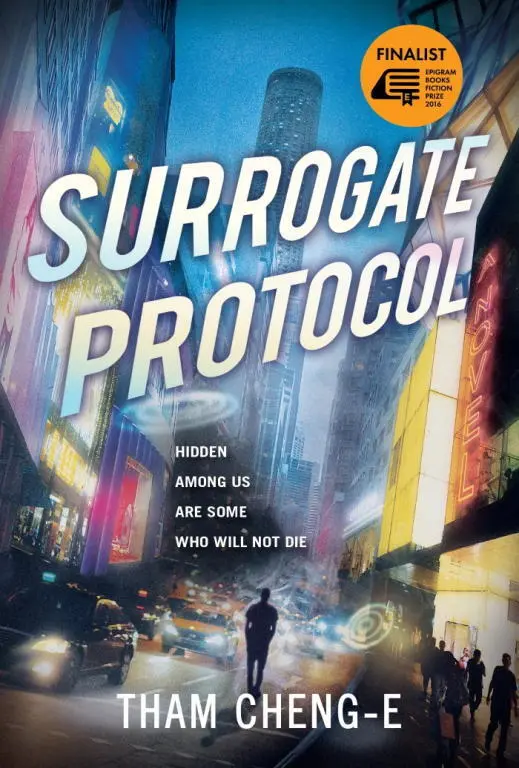
- Название:Surrogate Protocol
- Автор:
- Издательство:Epigram Books
- Жанр:
- Год:2017
- Город:Singapore
- ISBN:978-981-17-0091-0
- Рейтинг книги:5 / 5. Голосов: 1
-
Избранное:Добавить в избранное
- Отзывы:
-
Ваша оценка:
Surrogate Protocol: краткое содержание, описание и аннотация
Предлагаем к чтению аннотацию, описание, краткое содержание или предисловие (зависит от того, что написал сам автор книги «Surrogate Protocol»). Если вы не нашли необходимую информацию о книге — напишите в комментариях, мы постараемся отыскать её.
Landon Locke is no ordinary barista. A man of many names and identities, he has lived though many lifetimes, but his memory spans only days.
Danger brews as Landon struggles to piece together reality through his fog of amnesia. A mysterious organisation called CODEX bent on hunting him down, a man named John who claims to be a friend, and women from Landon’s past who have come back to haunt him.
As CODEX closes in, he finds himself increasingly backed into a corner. Battling an unreliable memory, Landon is forced to make a choice: who can he trust?
Surrogate Protocol — читать онлайн бесплатно полную книгу (весь текст) целиком
Ниже представлен текст книги, разбитый по страницам. Система сохранения места последней прочитанной страницы, позволяет с удобством читать онлайн бесплатно книгу «Surrogate Protocol», без необходимости каждый раз заново искать на чём Вы остановились. Поставьте закладку, и сможете в любой момент перейти на страницу, на которой закончили чтение.
Интервал:
Закладка:
It was true. The semi-autonomous slum dwellers, isolated from the Council administration, were rather civic-minded about fires. They even had an alarm system of roving watchmen at night. Despite lacking proper utilities and an effective postal system, the slum had an excellent communications network: a name was all that Arthur had to give to a family residing at the slum’s edge, and that name was relayed from one person to another, frisking children to labouring adults, until at last the name emerged from the tangle of alleys—a gaunt young man clothed in a frumpy singlet that hung emptily off his bony, sunburned shoulders. His hair however, was combed and oiled with liberal amounts of brilliantine.
“You must be Ar-ter,” he proclaimed loudly.
Nearby a few girls snickered. They were returning from a trip to the public tap, water-filled kerosene tins straddled across their small shoulders on bamboo poles. Arthur knew they were sniggering at his name, which meant “pig” in their dialect.
Arthur returned a nod. “I’m here for my documents. Khun said to collect today.”
The skinny young man curled a finger at him. “Ar-ter come, follow me.”
They trekked across bridges of coffin boards that spanned perilously across polluted canals and through alleys too narrow even for motorcycles. Four large pigs foraged in a squalid puddle beside a common latrine. After a series of painted wooden walls they turned a corner and crossed another narrow bridge to the next cluster of houses. Outside one of them two boys poured kerosene over four caged rats and set them alight. Then they upended the cage with a stick and had the flaming critters scurrying to their deaths.
It wasn’t long before Arthur lost track of the number of alleyways they passed or the number of corners they had rounded. The smell of charring grew stronger.
“Is it much farther?” he asked.
“We here,” his guide answered.
Arthur was hustled inside a shack, in which three men sat lunching around a table laden with little dishes of food and a blackened pot of rice porridge. The guide said something in dialect to one of them—a scraggy, dark-skinned man with a coarse gold chain that hung like a shackle around his thin neck. He gave Arthur no more than a quick dart of his eyes as he ate.
It was the guide who spoke. “Khun busy today. He tell me to give you this.”
Arthur took over a brown paper envelope from him. He tipped it and out slid IC renewal documents and a blue passport bearing a coat of arms depicting a lion and a unicorn.
“Did he say where he went?”
“Kio yi mai meng ah ni tsuay la,” the gold-shackled man said tetchily. “Kio yi gia yi e mee knia gin tsao la.”
Arthur looked away. They didn’t know that he comprehended the string of dialect and it was better left that way.
“Maybe gone downtown,” the guide added in an empathetic tone. “If your document okay give me collection money. Forty-five a week.”
“Khun said forty a week for ten weeks,” said Arthur, taking care to sound more surprised than belligerent.
“Forty-five,” said the guide. “Plus interest.”
Even a fool would know better than to fuss with the yobs of the Twenty-Four Society. In a spot like this you just had to know your way around, and Arthur came prepared. The extra five dollars were meant for them and it had always been that way. Bastards . Grudgingly he shoved a roll of notes into the guide’s open hand and trudged up the alleyway from which he came.
Or did he?
Fifty yards into the maze Arthur realised he was lost. He stood in the middle of the alley like a rock between streams of kampong folks going about their business in a shade of unspoken apprehension. The distant column of smoke was still rising, and it had widened considerably such that it gave its end of the sky a stormy hue.
A squad of volunteer firefighters appeared from around a street corner. They were young men in their teens, some of whom bore red tin buckets and hooked poles that were used to dislodge burning attap roofs. A last man was dragging a partly reeled fire hose with its end burnt away. They were sooty and soaked.
The buzz of human activity amassed around the battered firefighters. The nest was stirred. Following a brief exchange of words the crowd hurriedly dispersed, scurrying in all directions in a sort of organised panic. Messages were hollered and relayed. Ablebodied men sprang into action fetching pails and empty kerosene tins. Nearby a group of caterwauling women began trundling out children and cast-iron sewing machines.
A southerly wind carried an acrid odour, and Arthur knew for certain that a conflagration was underway. Someone ran into his shoulder; the tides of panic were pouring into the alleys. At the base of the smoke column Arthur saw sporadic flashes of orange—his first glimpse of the flames.
He folded the documents securely into his pocket and packed himself into the growing lines of fleeing folks, certain that they would lead him out. Behind him another pail-wielding firefighting squad began dousing the attap roofs with water. Farther south he saw steam rising.
The lines led him around a bend, possibly towards the direction of Delta Circus. Just ahead an old woman joined the human river, her arms wrapped around two live hens. Somewhere in the middle a family rolled out bulky furniture and halted the flow. Hysteria spread amongst the fleeing folks as powerful updrafts hurled zinc roofing sheets into the sky. Close behind, flames raged over the roofs of doomed homes. Heavy black smoke suffocated everything in billows of umbral gloom.
Waves of frenetic jostling shoved Arthur onto the threshold of an abandoned, ramshackle home where he spotted a peculiarity. Amidst a clutter of greasy rags and wicker baskets, a bundle of blue chequered cloth moved. Then a corner of the cloth fell away to reveal a small, pudgy hand.
The discovery frightened him and the panic Arthur thought he had under control surged forth. He began hollering in a mixture of English and dialect and pointing to the infant. But few paid attention.
A passing woman responded, “Nei fai di pou houi zhao le! Ngor dou mm ji bin gor hai hui ke lou-mou.”
She had a baby on her back and two young children clutching her trousers. Arthur was burdened by nothing. He scooped the bundle into his arms. It felt light. Parting the swaddle, he found an emaciated toddler with ribs showing, limp as a stringed puppet and clothed in nothing but a pair of brown shorts.
To the right, a group of men tore away a large section of attap roof in the hope of creating a firebreak, but instead sent flames billowing from a burning structure behind it. Arthur pressed the child to his chest and ran himself up against the wall of fleeing folks. A few of them tripped over their own possessions. They hustled to pick them up and were quickly left behind. Explosions rang out from the kitchen of another house when the fire got to its kerosene stock. Flames rolled over a window and ravenously consumed its attap roof. Against declining visibility Arthur tried in vain to locate his bearings. He knew nothing of the route except that they were now shuffling towards higher terrain.
An explosion engulfed the Beo Lane warehouses to a barrage of screams. Livestock, corralled and doomed, squawked and bleated into the streams of fleeing folks. Farther ahead looters carted rice and crates of tinned milk and canned food out of provision shops.
The torrent of fleeing folks poured into the safety of Havelock Road and Arthur found himself deposited on the sidewalk. The road was choked with the cars of rubbernecking drivers, who hadn’t realised they were obstructing the arriving fire trucks. A curious crowd lined the skeletal structures of unfinished flats at the nearby Ma Kau Tiong estate as if the fiery spectacle were a football game.
Читать дальшеИнтервал:
Закладка:
Похожие книги на «Surrogate Protocol»
Представляем Вашему вниманию похожие книги на «Surrogate Protocol» списком для выбора. Мы отобрали схожую по названию и смыслу литературу в надежде предоставить читателям больше вариантов отыскать новые, интересные, ещё непрочитанные произведения.






Обсуждение, отзывы о книге «Surrogate Protocol» и просто собственные мнения читателей. Оставьте ваши комментарии, напишите, что Вы думаете о произведении, его смысле или главных героях. Укажите что конкретно понравилось, а что нет, и почему Вы так считаете.