Tham Cheng-E - Surrogate Protocol
Здесь есть возможность читать онлайн «Tham Cheng-E - Surrogate Protocol» весь текст электронной книги совершенно бесплатно (целиком полную версию без сокращений). В некоторых случаях можно слушать аудио, скачать через торрент в формате fb2 и присутствует краткое содержание. Город: Singapore, Год выпуска: 2017, ISBN: 2017, Издательство: Epigram Books, Жанр: Фантастика и фэнтези, Триллер, Современная проза, на английском языке. Описание произведения, (предисловие) а так же отзывы посетителей доступны на портале библиотеки ЛибКат.
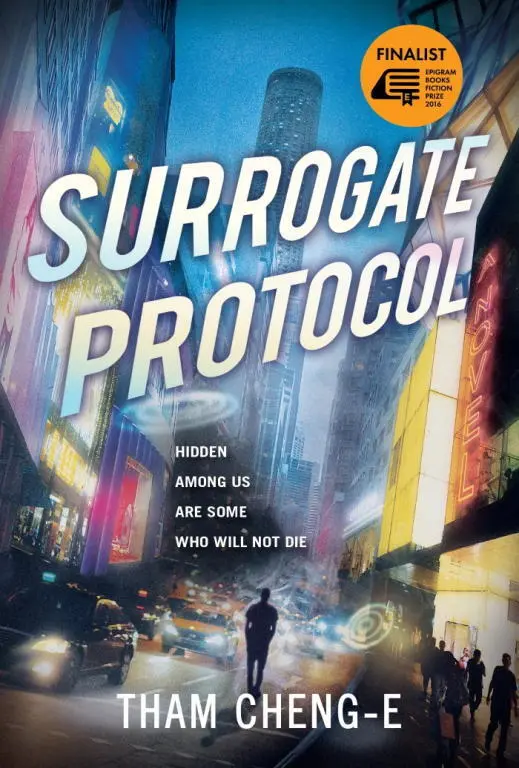
- Название:Surrogate Protocol
- Автор:
- Издательство:Epigram Books
- Жанр:
- Год:2017
- Город:Singapore
- ISBN:978-981-17-0091-0
- Рейтинг книги:5 / 5. Голосов: 1
-
Избранное:Добавить в избранное
- Отзывы:
-
Ваша оценка:
Surrogate Protocol: краткое содержание, описание и аннотация
Предлагаем к чтению аннотацию, описание, краткое содержание или предисловие (зависит от того, что написал сам автор книги «Surrogate Protocol»). Если вы не нашли необходимую информацию о книге — напишите в комментариях, мы постараемся отыскать её.
Landon Locke is no ordinary barista. A man of many names and identities, he has lived though many lifetimes, but his memory spans only days.
Danger brews as Landon struggles to piece together reality through his fog of amnesia. A mysterious organisation called CODEX bent on hunting him down, a man named John who claims to be a friend, and women from Landon’s past who have come back to haunt him.
As CODEX closes in, he finds himself increasingly backed into a corner. Battling an unreliable memory, Landon is forced to make a choice: who can he trust?
Surrogate Protocol — читать онлайн бесплатно полную книгу (весь текст) целиком
Ниже представлен текст книги, разбитый по страницам. Система сохранения места последней прочитанной страницы, позволяет с удобством читать онлайн бесплатно книгу «Surrogate Protocol», без необходимости каждый раз заново искать на чём Вы остановились. Поставьте закладку, и сможете в любой момент перейти на страницу, на которой закончили чтение.
Интервал:
Закладка:
John slings his backpack over his shoulder. “How blind is mine, do you think?”
“Very. If it isn’t empirically justified.”
John gives a slight sigh, as if he is about to launch into an explanation he has repeated many times over. “You’re making the mistake of assuming that faith and the empirical negate each other. In reality they don’t. There is a kind of Truth unattainable by the empirical. That’s where faith comes in.”
Landon shrugs. “All believers claim their brand of mumbo jumbo is Truth.”
“I’ve got the only mumbo jumbo telling us we’re so depraved that it’s the Almighty who had to make the first move by nailing himself to a piece of wood for our damned sakes so we won’t burn in hell. If there truly is a God you would’ve expected this much of him, wouldn’t you?”
Landon pulls out a pipe from his pocket and tries to light it with shaky fingers. “It’s the first time I heard you curse,” he says. “You said ‘damned’.”
“I promised Ginn I’d cut back on it. And the cigarettes.”
“Ginn your wife?”
“No, a prehistoric relative.”
Landon chuckles and ejects a stream of smoke. “I almost believed you.”
John checks his watch, picks up two black briefcases and shoulders past him on his way out. “I’ll be remotely observing the property so don’t call me at the slightest shadow or sound. It’s just a precaution, nothing more.”
Somehow John’s reassurance sounds like juvenile wheedling. Landon examines the hardy little transmitter in his hand and surveys the length of wires running across the ceiling and corridor, and the tiny red lights of sensors and monitors planted amongst the antiquated clutter. Someone is out to murder him and the reality of it hits him like molten surf.
“I’ll see myself out.” John raises a hand in farewell and treads soundlessly downstairs.
Landon doesn’t follow. He stands morosely by the doorway of his bedroom, pipe in hand. The screech of a car engine rises and falls away into silence. Against the stillness he hears the ticking of the clock. It reads one in the morning. A gust of wind fills the curtains. A few minutes later, the first drops of rain amplify into a downpour. He rushes over to the windows and slams them shut. He checks all the rooms and makes it doubly certain that all openings are latched and doors locked. Twice he conducts a tour of the house and finds a note on the dining table:
You forgot our durian date.
Left you a pack and some mangosteens in the fridge. I drop by tomorrow night with nasi lemak from Boon Lay market. Hope you feeling better. Very worried when I saw accident on TV—Cheok.
He berates himself and promises to make it up. As a final measure he tucks a kitchen knife under his mattress and another beneath his pillow. He reads a few journal entries by lamplight. Even then the adrenaline continues coursing through his body, denying him sleep. Over the next hour he leafs through the pages, paying particular attention to entries from the 1960s.
One entry describes a visit to the Van Kleef aquarium with a child on his fourth birthday. The child was given a tin of biscuits and ended up sharing them with whoever came his way because he wanted the empty tin more than anything else. They devoured sugared ice balls and watched the bumboats off Clifford Pier at dusk, then they romped about the lawn and fired off firecrackers left over from the Lunar New Year celebrations. The accounts of the child ended abruptly in March 1965.
And the memory of that fateful day surfaces.
Landon presses the journal to his chest and a teardrop smudges the ink. “Oh Poppy…” He shudders with waves of grief. “I’m so, so sorry…”
26
MAY 1955
FOUR ROWS OF women, most of whom were driven by penury, knelt on burlap sacks and sorted coffee beans by their colour and appearance. The beans lay in furrows on the warehouse floor, and the women would remove defective ones not picked up during hulling. Everyone worked quietly.
The sounds of the riot came from afar—a cacophony of Mandarin slogans and frightful, belligerent shouting. They ebbed and flowed like roars from a distant football game. When they fell away that meant the water jets were being employed. If the rioters took their cause here they’d torch the slums and the police wouldn’t lift a finger. It would only have been convenient.
A round of irascible shouting sounded unnervingly close. The workers looked so nervous that Arthur decided to send them home while there was still daylight. He then chained up the large barn-doors just as the exterior came alive with the clatter of booted feet, accompanied by the hollow shrill of a police whistle. The din drove Arthur behind a timber column below the mezzanine deck. A shape rushed across the vertical slits between sheets of zinc cladding.
He picked up a shovel and hid in a shadowed corner. The chained doors erupted in a hail of frantic pounding.
Indecision gnawed at him, and as he dithered the pounding fell to a series of slow, infuriated beats. Arthur wanted to harden his heart and wait it out, hoping that the rioter would give up. But a pang of pity drove him to approach the door.
His hesitation made him clumsy, and he knocked the shovel over. The noise gave him away, and the pounding at the door rose in tenacity. He held his breath. It could be an entire gang for all he knew. But having decided that he did not stand on the side of the police, he unchained the door.
The stranger leapt in like a gust of wind, dressed in a shirt, a bandana and a pair of oversized slacks. Before Arthur could react the stranger closed the doors and threaded the chain through them.
“Lock,” he demanded, his voice muffled behind a damp towel that obscured half of his face. At first it felt like the stranger was calling his name, then Arthur felt the padlock in his hand and quickly thrust it out.
At the snap of the lock the stranger withdrew from the door and watched another menagerie of shapes fleet by, accompanied by more whistle shrills and shouting. When the commotion ebbed the stranger pulled off the bandana and surprised Arthur by shaking free a headful of long, damp locks.
“Hannah,” she said with a huff, lifting her flushed, sweaty cheeks.
He shook her hand. Her slender fingers were soft and cold to the touch.
“They killed a policeman.” She slumped onto a sack. “Torched him alive in his car. I heard they beat the hell out of a man somewhere near Alexandra Circus.”
Arthur found no reason to speak, so he listened.
“It pissed them off,” she swung her hair from one shoulder to the other and wrung water out of them. “They chased us down and whipped us with everything they’ve got. They turned back at the edge of Bukit Ho Swee though; wouldn’t risk following us into the alleys.”
“Hmm.”
“Some rioters got shit for brains,” she groused. “A chap was wounded by a gunshot, I told them to get him to a doctor but they refused, preferring instead to parade him around the crowds till he died. He was what—seventeen? Don’t think they’re here for the cause. They just joined up for fun.”
Arthur finally got his voice back. “What business have you with them?”
“Anti-colonialism,” said Hannah. “I don’t care much for the Hock Lee drivers but if part of the cause goes to merdeka, count me in. I held banners for them and performed some dances in the morning to cheer them on. Joined in the march until things turned ugly.”
“You’re from one of those Chinese schools.”
“Joined the student movement in ‘53.”
“You speak very good English for a Chinese-ed.”
“Thank you,” said Hannah. “And you don’t look very Chinese yourself.”
Читать дальшеИнтервал:
Закладка:
Похожие книги на «Surrogate Protocol»
Представляем Вашему вниманию похожие книги на «Surrogate Protocol» списком для выбора. Мы отобрали схожую по названию и смыслу литературу в надежде предоставить читателям больше вариантов отыскать новые, интересные, ещё непрочитанные произведения.









Обсуждение, отзывы о книге «Surrogate Protocol» и просто собственные мнения читателей. Оставьте ваши комментарии, напишите, что Вы думаете о произведении, его смысле или главных героях. Укажите что конкретно понравилось, а что нет, и почему Вы так считаете.