Tham Cheng-E - Surrogate Protocol
Здесь есть возможность читать онлайн «Tham Cheng-E - Surrogate Protocol» весь текст электронной книги совершенно бесплатно (целиком полную версию без сокращений). В некоторых случаях можно слушать аудио, скачать через торрент в формате fb2 и присутствует краткое содержание. Город: Singapore, Год выпуска: 2017, ISBN: 2017, Издательство: Epigram Books, Жанр: Фантастика и фэнтези, Триллер, Современная проза, на английском языке. Описание произведения, (предисловие) а так же отзывы посетителей доступны на портале библиотеки ЛибКат.
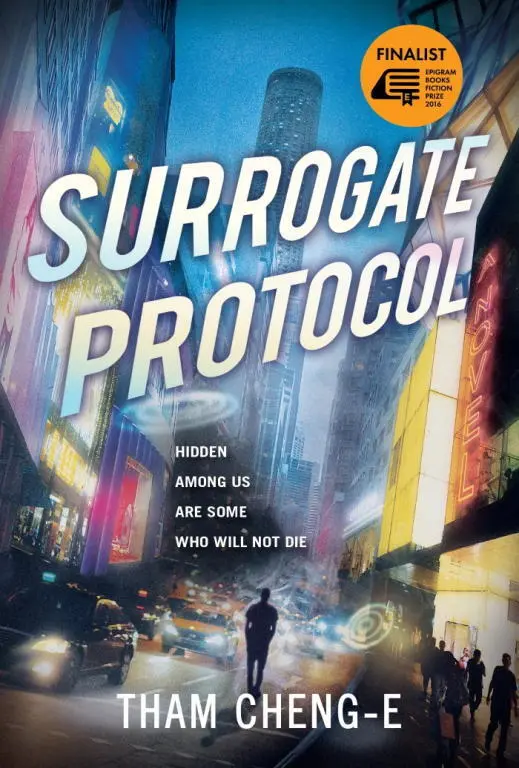
- Название:Surrogate Protocol
- Автор:
- Издательство:Epigram Books
- Жанр:
- Год:2017
- Город:Singapore
- ISBN:978-981-17-0091-0
- Рейтинг книги:5 / 5. Голосов: 1
-
Избранное:Добавить в избранное
- Отзывы:
-
Ваша оценка:
Surrogate Protocol: краткое содержание, описание и аннотация
Предлагаем к чтению аннотацию, описание, краткое содержание или предисловие (зависит от того, что написал сам автор книги «Surrogate Protocol»). Если вы не нашли необходимую информацию о книге — напишите в комментариях, мы постараемся отыскать её.
Landon Locke is no ordinary barista. A man of many names and identities, he has lived though many lifetimes, but his memory spans only days.
Danger brews as Landon struggles to piece together reality through his fog of amnesia. A mysterious organisation called CODEX bent on hunting him down, a man named John who claims to be a friend, and women from Landon’s past who have come back to haunt him.
As CODEX closes in, he finds himself increasingly backed into a corner. Battling an unreliable memory, Landon is forced to make a choice: who can he trust?
Surrogate Protocol — читать онлайн бесплатно полную книгу (весь текст) целиком
Ниже представлен текст книги, разбитый по страницам. Система сохранения места последней прочитанной страницы, позволяет с удобством читать онлайн бесплатно книгу «Surrogate Protocol», без необходимости каждый раз заново искать на чём Вы остановились. Поставьте закладку, и сможете в любой момент перейти на страницу, на которой закончили чтение.
Интервал:
Закладка:
“I have a bit of everything.”
Hannah pouted and gave a nod of disinterest. She sniffed the air and picked up a handful of coffee beans from a sack beside her. “What kind?”
“Lintong Arabica,” Arthur replied. “From Sumatra.”
“Can you tell by smelling them?”
“Of course.”
“You can?” Hannah’s eyes grew wide. “No.”
Arthur shrugged.
“Where did you learn to speak English?” she asked.
“The free Malay school provided by the British.”
“That was a very long time ago.” The suspicion in Hannah’s tone rang sharp. “You must be older than you look. Are you a local?”
“Yes.”
“You got identification?”
“Why should I show it to you?”
“You haven’t got any?” It didn’t sound like a question.
He felt demeaned. “I’m not obliged to answer.”
“Then don’t.” Hannah held him in a haughty stare. “But I want to thank you for what you did. Drop by at the Chinese middle school along Goodman Road at four pm tomorrow.”
“What are we doing?”
“Just come.”
Arthur tried to appear indifferent to her offer. “It’s near where I live.”
Hannah tilted her head the other way and ran her fingers through her hair. “So where do you live?”
“Clacton Road.”
“Ah.” Hannah stood up and headed for the exit. In seconds the lock snapped open in her hands and the chains rolled off the door. She stole a look outside and winked at Arthur over her shoulder. “Don’t be late then.”
The Chinese middle school was a sprawling compound of oblong classroom blocks of whitewashed concrete capped with Chinese hipped roofs. It had a field and a miniature lake stippled with duckweed, hyacinths and lotus pads. A concrete architrave framed the school gates and bore its name in calligraphic Mandarin ideograms.
Arthur found the gates latched and locked. After waiting for half an hour he resolved to leave; it was then he noticed what appeared to be coffee beans laid out along the roadside kerb, at intervals where one bean was just within visual range of another. He picked them up as he went and found that they led him to a point of entry—a part of the chain-link fence that had come loose.
The coffee trail now skirted a water-damaged quadrangle and stretched on to the foot of a classroom block. There it led up a staircase flanked by concrete screens tessellated in motifs of clouds and bats. He scaled four flights of steps before the trail ended at a corridor below the overhanging roof eaves. It ran on beside a series of decrepit rooms choked full of dusty furniture, cardboard props, old fabrics and other worthless items. From the depths of these cryptic spaces drifted the haunting melody of Romance Anónimo .
It was being played on a guitar in a halting, amateurish manner. Arthur followed it to the end of the corridor and found Hannah seated before a mountain of plastic chairs beside the stairwell.
“Late,” came her laconic greeting. She was in uniform—a clean white blouse and light brown skirt. She looked very good in them.
“It took me a while to figure out your candy trail.”
“Excuses.” Hannah put away her guitar. “Sit down.” She gestured at one of the empty chairs near him, some flecked with old paint and dusty with chalk. As soon as Arthur sat down she said, “So what coffee beans are those?”
Arthur took a whiff of the heap in his hand. “Regular stuff.”
“Not hard to tell by my gainful employment of them.”
“A blend,” Arthur took another whiff. “Mostly robusta. Indonesia, Lampung maybe.”
“Astounding. I’m impressed.”
“Thank you.” Arthur gave a gracious bow of his head. “You’re pretty astounding yourself at picking locks.”
Hannah slow-blinked her eyes and pressed her lips into a deliberate, pensive smile. Apparently she had no intention of responding to Arthur’s shifty commendation. It was obvious that he had suspected something.
“I thought school’s closed?” he added. Her stare was lingering too long for comfort.
“It is.”
“Why are you in uniform?”
“Had to look convincing. Makes it easier for me to leave home.”
“You mean to your parents?”
Hannah shrugged. “Whoever stupid enough to be fooled. School’s the safest place there is during a curfew. Do you like my little hideout?”
“It’s decent.”
“You don’t recognise me, do you?” said Hannah.
Arthur’s heart made a pleasant leap. He did not expect the question and for a moment his mind stalled. “Have we met?”
Hannah suddenly exuded an air of insouciance. “Perhaps as passing strangers.”
“I’m sorry, I don’t remember well.”
“Don’t be.” Hannah chirped with her chin in her hand. She crossed her fair, slender legs and started flexing an ankle habitually and went on looking cheekily at him.
Arthur basked in this, the company of a lovely stranger, but he was increasingly flummoxed over what was going on. “So what are we doing here?”
“You’re expecting a kiss? Perhaps something more?”
Arthur’s ears turned hot.
“I’m in the identity business,” said Hannah, now appearing rather pompous and impish about it. “I thought I could get you one.”
Arthur had to concede that her admission disappointed him.
Hannah put her chin back into her hands. “Are you an illegal immigrant?”
“No.”
“Born and bred here?”
“Yes.”
“Liar,” said Hannah. “You would’ve got yourself an identity when the registration ordinance came about in ‘48.”
Arthur had rehearsed for such conversations. “I got a registration of live birth back in ‘38. When the ordinance came about they told me I was too young to register, since I was under twelve and without a guardian. I tried again when I was fifteen but they rejected me because they said my birth registration was nothing more than a hospital record and that they’ve received too many forgeries to believe my story.”
“How old are you, exactly?”
“Seventeen.”
“You don’t look seventeen.”
“I take it as a compliment.”
“Don’t take it too far.”
Arthur threw out his arms a display of helplessness. “They wanted someone else who could validate my identity before they’d have me registered. When I told them my entire family died in the war they told me to get a guardian who would do so.”
“Rotten colonial administration,” Hannah griped, mumbling. “Then again, a live birth registration isn’t proof of identity. If the police catch you in the vicinity of any riots they’ll label you a commie and have you arrested.”
“With the way I look?” Arthur touched a finger to his nose. “You can’t be serious.”
“Eurasians aren’t off the list,” said Hannah. “Communism ranks as the highest threat to the region after the Japanese. They’ll still put you through a nice long interrogation and once they discover you’re without an identity they’d have you deported to China. But I could offer some help to fix this.”
Arthur listened glumly. The romantic prospect of the encounter was vanishing like mist in the sun. What better place to hold such surreptitious conversation than the old attic of a closed school at the break of curfew? Hannah was simply being practical. A kiss would’ve made his day. Even a braided friendship band would help. At least it would’ve suggested a beginning. But Hannah, as he had suspected, wasn’t what she seemed.
“So you accepting my help or not?” said Hannah.
“You can get me an identity?”
“Of course. It’s my business.”
“All right.”
Hannah smiled sweetly and rose to her feet.
Читать дальшеИнтервал:
Закладка:
Похожие книги на «Surrogate Protocol»
Представляем Вашему вниманию похожие книги на «Surrogate Protocol» списком для выбора. Мы отобрали схожую по названию и смыслу литературу в надежде предоставить читателям больше вариантов отыскать новые, интересные, ещё непрочитанные произведения.








Обсуждение, отзывы о книге «Surrogate Protocol» и просто собственные мнения читателей. Оставьте ваши комментарии, напишите, что Вы думаете о произведении, его смысле или главных героях. Укажите что конкретно понравилось, а что нет, и почему Вы так считаете.