Olaf Stapledon - Odd John
Здесь есть возможность читать онлайн «Olaf Stapledon - Odd John» весь текст электронной книги совершенно бесплатно (целиком полную версию без сокращений). В некоторых случаях можно слушать аудио, скачать через торрент в формате fb2 и присутствует краткое содержание. Город: London, Год выпуска: 2012, ISBN: 2012, Издательство: Hachette UK, Жанр: Фантастика и фэнтези, на английском языке. Описание произведения, (предисловие) а так же отзывы посетителей доступны на портале библиотеки ЛибКат.
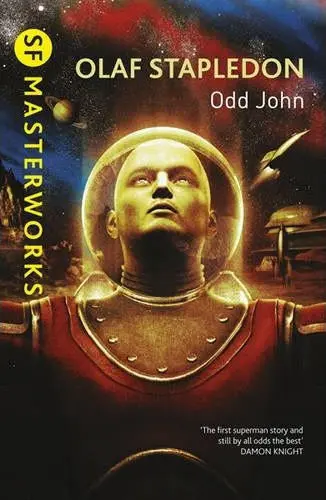
- Название:Odd John
- Автор:
- Издательство:Hachette UK
- Жанр:
- Год:2012
- Город:London
- ISBN:9780450038570
- Рейтинг книги:5 / 5. Голосов: 1
-
Избранное:Добавить в избранное
- Отзывы:
-
Ваша оценка:
Odd John: краткое содержание, описание и аннотация
Предлагаем к чтению аннотацию, описание, краткое содержание или предисловие (зависит от того, что написал сам автор книги «Odd John»). Если вы не нашли необходимую информацию о книге — напишите в комментариях, мы постараемся отыскать её.
Odd John — читать онлайн бесплатно полную книгу (весь текст) целиком
Ниже представлен текст книги, разбитый по страницам. Система сохранения места последней прочитанной страницы, позволяет с удобством читать онлайн бесплатно книгу «Odd John», без необходимости каждый раз заново искать на чём Вы остановились. Поставьте закладку, и сможете в любой момент перейти на страницу, на которой закончили чтение.
Интервал:
Закладка:
But though passably ‘human,’ according to the standards of Homo sapiens , she was strange. Were I an imaginative writer, and not merely a journalist, I might be able to suggest symbolically something of the almost “creepy” effect she had on me, something of its remote and sleepy power. As it is I can only record certain obvious features, and in general that curious combination of the infantile, or even the foetal, with the mature. The protruding brow, the short broad nose, the great distance between the great eyes, the surprising breadth of the whole face, the marked furrow from nose to lips—all these characters were definitely foetal; and yet the precisely chiselled lips themselves and the delicate moulding of the eyelids produced an expression of subtle experience suggestive of an ageless divinity. To me at least, prepared of course by familiarity with John’s own strangeness, this strange face seemed to combine idiosyncrasy and universality. Here, in spite of a vaguely repulsive uncouthness, was a living symbol of womanhood. Yet here also was a being utterly different from any other, something unique and individual. When I looked from her to the most attractive girl in the room I was shocked to find that it was the normal beauty that was repulsive. With something like vertigo I looked once more at the adorable grotesque.
While I was watching her, she and John stood regarding one another in complete silence. Presently the New Woman, as I had already cynically named her for my private amusement, asked us to move to her table, which we accordingly did. Her real name was given as Jacqueline Castagnet. The old lady, introduced as Mme. Lemaître, regarded us with hostility, but had to put up with us. She was thoroughly commonplace; yet I was struck with certain points of likeness with Jacqueline, certain indescribable traits of expression and of voice. I guessed that the two women were mother and daughter. Later it turned out that I was right; and yet also quite wrong.
There followed a few aimless remarks, and then Jacqueline began speaking in a language quite unknown to me. For a second John looked surprised, then laughed, and answered, apparently in the same tongue. For half an hour or so they continued speaking, while I laboured to maintain conversation with Mme. Lemaître in very bad French.
Presently the old lady reminded Jacqueline that they were both due elsewhere. When the two women had left us, John and I remained at the table for a while. He was silent and absorbed. I asked what language they had been talking. “English,” he said. “She wanted to tell me a lot about herself, and didn’t want the old one to know about it, so she started in on English-back-to-front. I’ve never tried that before, but it’s quite easy, for us.” There was a faint stress on the “us.” John evidently knew that I felt “left out,” for he continued: “I had better tell you the gist of what she said. The old lady is her daughter, but doesn’t know it. Jacqueline was married to a man called Cazé eighty-three years ago, but she cleared out when the child was four. A few days ago she came across this old thing, and recognized her as her baby daughter, and made friends with her. Mme. Lemaître showed her a photograph ‘of my mother who died when I was quite little—strangely like you, my dear. Perhaps you are some sort of great niece of mine.’ Jacqueline herself was born in 1765.”
John’s account of the amazing life story of Jacqueline I can only summarize. It deserves to be recorded in a fat volume, but my concern is with John.
Her parents were peasants of that bleak country called “Lousy Champagne,” between Châlons-sur-Marne and the Forest of Argonne. They were thrifty even to miserliness. Jacqueline, with her supernormal intelligence and sensibility and her ravenous capacity for life, was brought up in very cramping circumstances. This was probably a cause of the passion for pleasure and power which played so great a part in the earlier phases of her career. Like John, she took an unconscionable time a-growing up. This was a grievance to her parents, who were impatient for her to help in the house and on the land, and later were indignant that at an age when other girls were ready for marriage she was still a breastless child. The life which she was compelled to lead was physically healthy, but devastating to her spirit. She soon realized that she had capacities for all manner of subtle experience beyond the reach of her fellow mortals, and that the sane course was to devote herself to the exercise of these capacities; but her monotonous and dour existence made it impossible for her to detach herself from the less developed cravings of her nature, the increasing hunger for luxury and power. The fact that she inhabited a world of half-wits was borne in on her most obviously in the perception that the neighbouring peasants’ daughters, though they eclipsed her in normal sexual appeal, were too stupid to make full use of this asset as a means to dominance.
Before adolescence had properly begun, when she was only nineteen, she had already determined to beat them all at their own game, and indeed to become a queen among women. In the neighbouring town of Ste. Menehould she sometimes saw fine ladies passing through in their coaches on their way to Paris, or breaking their journey at the local inn. She observed them with scientific care, and laid the foundations of her future technique.
When she was on the threshold of womanhood, her parents betrothed her to a neighbouring farmer. She ran away. Making full use of her only two weapons, sex and intelligence, she struggled through from the humblest and most brutish sort of prostitution to become the mistress of a wealthy Parisian merchant. For some years she lived upon him, latterly giving him nothing in return but the terrible charm of her society once a week at dinner.
When she had reached the age of thirty-five she fell in love, for the first time in her life, with a young artist, one of those who were preparing the way for the vital and triumphant movement of Parisian painting. This novel experience brought to a climax the great conflict which tormented her. She who had followed the most ancient profession without repugnance was now horrified at herself. For the young man had wakened in her those dormant capacities which had perforce been thwarted by her career. She used her technique to capture him, and easily succeeded. They lived together. For a few months both were happy.
Gradually, however, she came to realize that, after all, she was mated to something which, from her point of view, was little better than an ape. She had known, of course, that her peasant clients, her Parisian clients, and her amiable wealthy patron, were “subhuman”; the artist, she had persuaded herself, was an exception. Yet she still clung to her man. To break with the being to whom she had given her soul, even though in error, would, she felt, have killed her. Moreover, she still genuinely, though irrationally, loved him. He was her almost-human animal. She cared for him as a huntswoman and a spinster might care for her horse. He was not human, and could never be the mate of her spirit; but he was a noble animal and she was proud of his animal attainments, namely of his triumphs in the sphere of “subhuman” art. She entered into his work with enthusiasm. She was not merely his source of inspiration; increasingly she took command of his artistic faculty. The more she possessed him, the more clearly the unhappy man realized that his native genius was being overborne and suffocated by the flood of her fertile imagination. His was a complex tragedy. He seems to have recognized that the pictures which he produced under her influence were more daring and aesthetically more triumphant than anything he could produce without her; but he realized also that he was losing his reputation, that even the most sensitive of his follow-artists could not appreciate them. He made a stand for independence, and began to regain his self-respect and reputation. On her this turn of affairs had the effect of rousing all her suppressed disgust. Each was striving to be rid of the other, yet each craved the other. There was a quarrel, in which she played the part of the divinity who had come down to raise him to her own level, and was rejected. Next day he shot himself.
Читать дальшеИнтервал:
Закладка:
Похожие книги на «Odd John»
Представляем Вашему вниманию похожие книги на «Odd John» списком для выбора. Мы отобрали схожую по названию и смыслу литературу в надежде предоставить читателям больше вариантов отыскать новые, интересные, ещё непрочитанные произведения.







Обсуждение, отзывы о книге «Odd John» и просто собственные мнения читателей. Оставьте ваши комментарии, напишите, что Вы думаете о произведении, его смысле или главных героях. Укажите что конкретно понравилось, а что нет, и почему Вы так считаете.