Olaf Stapledon - Odd John
Здесь есть возможность читать онлайн «Olaf Stapledon - Odd John» весь текст электронной книги совершенно бесплатно (целиком полную версию без сокращений). В некоторых случаях можно слушать аудио, скачать через торрент в формате fb2 и присутствует краткое содержание. Город: London, Год выпуска: 2012, ISBN: 2012, Издательство: Hachette UK, Жанр: Фантастика и фэнтези, на английском языке. Описание произведения, (предисловие) а так же отзывы посетителей доступны на портале библиотеки ЛибКат.
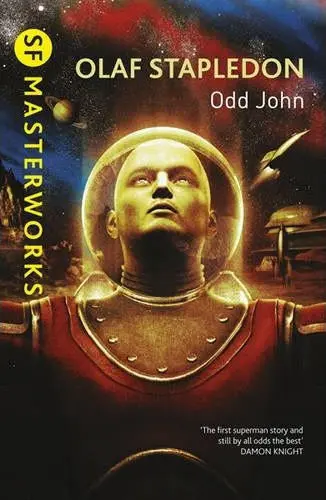
- Название:Odd John
- Автор:
- Издательство:Hachette UK
- Жанр:
- Год:2012
- Город:London
- ISBN:9780450038570
- Рейтинг книги:5 / 5. Голосов: 1
-
Избранное:Добавить в избранное
- Отзывы:
-
Ваша оценка:
Odd John: краткое содержание, описание и аннотация
Предлагаем к чтению аннотацию, описание, краткое содержание или предисловие (зависит от того, что написал сам автор книги «Odd John»). Если вы не нашли необходимую информацию о книге — напишите в комментариях, мы постараемся отыскать её.
Odd John — читать онлайн бесплатно полную книгу (весь текст) целиком
Ниже представлен текст книги, разбитый по страницам. Система сохранения места последней прочитанной страницы, позволяет с удобством читать онлайн бесплатно книгу «Odd John», без необходимости каждый раз заново искать на чём Вы остановились. Поставьте закладку, и сможете в любой момент перейти на страницу, на которой закончили чтение.
Интервал:
Закладка:
Suddenly the spell broke, and I leapt up to put more coal on the fire. John was gazing out of the window, and saying, in his normal friendly voice, “Well, of course I can’t tell you what that special quality is, can I? Think of it this way. It’s seeing each thing, each event, on its eternal side, instead of merely as a dated thing; seeing it as a living leaf on the tree Yggdrasill, flushed with the sap of eternity, and not merely as a plucked and dried and dated specimen in the book of history.”
There was a long silence, then he continued his report. “The first trace of mentality like my own gave me a lot of trouble. I could only catch occasional glimpses of this fellow, and I couldn’t make him take any notice of me. And the stuff that did come through to me was terribly incoherent and bewildering. I wondered whether this was the fault of my technique, or whether his was a mind too highly developed for me to understand. I tried to find out where he was, so that I could go and see him. He was evidently living in a large building with lots of rooms and many other people. But he had very little to do with the others, Looking out of his window, he saw trees and houses and a long grassy hill. He heard an almost continuous noise of trains and motor traffic. At least I recognized it as that, but it didn’t seem to mean much to him. Clearly, I thought, there’s a main line and a main road quite close to where he lives. Somehow I must find that place. So I bought the motor-bike. Meanwhile I kept on studying him. I couldn’t catch any of his thoughts, but only his perceptions, and the way he felt about them. One striking thing was his music. Sometimes when I found him he was outside the house in a sloping field with trees between it and the main road; and he would be playing a pipe, a sort of recorder, but with the octave very oddly divided, I discovered that each of his hands had five fingers and a thumb. Even so, I couldn’t make out how he managed all the extra notes. The kind of music he played was extraordinarily fascinating to me. Something about it, the mental pose of it, made me quite sure the man was really my sort. I discovered, by the way, that he had the not very helpful name of James Jones. Once when I got him he was out in the grounds and near a gap in the trees, so that he could see the road. Presently a bus flashed past. It was a ‘Green Line’ bus, and it was labelled ‘BRIGHTON.’ I noticed with surprise that these words apparently meant nothing to James Jones. But they meant a lot to me, I went off on the bike to search the Green Line routes out of Brighton. It took me a couple of days to find the right spot—the big building, the grassy hill, and so on. I stopped and asked someone what the building was. It was a lunatic asylum.”
John’s narrative was interrupted by my guffaw of relief. “Funny,” he said, “but not quite unexpected. After pulling lots of wires I got permission to see James Jones, who was a relative of mine, I said. They told me at the Asylum that there was a family likeness, and when I saw James Jones I knew what they meant. He’s a little old man with a big head and huge eyes, like mine. He’s quite bald, except for a few crisp white curls above the ears. His mouth was smaller than mine (for the size of him) and it had a sort of suffering sweetness about it, specially when he let it do a peculiar compressed pout, which was a characteristic mannerism of his. Before I saw him they had told me a bit about him. He gave no trouble, they said, except that his health was very bad, and they had to nurse him a lot. He hardly ever spoke, and then only in monosyllables. He could understand simple remarks about matters within his ken, but it was often impossible to get him to attend to what was said to him. Yet oddly enough, he seemed to have a lively interest in everything happening around him. Sometimes he would listen intently to people’s voices; but not, apparently, for their significance, simply for their musical quality. He seemed to have an absorbing interest in perceived rhythms of all sorts. He would study the grain of a piece of wood, poring over it by the hour; or the ripples on a duck-pond. Most music, ordinary music invented by Homo sapiens , seemed at once to interest and outrage him; though when one of the doctors played a certain bit of Bach, he was gravely attentive, and afterwards went off to play oddly twisted variants of it on his queer pipe. Certain jazz tunes had such a violent effect on him that after hearing one record he would sometimes be prostrate for days. They seemed to tear him with some kind of conflict of delight and disgust. Of course the authorities regarded his own pipe-playing as the caterwauling of a lunatic.
“Well, when we were brought face to face, we just stood and looked at one another for so long that the attendant found it uncomfortable. Presently James Jones, keeping his eyes on mine, said one word, with quiet emphasis and some surprise, ‘Friend!’ I smiled and nodded. Then I felt him catch a glimpse of my mind, and his face suddenly lit up with intense delight and surprise. Very slowly, as if painfully searching for each word, he said, ‘You—are—not—mad, NOT MAD! We two, NOT MAD! But these—’ (slowly pointing at the attendant and smiling) ‘All mad, quite, quite mad. But kind and clever. He cares for me. I cannot care for self. Too busy with—with—’ The sentence trailed into silence. Smiling seraphically, he nodded slowly, again and again. Then he came forward and laid a hand for an instant on my head. That was the end. When I said yes, we were friends, and he and I saw things the same way, he nodded again; but when he tried to speak, an expression of almost comic perplexity came over his face. Looking into his mind, I saw that it was already a welter of confusion. He perceived, but he could not find any mundane significance in what he perceived. He saw the two human beings that confronted him, but he no longer connected my visible appearance with human personality, with the mind that he was still striving to communicate with. He didn’t even see us as physical objects at all, but just as colour and shape, without any meaning. I asked him to play to me. He could not understand. The attendant put the pipe into his hand, closing the fingers over it. He looked blankly at it. Then with a sudden smile of enlightenment he put it to his ear, like a child listening to a shell. The attendant took it again, and played a few notes on it, but in vain, Then I took it and played a little air that I had heard him play before I found him. His attention was held. Perplexity cleared from his face. To our surprise he spoke, slowly but without difficulty. ‘Yes, John Wainwright,’ he said, ‘you heard me play that the other day. I knew some person was listening. Give me my pipe.’
“He took it, seated himself on the edge of the table, and played, with his eyes fixed on mine.”
John startled me with one sharp gasp of laughter. “God! it was music,” he said. “If you could have heard it! I mean if you could have really heard it, and not merely as a cow might! It was lucid. It straightened out the tangles of my mind. It showed me just precisely the true, appropriate attitude of the adult human spirit to its world. Well, he played on, and I went on listening, hanging on to every note, to remember it. Then the attendant interrupted. He said this sort of noise always upset the other patients. It wasn’t as if it was real music , but such crazy stuff. That was why J. J. was really only allowed to play out of doors.
“The music stopped with a squawk. J. J. looked with a kindly but tortured smile at the attendant. Then he slid back into insanity. So complete was his disintegration that he actually tried to eat the mouthpiece.”
Читать дальшеИнтервал:
Закладка:
Похожие книги на «Odd John»
Представляем Вашему вниманию похожие книги на «Odd John» списком для выбора. Мы отобрали схожую по названию и смыслу литературу в надежде предоставить читателям больше вариантов отыскать новые, интересные, ещё непрочитанные произведения.












Обсуждение, отзывы о книге «Odd John» и просто собственные мнения читателей. Оставьте ваши комментарии, напишите, что Вы думаете о произведении, его смысле или главных героях. Укажите что конкретно понравилось, а что нет, и почему Вы так считаете.