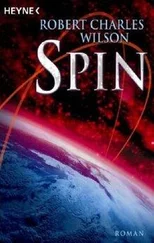
Robert Charles Wilson - SPIN
Здесь есть возможность читать онлайн «Robert Charles Wilson - SPIN» весь текст электронной книги совершенно бесплатно (целиком полную версию без сокращений). В некоторых случаях можно слушать аудио, скачать через торрент в формате fb2 и присутствует краткое содержание. Город: New York,NY, Год выпуска: 2005, ISBN: 2005, Издательство: Tom Doherty Associates,LLC, Жанр: Фантастика и фэнтези, на английском языке. Описание произведения, (предисловие) а так же отзывы посетителей доступны на портале библиотеки ЛибКат.

- Название:SPIN
- Автор:
- Издательство:Tom Doherty Associates,LLC
- Жанр:
- Год:2005
- Город:New York,NY
- ISBN:978-0-765-34825
- Рейтинг книги:5 / 5. Голосов: 1
-
Избранное:Добавить в избранное
- Отзывы:
-
Ваша оценка:
SPIN: краткое содержание, описание и аннотация
Предлагаем к чтению аннотацию, описание, краткое содержание или предисловие (зависит от того, что написал сам автор книги «SPIN»). Если вы не нашли необходимую информацию о книге — напишите в комментариях, мы постараемся отыскать её.
The effect is worldwide. The sun is now a featureless disk a heat source, rather than an astronomical object. The moon is gone, but tides remain. Not only have the world's artificial satellites fallen out of orbit, their recovered remains are pitted and aged, as though they'd been in space far longer than their known lifespans. As Tyler, Jason, and Diane grow up, space probe reveals a bizarre truth: The barrier is artificial, generated by huge alien artifacts. Time is passing faster outside the barrier than inside more than a hundred million years per day on Earth. At this rate, the death throes of the sun are only about forty years in our future.Jason, now a promising young scientist, devotes his life to working against this slow-moving apocalypse. Diane throws herself into hedonism, marrying a sinister cult leader who's forged a new religion out of the fears of the masses. Earth sends terraforming machines to Mars to let the onrush of time do its work, turning the planet green. Next they send humans...and immediately get back an emissary with thousands of years of stories to tell about the settling of Mars. Then Earth's probes reveal that an identical barrier has appeared around Mars. Jason, desperate, seeds near space with self-replicating machines that will scatter copies of themselves outward from the sun and report back on what they find. Life on Earth is about to get much, much stranger.
SPIN — читать онлайн бесплатно полную книгу (весь текст) целиком
Ниже представлен текст книги, разбитый по страницам. Система сохранения места последней прочитанной страницы, позволяет с удобством читать онлайн бесплатно книгу «SPIN», без необходимости каждый раз заново искать на чём Вы остановились. Поставьте закладку, и сможете в любой момент перейти на страницу, на которой закончили чтение.
Интервал:
Закладка:
But then I thought of the luggage I had left in Ina's back room. Luggage containing not just clothing but notebooks and discs, small slivers of digital memory and incriminating vials of clear liquid.
I turned back. Inside, I latched the door behind me. I walked barefoot and alert, listening for the sound of the policemen. They might be circling the building or they might make another attempt at the front door. The fever was coming on fast, however, and I heard many things, only some of which were likely to be real sounds.
Back in Ina's hidden room the overhead light was still out. I worked by touch and moonlight. I opened one of the two hard-shell suitcases and shoved in a stack of handwritten pages; closed it, latched it, lifted it and staggered. Then I picked up the second case for starboard ballast and discovered I could barely walk.
I nearly tripped over a small plastic object which I recognized as Ina's pager. I stopped, put down the luggage, grabbed the pager and slid it into my shirt pocket. Then I drew a few deep breaths and lifted the cases again; mysteriously, they seemed to have grown even heavier. I tried to tell myself You can do this, but the words were trite and unconvincing and they echoed as if my skull had expanded to the size of a cathedral.
I heard noises from the back door, the one Ina kept closed with an exterior padlock: clinking metal and the groaning of the latch, maybe a crowbar inserted between the hasps of the lock and twisted. And pretty soon, inevitably, the lock would give way and the men from the car would come inside.
I staggered to the third door, En's door, the side door, unlatched it and eased it open in the blind hope that no one was standing outside. No one was. Both intruders (if there were only two of them) were at the back. They whispered as they worked the lock, their voices faintly audible over frog-choruses and the small sound of the wind.
I wasn't sure I could make it to the concealment of the rice field without being seen. Worse, I wasn't sure I could make it without falling down.
But then there was a loud percussive bang as the padlock parted company with the door. The starting gun, I thought. You can do this, I thought. I gathered up my luggage and staggered barefoot into the starry night.
HOSPITALITY
"Have you seen this?" Molly Seagram waved her hand at a magazine on the reception desk as I entered the Perihelion infirmary. Her expression said: Badjuju, evil omens. It was the glossy print edition of a major monthly news magazine, and Jason's picture was on the cover. Tag line: the very private personality BEHIND THE PUBLIC FACE OF THE PERIHELION PROJECT.
"Not good news, I take it?"
She shrugged. "It's not exactly flattering. Take it. Read it. We can talk about it over dinner." I had already promised her dinner. "Oh, and Mrs. Tuckman is prepped and waiting in stall three."
I had asked Molly not to refer to the consulting rooms as "stalls," but it wasn't worth arguing about. I slid the magazine into my mail tray. It was a slow, rainy April morning and Mrs. Tuckman was my only scheduled patient before lunch.
She was the wife of a staff engineer and had been to see me three times in the last month, complaining of anxiety and fatigue. The source of her problem wasn't hard to divine.
Two years had passed since the enclosure of Mars, and rumors of layoffs abounded at Perihelion. Her husband's financial situation was uncertain and her own attempts to find work had foundered. She was going through Xanax at an alarming pace and she wanted more, immediately.
"Maybe we should consider a different medication," I said.
"I don't want an antidepressant, if that's what you mean." She was a small woman, her otherwise pleasant face crunched into a fierce frown. Her gaze flickered around the consulting room and alighted for a time on the rain-streaked window overlooking the landscaped south lawn. "Seriously. I was on Paraloft for six months and I couldn't stop running to the bathroom."
"When was this?"
"Before you came. Dr. Koenig prescribed it. Of course, things were different then. I hardly saw Carl at all, he was so busy. Lots of lonely nights. But at least it looked like good, steady employment in those days, something that would last. I guess I should have counted my blessings. Isn't that in my, um, chart or whatever you call it?"
Her patient history was open on the desk in front of me. Dr. Koenig's notes were often difficult to decipher, though he had kindly used a red pen to highlight matters of pressing urgency: allergies, chronic conditions. The entries in Mrs. Tuckman's folder were prim, terse, and ungenerous. Here was the note about Paraloft, discontinued (date indecipherable) at patient's request, "patient continues to complain of nervousness, fears for future." Didn't we all fear for the future?
"Now we can't even count on Carl's job. My heart was beating so hard last night—I mean, very rapidly, unusually rapidly. I thought it might be, you know."
"What?"
"You know. CVWS."
CVWS—cardiovascular wasting syndrome—had been in the news the last few months. It had killed thousands of people in Egypt and the Sudan and cases had been reported in Greece, Spain, and the southern U.S. It was a slow-burning bacterial infection, potential trouble for tropical third world economies but treatable with modern drugs. Mrs. Tuckman had nothing to fear from CVWS, and I told her so.
"People say they dropped it on us."
"Who dropped what, Mrs. Tuckman?"
"That disease. The Hypotheticals. They dropped it on us."
"Everything I've read suggests CVWS crossed over from cattle." It was still mainly an ungulate disease and it regularly decimated cattle herds in northern Africa.
"Cattle. Huh. But they wouldn't necessarily tell you, would they? I mean, they wouldn't come out and announce it on the news."
"CVWS is an acute illness. If you did have it you'd have been hospitalized by now. Your pulse is normal and your cardio is fine."
She looked unconvinced. In the end I wrote her a prescription for an alternative anxiolytic—essentially, Xanax with a different molecular side chain—hoping the new brand name, if not the drug itself, would have a useful effect. Mrs. Tuckman left the office mollified, clutching the script in her hand like a sacred scroll.
I felt useless and vaguely fraudulent.
But Mrs. Tuckman's condition was far from unique. The whole world was reeling with anxiety. What had once looked like our best shot at a survivable future, the terraforming and colonization of Mars, had ended in impotence and uncertainty. Which left us no future but the Spin. The global economy had begun to oscillate, consumers and nations accumulating debt loads they expected never to have to repay, while creditors hoarded funds and interest rates spiked. Extreme religiosity and brutal criminality had increased in tandem, at home and abroad. The effects were especially devastating in third world nations, where collapsing currencies and recurrent famine helped revive slumbering. Marxist and militant Islamic movements.
The psychological tangent wasn't hard to understand. Neither was the violence. Lots of people harbor grievances, but only those who have lost faith in the future are likely to show up at work with an automatic rifle and a hit list. The Hypotheticals, whether they meant to or not, had incubated exactly that kind of terminal despair. The suicidally disgruntled were legion, and their enemies included any and all Americans, Brits, Canadians, Danes, et cetera; or, conversely, all Moslems, dark-skinned people, non-English-speakers, immigrants; all Catholics, fundamentalists, atheists; all liberals, all conservatives… For such people the consummate act of moral clarity was a lynching or a suicide bombing, a fatwa or a pogrom. And they were ascendant now, rising like dark stars over a terminal landscape.
Читать дальшеИнтервал:
Закладка:
Похожие книги на «SPIN»
Представляем Вашему вниманию похожие книги на «SPIN» списком для выбора. Мы отобрали схожую по названию и смыслу литературу в надежде предоставить читателям больше вариантов отыскать новые, интересные, ещё непрочитанные произведения.






Обсуждение, отзывы о книге «SPIN» и просто собственные мнения читателей. Оставьте ваши комментарии, напишите, что Вы думаете о произведении, его смысле или главных героях. Укажите что конкретно понравилось, а что нет, и почему Вы так считаете.